Tunisia's legal environment is now profoundly eroded, almost desertified, under successive waves of populist and authoritarian dunes. So much so, in fact, that talking about the law has ultimately become an intellectual luxury. What the regime wants, the law now seems to want. However, this hopefully short parenthesis in which justice is faltering and crumbling should not obscure the need to reflect on legal texts and their application, even if this application is often liberticidal or arbitrary.
As part of the fight against corruption, the Tunisian Penal Code devotes Section III "Concussion" of Chapter III "Offences committed by public officials or assimilated persons in the exercise or on the occasion of the exercise of their functions". This section comprises several articles (from article 95 to article 98), but it is article 96 that stands out as the star of the show, such is its recurrent use.
Article 96 states:
"Is punishable by ten years' imprisonment and a fine equal to the advantage received or the prejudice suffered by the administration, any public or assimilated official, any director, member or employee of a local public authority, an association of national interest, a public industrial and commercial establishment, a company in which the State directly or indirectly holds any share of the capital, or of a company belonging to a local authority, entrusted by virtue of his or her position with the sale, purchase, manufacture, administration or custody of any goods whatsoever, who uses his or her position and thereby procures for himself or herself or for a third party an unjustified advantage, causes prejudice to the administration or contravenes the regulations governing these operations with a view to achieving the aforementioned advantage or prejudice. "
We propose to examine this provision from two angles:
- I. Analysis of the text of article 96
- II. Challenges and possible pitfalls in its application
I. The text
Article 96 therefore concerns a category of persons (1) for decisions taken (2) which have generated a profit and harmed the public interest (3).
- The person
The person concerned must be a public official or equivalent in a central or local administration, or in a public establishment. In effect, the legislator here extends the list of officials already mentioned in article 95, which refers to public servants and assimilated officials.
The status of public official is defined in Article 82 of the Tunisian Penal Code, which states:
"A public official subject to the provisions of the present law is any person holding public authority or performing duties in one of the services of the State or a local authority, or in a public office or establishment or a public company, or performing duties in any other person involved in the management of a public service.
Any person having the status of public officer, or invested with an elective mandate of public service, or designated by justice to accomplish a judicial mission, is assimilated to a public servant."
It can therefore be said that any official of a public or private entity involved in the management of a public service is included in the category of officials within the meaning of article 96. This could include, for example, a national organization, a professional order of a regulated profession or even a trade union. It could also include the managers of community companies, a relevant consideration in the current context.
2. The decision
The common denominator of the persons referred to in article 96 is their decision-making power within the entity they represent. This decision may take the form of a contract or agreement. The article lists several examples of such decisions: the sale, purchase, manufacture, administration or custody of any goods. We could also add actions such as conciliation, total or partial renunciation of a right, or even acknowledgement of liability.
An important question is whether the decision must necessarily be illegal. This would imply that the person responsible has taken a decision outside his or her competence, in breach of the law, applicable regulations or the principles of good governance. This could concern the procedure(modus operandi), the legal form of the act(instrumentum) or its substantive content(negotium).
However, even though an illegal act may constitute an essential factual element of the crime under article 96, this does not mean that it is an absolute criterion. A legal act can also give rise to criminal liability if the other two conditions (the person and the harm) are met. This is the specificity of article 96.
Thus, to establish the criminal responsibility of the accused, the court, through the instruction and the investigation, will not only verify the legality of the incriminated decision. It will also exercise a control of opportunity, as the result of the act constitutes a material element of the crime.
3. Profit and loss
The decision taken by the persons referred to in article 96 must have generated a benefit to the detriment of the administration or public entity, whose general interest is entrusted to these persons.
The benefit can take various forms: it can be pecuniary, a service rendered, or any form ofunjustified advantage, including a simple saving of loss. The text uses the term "advantage", which is broad enough to include varied and subtle forms of benefit.
The beneficiary can be :
- The decision-maker himself;
- A third party, such as a relative, friend, business associate, or even an ordinary citizen requesting a public service;
- A legal entity, such as a company, a political party, a trade union, etc.
As far as prejudice is concerned, it is not necessary for it to be established in a material or even moral way. The text states:
"or contravenes the regulations governing these operations with a view to achieving the aforementioned advantage or prejudice".
The legislator thus presumes harm to the general interest, even if the act is legal. This is logical, as a legal act can also be criminally reprehensible if it has caused harm or allowed an unjustified advantage. This confirms what has already been said: the incriminating decision may be as much a problem of legality as of expediency.
Article 96 is therefore a special provision of Tunisian criminal law, as it makes it possible to punish not only illegal decisions, but also legal decisions which, because of the circumstances and results they have generated, are deemed to be contrary to the public interest.
II. The application
Amended in 1985, article 96 of the Penal Code uses fairly broad formulas for a criminal text, which perhaps explains why it has historically been the preferred text of the public prosecutor and, let's face it, of most successive regimes. It has the advantage of being less demanding in terms of proof than the corruption-related offences governed by articles 83 to 93 of the Penal Code. What's more, the fate of prosecutions often depends on expert reports, whose conclusions can be manipulated by the authorities.
It's true that Article 96 has been applied to good effect in certain cases, but it's also true that it has been used against officials who have been disgraced or no longer enjoy political cover, thus becoming the target of reprisals by the powers that be, whether under Bourguiba or Ben Ali.
1. the instrumentalization of article 96
Even after the revolution of January 14, 2011, this instrumentalization has not disappeared. For example, in the case of a judge known for his allegiance to the Ben Ali regime, the Tunis Court of First Instance ruled that partially unjustified wealth was sufficient to convict the person on the basis of article 96. The Tunis Court of Appeal confirmed this decision. We could also mention the officials of the Ben Ali regime, tried after the revolution, often on the basis of poorly investigated cases. The courts convicted them, sometimes under pressure from public opinion, rather than on the basis of solid evidence.
In June 2020, the Minister of State to the Head of Government in charge of the Civil Service, Governance and the Fight against Corruption announced a bill amending Article 96, adopted by the Council of Ministers. The Minister himself has acknowledged that the current text violates the principle of the legality of sanctions and penalties, but no concrete reform has followed.
2. Instrumentalization under Kaïs Saïed
Following Kais Saïed's coup d'état, the use of Article 96 took on unprecedented proportions. The judiciary, brought to heel, now serves the presidential narrative, which relies on massive accusations of corruption and mismanagement against those responsible for the decade he describes as "black". Kais Saïed uses this rhetoric to justify the violation of the 2014 Constitution and explain his failure to meet the challenges facing the country.
The prosecutions have targeted several political figures from the old era. While the fight against public mismanagement is in itself a positive step, the problem arises when prosecutions are carried out excessively, echoing the President's political accusations. Mass arrests and public threats to judges turn these trials into hunting trophies for the President, in defiance of the principle of presumption of innocence and the right to freedom.
This attitude has deleterious effects not only on the human rights of the accused, victims of a veritable witch-hunt, but also on the general interest and justice. In fact, even when the people being prosecuted are genuinely at fault, the form of the proceedings makes them appear to be victims, which undermines the credibility of the convictions.
3. The paralyzing effects of article 96 on administration
The application of Article 96 reveals a penal policy that encourages self-censorship and paralyzes the administration. Officials, especially politicians, are reluctant to take legal decisions if they are open to criticism as to their appropriateness. As a result, idleness becomes the safest and most widespread posture.
Let's take the example of administrative litigation: sometimes, it would be in the administration's interest to conclude a conciliation to limit its losses and avoid unnecessary legal fees. But the person in charge will not dare to take the initiative, for fear of being accused later under article 96, and will therefore prefer to let the case go through a lengthy judicial process, even if this proves harmful to the public interest.
Over time, those in charge become reluctant to sign or take any decision that could entail criminal liability. This excessive caution further paralyzes an administration already weakened by other ills.
In October 2023, a draft amendment to Article 96 was submitted to the Assembly of People's Representatives (ARP). The grounds for this draft read:
"Encourage public officials to assume their responsibilities within the public administration, without being under constant threat of accountability because of their individual performance or initiative."
4. An insufficient and worrying reform
In December 2023, Kais Saïed acknowledged that many public services were no longer functioning properly, with the fear of Article 96 being used as an alibi by officials to justify their inaction. He therefore announced a modification of the text. However, while we were expecting a reform aimed at clarifying its formulas and streamlining its application, Kais Saïed added further constraints.
In the name of public accountability, it now proposes to criminalize anyone who knowingly fails to carry out a task related to their work, with the aim of hindering the running of a public service. Two bills were submitted to the ARP, with the last hearing taking place in February 2024. However, no amendments have yet been adopted.
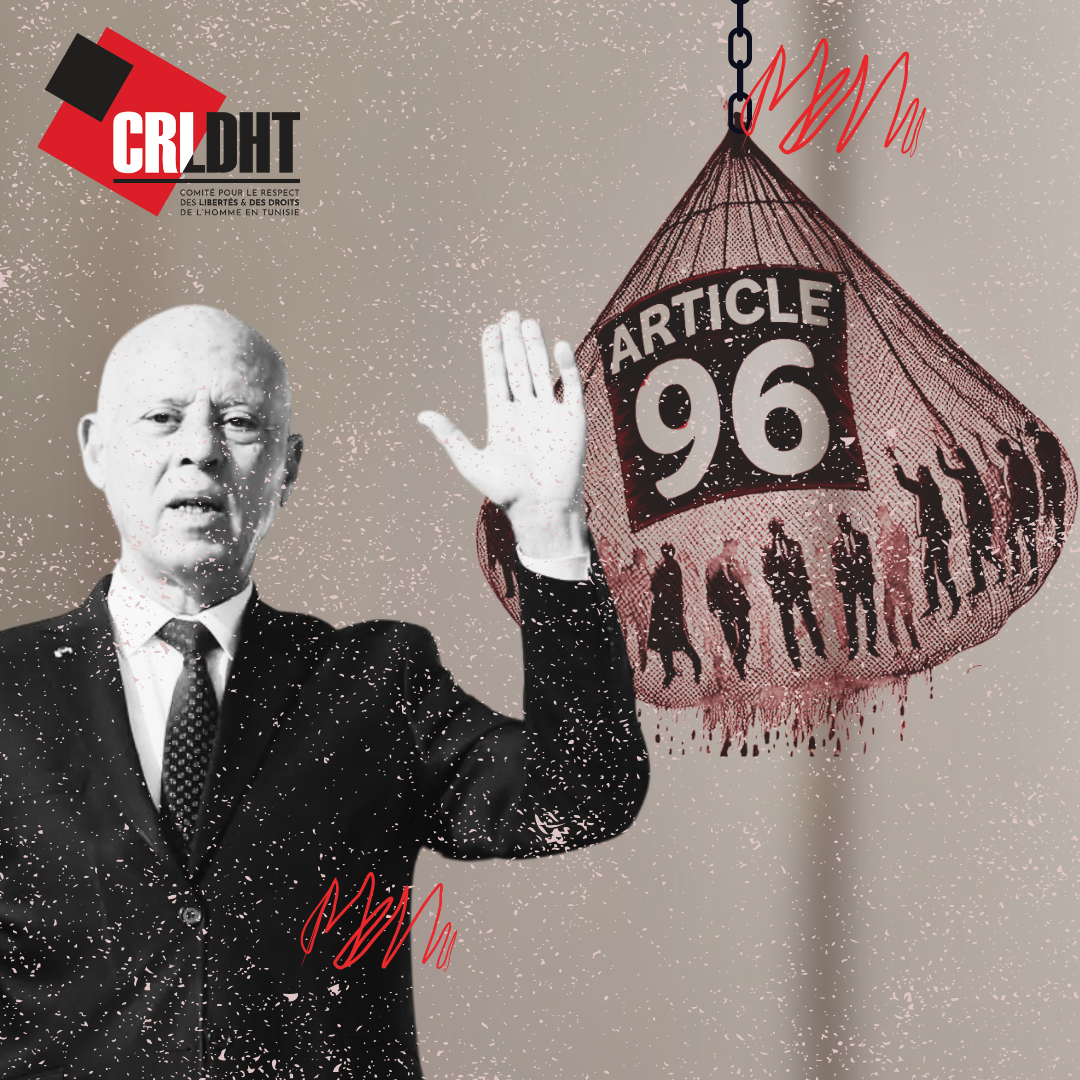
The President dithers, but the direction is clear: the net is being tightened even further. This "trawling" is likely to continue, with all the possible ravages for the country's administration, investment and economy.
In summary:
Article 96, originally designed to combat corruption, has become an instrument of political repression and a source of administrative paralysis. Without in-depth reform, it will continue to hold back public action, while being used to muzzle political opponents and control institutions to the detriment of the general interest.