Kaïs Saïed's nebulous theory of "building from the bottom up" might have led one to believe that local democracy, particularly through municipal elections, was about to experience the most significant boom in Tunisian history. But this was not to be. On the contrary, President Saïed's era sounded the death knell for these elections and for this form of grassroots democracy.
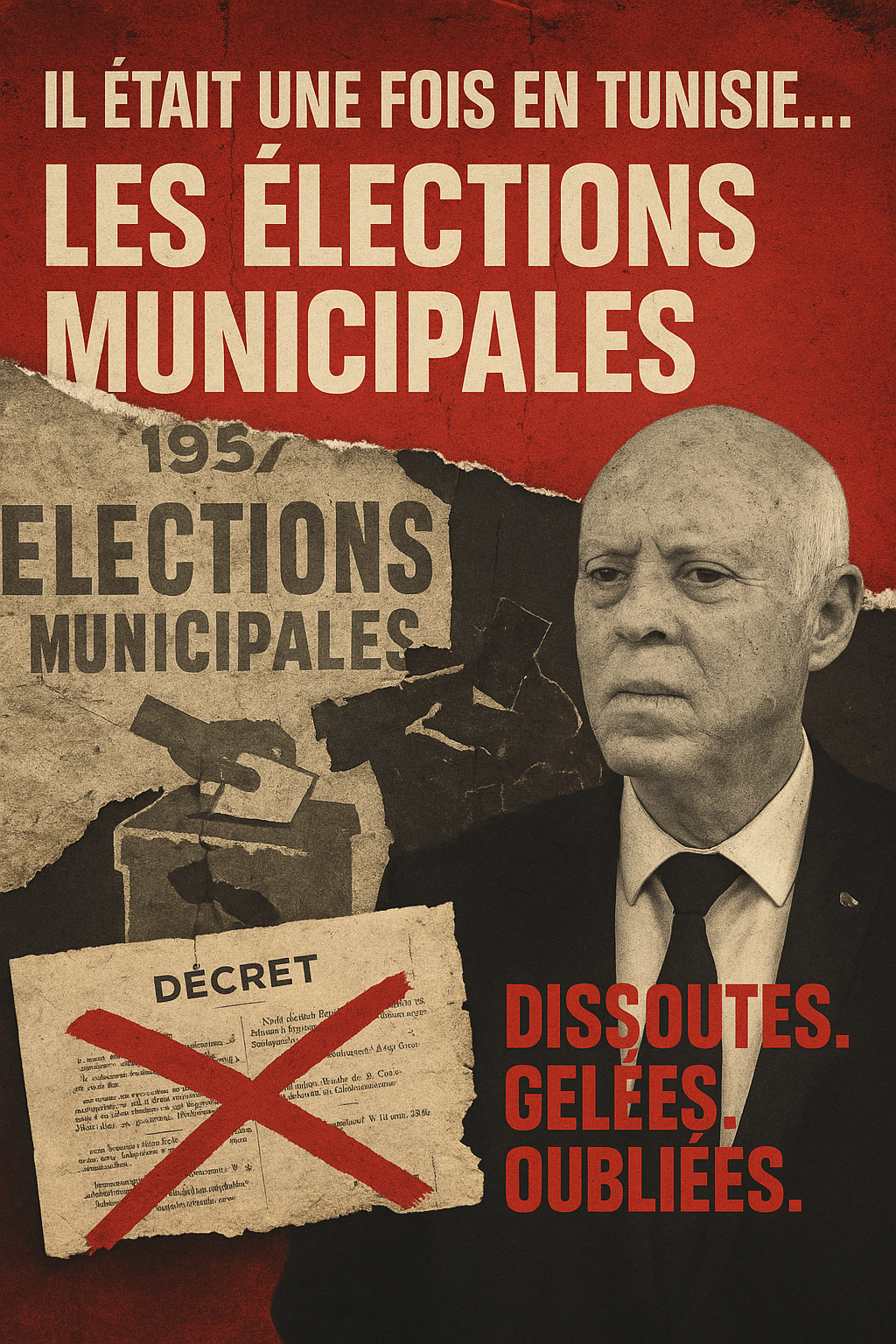
This theory is just a slogan, and a slogan, for President Saïed, is just a slogan: don't expect anything more - like "no turning back the clock". In reality, with Kaïs Saïed, we've taken a leap of almost 86 years backwards. Although the first municipal council was created in Tunis in 1858, the first municipal elections were not held until 1957, following the promulgation of the decree of March 14, 1957 concerning the law on municipalities. On March 8, 2023, President Saïed published a decree-law (no. 09/2023) in the Tunisian Official Gazette, ordering the dissolution of municipal councils and appointing municipal secretaries-general to manage their day-to-day affairs and administration.
Admittedly, article 1 of the decree-law specifies that the dissolution is temporary until new councils are elected. However, it completely ignores the Local Authorities Code, in particular articles 204 and 209, which it violates both in terms of form and content. Indeed, according to this code, the dissolution of a municipal council can only take place as a last resort, and only in the event of proven serious misconduct attributable to a given council - and not by a blanket decree without justification. What's more, unlike in 2011, no special delegation has been appointed for each municipality. Municipalities have simply been annexed to governors (prefects), thereby gutting the Code and its principles, and above all putting an end to decentralization.
The "grassroots" are clearly not considered capable of managing themselves on a day-to-day basis according to the president's actions. The municipality, as a place for citizens and political parties alike to learn about democracy and participatory management of public affairs, is no longer relevant.
Two years after this annexation and annihilation of local democracy and decentralized administration, there is nothing to suggest that municipal elections will be held. Worse still, there are indications that they have been postponed indefinitely.
At least two clues point in this direction:
1. ISIE minutes n°8/2025 of June 20, 2025, published in the Journal officiel de la République tunisienne (JORT) n°83 of June 27, 2025, include as the first item on the agenda the deliberation on the special mission of the body for the year 2026. The minutes contain no mention of the possible holding of municipal elections. It is likely that the ISIE will refrain, as it did for the presidential elections, from confirming the organization of these elections or setting the date. No indication is given, even for a hypothetical scenario. The draft State budget for 2026 will confirm or deny this observation.
2. The second clue is a text also published in the JORT: a joint order of the Minister of the Interior and the Minister of Public Works and Housing dated July 16, 2025, relating to the creation of technical commissions for housing estates and building permits, specifying their composition and operating procedures.
Two arguments suggest that municipal elections are not on the agenda. Firstly, the Order does not mention the Local Authorities Code or the Town and Country Planning Code in its references. Secondly, and more importantly, the decree explicitly excludes the chairmen and members of the municipal councils from these commissions: only the secretary general in charge of municipal management now chairs them. Management is no longer provisional, it has become institutionalized. The secretary-general is no longer a mere interim: he or she becomes the legal representative of the municipality.
As for the parallelism of forms, this no longer seems to be a relevant issue in Tunisia: a ministerial decree can now abrogate an organic law, or even the Constitution, notably article 133: "Municipal and regional councils, district councils and the bodies that the law confers on them the status of local authorities, watch over local and regional interests under the conditions set by the law." And they have to exist to be able to look after anything.