Introduction
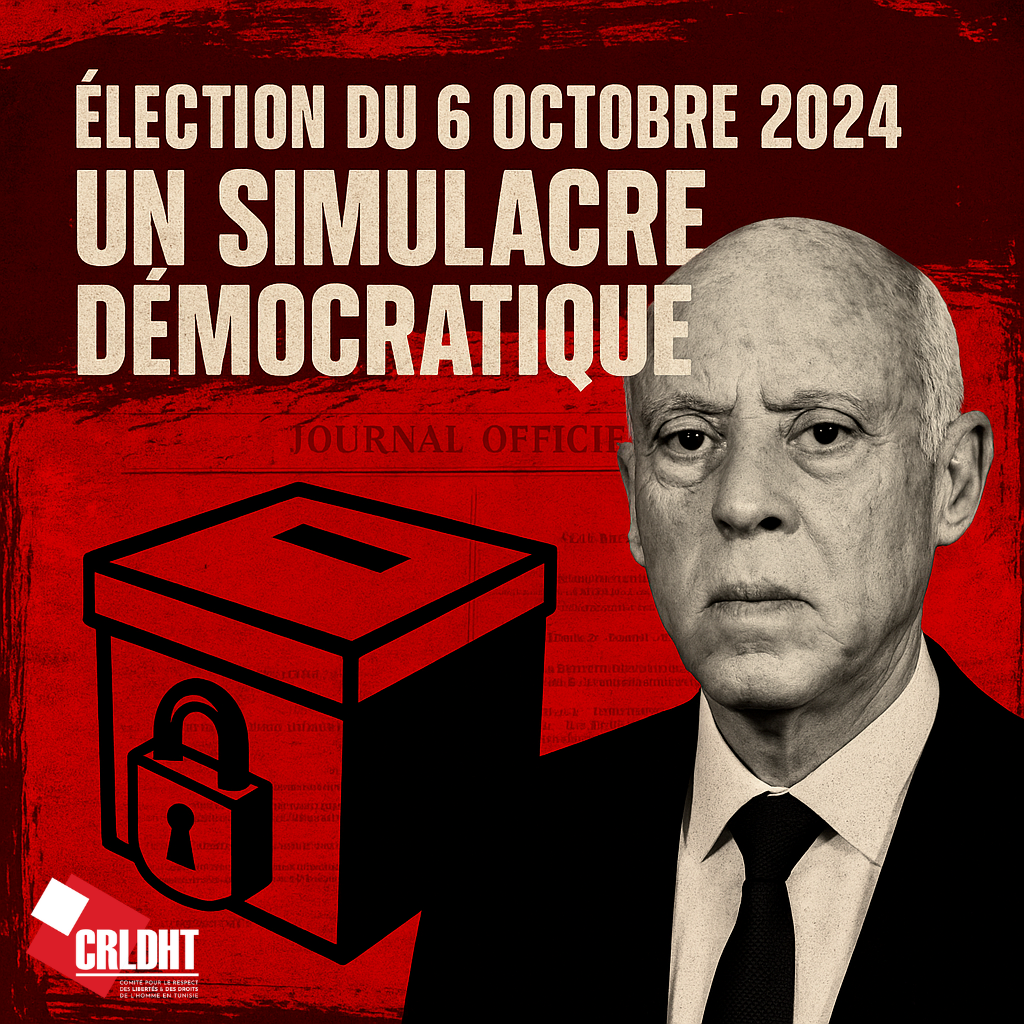
The October 6, 2024 presidential election was held in a climate of institutional deadlock unseen since 2011. The incumbent president, Kaïs Saïed, a candidate in his own succession, put in place a legal and administrative framework tailored to his political ambitions. The final report published by the Instance Supérieure Indépendante des Élections (ISIE) on March 26, 2025 in the Journal Officiel (n°35 of the 168th year) offers an institutional reading of a deeply flawed electoral process. Seemingly technical, this document conceals the excesses, abuses and decisions contrary to the law that marked every stage of the election, from the arbitrary setting of the date to the exclusion of candidates and the contempt shown for court rulings.
This text offers a critical and documented reading of this report, structuring the analysis around four axes: presidential control of the electoral process, infringements of the rule of law in the organization of the ballot, the self-assignment of jurisdictional powers by the ISIE, and finally the lack of transparency of this body supposed to guarantee the integrity of the democratic process.
I. An election under presidential control: staging and institutional blocking
A. A body at the service of the president-candidate
After submitting the report on the presidential elections of October 6, 2024 to the President of the Republic - a happy candidate-President - the President of the ISIE published this report in the Official Gazette No. 35 of the 168th year, dated March 26, 2025. The report aroused no interest in the press or media; it passed unnoticed, without analysis or debate. For the regime's supporters, the main thing is done: the "how" doesn't matter. In fact, it's logical: there's nothing to praise or be proud of. As for the dissidents, the systemic and numerous violations are occurring at such a pace that they don't know where to turn - as if to confirm the Tunisian proverb: "He who steals outweighs he who cries out."
B. the legal framework shaped by the president-candidate
President Kaïs Saïed has even improvised himself into a constituent power by drafting, on his own, a proposed Constitution which takes up the excesses of decree 117/2021, and has put this text to a referendum after having disfigured the electoral law, in particular organic law n°23/2021. Among other changes, it becomes the party that appoints the members of the ISIE, its president, and even holds the prerogative to dismiss them, thus destroying the superiority and independence of the body, as well as law n°16/2014 relating to elections.
C. An election date imposed unilaterally
Until July 2, 2024, nobody knew that there would be presidential elections in October. The date of October 6, 2024 was set directly by the president-candidate, without consultation or deliberation. The ISIE report justifies this practice by asserting that the electoral agenda must be derived from the decree convening the electorate, whereas this logic inverts the fundamental principle of the neutrality of the agenda. The ISIE goes so far as to suggest a reform of the texts (page 45), even though it already has this competence. All previous compositions of the ISIE had set election dates on the basis of the same unchanged texts.
II. Targeted electoral engineering: exclusion, obstacles and illegitimate filters
- The distortion of the ISIE's legal framework
The report completely ignores article 134 in fine of Kaïs Saïed's Constitution:
"The Authority is made up of nine independent, neutral, competent and honest members. They exercise their mission for a non-renewable six-year term. One-third of its members are renewed every two years." It merely mentions Decree-Law no. 22/2022, which reduced this number to seven, without making any reference to the Constitution or to the non-renewal of one-third of the members every two years. Respect for the hierarchy of norms has evaporated on this point: it's an à la carte Constitution, a menu to be applied as one pleases.
The report also notes the growth in the number of polling stations, and boasts of the proximity of these stations to the electorate, even though this has been a classic recipe since the Bourguiba and Ben Ali eras: the multiplication and scattering of polling stations makes it more difficult to observe elections. This is all the more true given that these elections involve formal candidates, with no real, well-honed partisan electoral machine, nor the manpower to cover all the polling stations.
B. the illegal addition of subjective criteria
As regards the conditions for candidacy, the ISIE claimed to apply and respect the 2022 Constitution and the electoral law, by amending its regulatory decree n°18/2024. In fact, the ISIE admits to having violated article 75 of the Constitution, since the electoral law can only take the form of an organic law. The amendments made by the ISIE to its regulatory order are therefore contrary to organic law n°16/2014, and therefore to the Constitution of 2022.
For even by claiming to apply the Constitution, in particular Article 89, the ISIE has violated Article 75. And even recourse to Article 134, which confers regulatory powers on the ISIE, cannot justify - contrary to what the ISIE claims (page 74) - the violation of the provisions of Article 75 of the Constitution and the norm of the hierarchy of texts.
Regulatory power, even if expressly granted by the Constitution, does not authorize the ISIE to ignore higher-ranking texts. Moreover, it is in clear contradiction: it recognizes the superiority of the presidential decree over its regulatory orders (page 9), but takes the liberty of ignoring the superiority of the organic law (page 74), which is nevertheless of a much higher rank than that of a presidential decree.
In its amendment, the ISIE even goes so far as to violate the Constitution itself, by adding conditions that are not laid down in article 89, which it claims to apply, based on article 134 (page 75), in particular the requirement to present a bulletin n°3 (certificate of criminal record). She justifies this "de facto constitutional amendment" on the one hand by the fact that article 89 requires candidates to enjoy their civil and political rights, which, she argues, gives her the right to demand the presentation of bulletin n°3 (page 77).
However, this reasoning should simply lead to checking whether the candidate is registered on the electoral roll. Moreover, ISIE seems aware of the absurdity of its own argument, adding that it would be illogical for a person who does not enjoy his or her rights to be elected President of the Republic. In its view, it would be necessary to ensure that the potential candidate is of good conduct and behavior, and that he or she is mentally, morally and politically fit (page 78).
This is a very serious point, because we don't know what the conditions of this political aptitude criterion are that the ISIE admits to applying. Moreover, it does not limit itself to these criteria: it adds to them the assurance that the potential candidate is capable of managing his or her rights and affairs, bearing the constraints of the office and carrying out the tasks assigned to him or her with mastery and merit.
The ISIE has not clarified how it applied these subjective criteria, incompatible with the nature of its mission. But most importantly, it has not specified the relationship between these criteria and the unconstitutional imposition of the bulletin n°3 requirement.
On the other hand, still in the argument relating to the condition of presentation of bulletin no. 3, although the ISIE acknowledges that this condition is not set out in Article 89 of the Constitution, it claims that its consecration was tacit in Article 74, first paragraph, of the 2014 Constitution, which provides: "Candidacy for the Presidency of the Republic is a right for any voter of Tunisian nationality by birth and of Muslim faith." The retention of this condition in article 89 of the 2022 Constitution, as an essential condition, supports the addition of this requirement, especially as the electoral law has enacted several cases of prohibition of candidacy.
But this development by ISIE is really just a rewording of its first argument, and does not explain how the imposition of bulletin n°3 would achieve its alleged aims. Nor, of course, does it mention the case law that ruled out this condition well before 2021.
What's most striking - and perhaps most disconcerting - is that in its own suggestions (page 117, last paragraph), the ISIE expressly admits that bulletin n°3 does not reflect the real situation of individuals or their criminal record.
C. An obstacle strategy through formalism
In the case of sponsorship, particularly popular sponsorship, the ISIE defends its exaggerated hyper-formalism on the basis of history and previous electoral experience (page 82). However, the statistics it has published demonstrate the ineffectiveness of its preventive measures and the uselessness of this formalism, since the number of complaints rose from 50 during the 2019 presidential elections to 560 for those of 2024 - unless the aim pursued by the ISIE was, paradoxically, to increase fraud, and therefore complaints.
In its report, the ISIE failed to mention cases where it refused to issue sponsorship forms to potential candidates, on the grounds that they were not duly represented. This was the case, for example, for Ghazi Chaouachi, despite the fact that his son had presented a legal power of attorney, or for Abir Moussi, who was represented by her lawyer - whom the ISIE nevertheless considered as a potential candidate, even in its report (page 106).
Nor did the ISIE report address the issue of the Ministry of the Interior's refusal to issue ballot papers No. 3, thus creating a pre-selection process which the ISIE endorsed, instead of intervening to demand that the administration provide these documents, which are a right of candidates. It is worth recalling that, in the elections prior to 2021, the ISIE was content with application receipts and contacted the Ministry directly to obtain the ballot papers.
III. Judge and jury: bypassing the law and judicial insubordination
- Selective enforcement of administrative judgments
As far as candidate disputes are concerned, the report skips over the main issue of these elections: the question of compliance with court rulings, which constituted the ultimate proof of the partiality of the body, appointed by the president-candidate - and above all for the president-candidate. A brief paragraph reiterates the electoral body's alibis for not complying with court rulings and for excluding three candidates in favor of the president-candidate.
ISIE takes up its argument, which is however unfounded, based on an abusive interpretation of article 47 of organic law no. 16/2014, which states:
"The court clerk notifies the parties of the judgment, by any means that leaves a written trace, and this, within 48 hours of the date of its pronouncement. "
ISIE acknowledges that it has received notification of the operative parts of the judgments, but refuses to apply them on the grounds that it has not received the complete judgments, arguing that the article specifies that it is a "judgment" and not a "operative part", and that the procedural text cannot be interpreted.
This alibi, however, runs counter to its own regulatory decree, which spells out the procedures of the aforementioned Article 47. In fact, article 24 of ISIE decree no. 18/2014 on the rules and procedures for candidacy in the presidential election stipulates that ISIE must execute the rulings of the Plenary Jurisdictional Assembly of the Administrative Court, provided that it is notified of the ruling or its operative part. Article 25 of the same decree defines execution as the inclusion of a candidate in the final list of admitted candidates, or its removal from the list.
Nothing could be clearer, all the more so as the whole purpose and interest of the procedure is summed up in the operative part. The ISIE has no legitimate interest in demanding the full text of the rulings, which are not subject to appeal, and it has no right of review or appraisal: it can only comply - if, of course, it remains in its role as an election authority, which the ISIE has obviously not respected.
In her report, she did not even mention the interpretation ruling by the Administrative Court's Jurisdictional Assembly, nor the correspondence sent by the Court's First President to witness its execution.
Of course, the ISIE also failed to point out that article 47 does not stipulate any penalties for exceeding the 48-hour deadline, and that it declared the final list 24 hours before the deadline set in the electoral agenda it had itself drawn up.
The ISIE report even takes the liberty of evaluating and commenting on the rulings of the Administrative Court, arguing that they failed to order their immediate execution and that they omitted to address certain points (page 114). Following this, she relies on article 134 of the Constitution (which, however, she violated in the very composition of the ISIE), which, according to her, confers on it the primary responsibility of guaranteeing the integrity of the elections - and on her faith (yes, her faith) that anyone who has participated in the falsification of sponsorships or who has corrupted voters must be banned, to justify the exclusion of candidates, contrary to what the competent court has decided.
B. Unilateral political exclusions
The ISIE has not only ignored court rulings, but has also set itself up as a court whose decisions are final and irrevocable, despite the fact that it does not respect any of the principles of criminal trial. Indeed, in its report (pages 111 and 112), the ISIE explains that it has excluded from its final list of candidates those against whom criminal judgments have been handed down for falsification of sponsorship, corruption or swindling of sponsors in the context of the 2024 presidential election, and who have been sentenced to penalties accompanied by the additional sanction of a lifetime ban on standing as a candidate.
This element of the report betrays a total lack of respect for human rights and the right to a fair trial. First of all, these convicted persons still enjoy the presumption of innocence; these are not final decisions. In so doing, the ISIE has in fact condemned them definitively, applying a sanction that law n°16/2014 only provides for legislative elections, and not for presidential elections - thus violating the sacrosanct principle of the legality of sanctions.
But the ISIE bulldozer, with guaranteed impunity, even dares to admit that it has sanctioned candidates against whom proceedings are still pending.
Still on the subject of reasons for refusal, ISIE mentions failure to present the bulletin n°3 (page 112), without saying a word about the attitude of the administration and its de facto exclusion of certain candidates by refusing to issue them with this document. It even claims that the Administrative Court did not deal with this point and did not issue a preliminary ruling on the matter, whereas the Administrative Court simply annulled this condition and considered it null and void.
So ISIE goes to extremes in its denial of reality. The texts of the judgments are published - perhaps it's banking on the fact that no one will read its report.
IV- A non-transparent body serving an authoritarian regime
- The accreditation refusal scandal
In its report (page 223), the ISIE explains that it has refused accreditation to local associations whose purpose is to observe elections, on the basis of suspicions of "dubious" foreign funding from countries with no diplomatic relations with Tunisia. These accusations were neither specified nor based on clear criteria. No information was provided on the countries, amounts or "official parties" behind these revelations.
This article does not claim to deal with all the violations and contradictions in the report, but it cannot be concluded without mentioning another problem - indeed, a scandal - that reveals the faith of this body appointed by Kaïs Saïed. Turning to the question of accreditation, the report (page 223, penultimate paragraph) states:
"In this regard, the body has refused to accredit local associations whose purpose is to observe elections, which have been found to have received huge, dubious amounts of money from abroad, from countries that have no diplomatic relations with Tunisia. The body was informed by official parties on September 9, 2024, during the processing of accreditation applications... "
B. A body that is neither independent nor superior
The ISIE is still not waiting for justice: it is condemning these associations with charges of serious crimes, heavily punished by criminal law, based solely on the fact that they have allegedly received money from abroad - even though this is highly regulated by Tunisian law. Associations can only access this type of financing after intervention by the Central Bank and the CTAF (Tunisian Financial Analysis Commission).
The ISIE reveals neither the criteria for qualifying the term "dubious", nor the legal basis enabling it to make such an assessment, nor the countries that would have sent these supposedly suspect funds, nor even the "official parties" that would have provided it with this information - or rather these instructions. This proves, once again, that the ISIE is neither independent nor superior, and that its attitude was in no way consistent with the nature of its mission, within the meaning of the 2022 Constitution or the Electoral Law, particularly with regard to article 75 of the said Constitution.
Conclusion
The ISIE's final report, far from being a neutral or purely administrative document, bears witness to a systematic alignment with the choices of the president-candidate. Through a series of illegal decisions, abusive interpretations, disregard for judicial rulings and opacity on major issues such as observer accreditation and foreign funding of associations, the ISIE has failed to meet all its constitutional obligations.
This report reveals an electoral process emptied of its democratic substance, where the body responsible for guaranteeing the fairness of the ballot has become an instrument for legitimizing a power without checks and balances. It is now up to civil society, legal experts, independent observers and international partners to denounce this drift and demand a thorough overhaul of Tunisia's electoral framework, based on the rule of law, independence and respect for fundamental freedoms.