A budget cannot be judged solely by its deficit or the level of social spending it reflects. It is also necessary to examine who benefits from it, who bears the cost, and whether it leads to real progress in access to employment, health care, education, social protection, and an adequate standard of living.
Tunisia is a party to the International Covenant on Economic, Social, and Cultural Rights (ICESCR). The Covenant requires States to make the best use of their resources to progressively realize these rights and ensure their exercise without discrimination. These obligations do not preclude budgetary constraints: they require that decisions regarding spending, revenue, and borrowing be justified, transparent, and evaluated based on their impact on the population. The Committee on Economic, Social, and Cultural Rights emphasizes, in particular, the need to assess the effects of fiscal policies on low-income households, women, and disadvantaged groups.
The 2027 budget bill, submitted to the Assembly of the Representatives of the People, projects 54.28 billion dinars in revenue and 68.895 billion in expenditures. The deficit shown in the financing table amounts to 14.615 billion. Tax revenue accounts for 49.6 billion; the remainder comes from 4.33 billion in non-tax revenue and 350 million in grants.
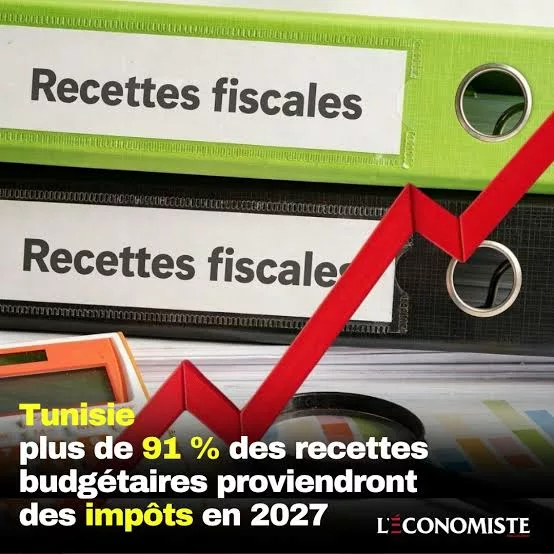
Tax revenue thus accounts for 91.4% of total revenue. This proportion highlights the budget’s heavy reliance on tax revenue
The government plans to provide 28.122 billion dinars in funding. This amount is not intended solely to cover the deficit; it also includes the repayment of 13.307 billion dinars in principal on the debt —6.823 billion in domestic debt and 6.484 billion in foreign debt—as well as other treasury operations. The plan also calls for up to 9.8 billion dinars in interest-free facilities from the Central Bank, repayable over fifteen years following a three-year grace period. These figures do not yet indicate how the funds will be used or what results they will produce.
Public debt could reach 85 percent of GDP by the end of 2027. As of the end of September 2026, debt service had reached 17.906 billion dinars, including 5.623 billion in interest.
The budgets of the so-called “sovereign institutions” warrant careful scrutiny, as they reflect the resources allocated to the central institutions of the state. The budget for the Office of the President of the Republic is reported to be 248.576 million dinars, an increase of approximately 8.2% compared to 2026. The budget for the Justice Ministry totals 1.112 billion, or 1.61% of government spending, an increase of approximately 8.43%.
In addition to these amounts , 5.628 billion dinars are allocated to National Defense —approximately 8.2% of expenditures— 6.560 billion to the Interior —approximately 9.5% —and 404.150 million to Foreign Affairs, Migration, and Tunisians Abroad —approximately 0.6%. Together, these five areas account for nearly 13.953 billion dinars, or 20.3% of projected budget expenditures. The figure for Defense does not include the own-source revenues of its public institutions.
This concentration of resources in central, security, judicial, and diplomatic institutions represents a major political decision. Against the backdrop of the concentration of power around Kaïs Saïed, it helps provide the institutions that support the regime’s actions with significant resources.
Within the Justice budget, the “Prisons and Rehabilitation” program accounts for 50.97% of appropriations, or approximately 566.8 million dinars. This budget covers the entire program—including salaries, inmate care, operations, maintenance, and equipment—and does not consist entirely of construction expenditures. Commitment appropriations for capital expenditures across the entire Justice sector are projected at 329 million, compared to 90 million in 2026; not all of these funds are earmarked for prisons.
Reports on the budget presentation mentioned plans for a new prison in Belli, with an announced capacity of 1,000 inmates and an estimated cost of 64 million dinars. This project should be distinguished from the overall budget of 566.8 million, which the ministry clarified is not entirely earmarked for construction. From a human rights perspective, it is also important to ask how this investment aligns with efforts to reduce incarceration, promote alternative sentences, improve prison conditions, and facilitate reintegration.
Aid programs whose results have yet to be measured
The bill provides aid for small businesses, startups, young entrepreneurs, and small-scale farmers. However, it does not specify how many sustainable jobs this aid is expected to create. It authorizes 692, 702 public employees, without specifying the unemployment rate or assessing the impact of these measures on employment. This figure represents the maximum number of authorized employees, not the number of new hires.
An analysis focusing on funding and employment highlights the need to measure the results of aid, not just the amounts announced. How many projects have been funded? How many are still active after several years? What jobs have been created, and in which regions? Without this data, it is difficult to assess the effectiveness of these measures.
Data from the National Institute of Statistics show that in the second quarter of 2026, the unemployment rate stood at 14.9 percent, 26.6 percent among college graduates, and 35.4 percent among young people aged 15 to 24. It affected 21.6 percent of women and 35.6 percent of female college graduates. The proposal does not set a specific target for reducing these disparities, nor does it specify how many sustainable jobs its measures are expected to create.
Investment and Public Services
The document provided does not include tables detailing expenditures by sector. Therefore, on its own, it does not allow for verification of the total amount of public investments for 2027 or their regional breakdown. However, the Assembly has posted additional documents regarding the plan online. The minister’s presentation announces 12.530 billion dinars in development spending—a 7.6% increase—for projects related to water, transportation, renewable energy, health, education, and infrastructure, among other areas. This figure should not be automatically equated with the actual amount of public investment carried out.
The project provides for targeted funding, including 100 million dinars for small farmers and cooperatives in the olive sector, for the period 2027–2030. However, these measures do not replace a comprehensive overview of investments by sector and by region.
This lack of detailed data limits the assessment of the impact on rights. It is essential to determine whether budget allocations are helping to improve access to health care, education, transportation, water, and social protection. A critical analysis of budget priorities raises questions about the discrepancy between stated objectives and reported investments. To resolve this, the tables and implementation data must be made public.
Who covers the cost of the budget?
The bill calls for increases in certain taxes, particularly on travel abroad—where the tax will rise from 60 to 80 dinars —and on games and contests, for which the rate will increase from 40% to 60%. Their impact must be analyzed: who pays them, what share of income do they represent, and do these taxes increase the cost of services or products used by households? A tax measure cannot be evaluated solely based on the revenue it generates; its effects on low-income individuals must also be examined.
The text does not provide detailed data on imports and exports. The minister’s presentation indicates, however, that as of the end of September 2026, imports had increased by 13.1 percent, compared with 8.6 percent for exports, and that the ratio of exports to imports stood at 70.6 percent. She also notes that the project is based on an assumption of $80 per barrel for Brent crude. These elements describe the context and the assumptions used, but do not replace detailed foreign trade forecasts or an analysis of various energy scenarios.
To determine whether the budget is truly socially oriented, we therefore need to have access to the complete tables, economic assumptions, and expected results. We must be able to verify whether subsidies create jobs, whether public services are improving, and whether tax measures place a disproportionate burden on households that are already vulnerable.
International human rights standards call for transparency, participation, and an assessment of budgetary impacts. The debate, therefore, is not solely about the size of the deficit. It also concerns how resources are mobilized and allocated, and the concrete progress they enable for the entire population.
Documentary Sources
- 2027 Finance Bill — Assembly of People's Representatives Draft Law No. 063/2026 Concerning the Finance Act for the Year 2027
- Analysis of the Budget Proposal https://magazineflashinfo.net/2026/10/18/%D9%85%D9%8A%D8%B2%D8%A7%D9%86%D9%8A%D8%A9-%D8%AA%D9%88%D9%86%D8%B3-%D9%84%D8%B3%D9%86%D8%A9-2027-%D8%AA%D8%AD%D8%AA-%D9%85%D8%AC%D9%87%D8%B1-%D8%A7%D9%84%D8%AE%D8%A8%D8%B1%D8%A7%D8%A1-%D8%B9%D8%AC/?
- Estimates of Debt and Expenditures Al-Arabi Ben Bouhali writes about “The Frightening Secrets Behind Tunisia’s 2027 Budget” – Tunisia News
- Analysis of Funding and Employment https://arabic.pressbee.net/show11073996.html?title=%D9%85%D8%B4%D8%B1%D9%88%D8%B9-%D9%85%D9%8A%D8%B2%D8%A7%D9%86%D9%8A%D8%A9-%D8%A7%D9%84%D8%AF%D9%88%D9%84%D8%A9-%D9%84%D8%B3%D9%86%D8%A9-2027-%D9%83%D9%85%D8%A7-%D9%8A%D9%82%D8%B1%D8%A4%D9%87%D8%A7-%D8%B1%D8%AC%D9%84-%D8%A7%D9%84%D8%A7%D9%82%D8%AA%D8%B5%D8%A7%D8%AF-%D8%B1%D8%B6%D8%A7-%D8%A7%D9%84%D8%B4%D9%83%D9%86%D8%AF%D8%A7%D9%84%D9%8A
- A Critical Analysis of Budgetary Priorities Managing the Recession: The Welfare State—Between Slogans and the Figures in the 2027 Budget Bill