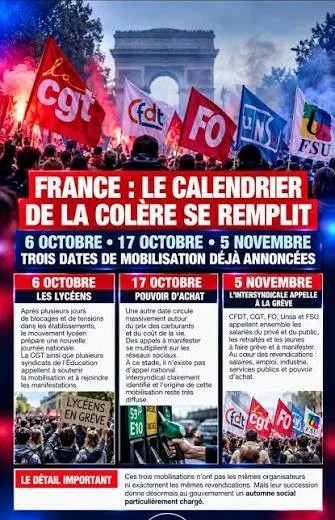
France is going through a crisis that cannot be reduced to either the looting on October 17 or the clashes with the police. For several weeks now, high school students, college students, workers, civil servants, and families have been protesting the deterioration of the education system, the high cost of living, and inadequate public services. Their anger has become visible in the streets. The authorities’ response, meanwhile, has gradually centered on bans, curfews, and heightened security measures.
This trend is cause for concern: it risks pushing the protesters’ demands into the background and reducing social protest to a mere matter of public order. It is all the more concerning given that teenagers have been seriously injured during police interventions and that the freedom to protest is sometimes treated as a threat rather than a right to be protected.
Social anger that violence cannot erase
On October 17, the protests drew several hundred thousand people. The Ministry of the Interior estimated the number at 550,000, while the organizers put it at 800,000. On October 24, estimates again differed: 410,000 protesters according to the ministry, 800,000 according to the unions. Participants called for more funding for education, better living conditions, and public services that meet people’s needs.
There were also incidents of looting, arson, and vandalism. These are serious offenses and must be condemned. However, the actions committed by certain groups do not hold the hundreds of thousands of people who came to demonstrate peacefully responsible. Those who committed crimes must be held individually accountable for their actions; social demands, on the other hand, call for a political response.
By focusing the debate solely on the rioters, the authorities and the media run the risk of obscuring the causes of the protests: dilapidated schools, a shortage of teachers, financial insecurity among students, the high cost of living, and the feeling of not being heard. Security is the state’s responsibility. It cannot be a substitute for social policy.
The Cost of Inequality and the Defense of Privileges
Anger does not arise out of nowhere. It develops in a society where wealth is highly concentrated, while public services and living conditions for a segment of the population are deteriorating. Oxfam’s figure— 53 billionaires are wealthier than 32 million people combined —provides a striking measure of this concentration. According to the organization, their wealth has doubled since 2017.
This can be seen as one of the political outcomes of nearly a decade of “Macronism”: spectacular wealth accumulation at the top, while funding for education, social protection, and public services is often subject to budgetary constraints. The refusal to require the wealthiest to contribute more is by no means an abstract fiscal debate: it reveals a determination to preserve an economic order that protects the privileges of the wealthiest and shifts the burden onto everyone else. As soon as measures are proposed to reduce tax inequalities, the ultra-wealthy and business leaders mobilize to fight them. It is not tax justice that triggers their offensive, but the threat it poses to their privileges.
A crackdown that could play into the hands of the far right
Tighter security measures carry another risk: they provide the far right with the political ground on which it thrives. When public debate is reduced to fear of disorder, calls for a tough stance, and the scapegoating of certain groups, the far right can present itself as the sole defender of order, while diverting attention from inequalities and social demands.
This dynamic is reinforced by the role of certain media outlets: a significant portion of the media landscape is controlled by the ultra-wealthy, while other newsrooms all too often adopt the government’s security-focused narrative without sufficient critical distance. The protests are thus reduced to images of looting and clashes, while the demands of young people and workers are pushed into the background. This concentration of public discourse and this narrow focus play into the hands of the far right: by criminalizing the movement as a whole, they divert attention from inequalities and political responsibilities, cut off a segment of the youth from the democratic debate, and reinforce their distrust of institutions.
Injuries and deaths that demand the truth
Several serious injuries that occurred during the high school protests have dominated the debate. In Lens, a 15-year-old boy lost a hand after a grenade exploded. In Saint-Ouen-l’Aumône, 14-year-old Eden suffered serious facial injuries after a grenade launcher was fired. In Paris, a 59-year-old man died on October 17. An investigation is underway, and his family is demanding the autopsy results.
These events call for prompt, independent, and transparent investigations. It is essential to establish the circumstances surrounding each injury, determine whether the weapons used and the orders given were appropriate, and provide accountability to the victims and their families. The presumption of innocence must be respected; it cannot be used to dismiss legitimate questions.
In Marseille, eyewitness accounts and police reports reviewed by Mediapart also point to shifting orders and an overwhelmed security presence around City Hall. The prefecture cited a figure of “more than 30,000 looters,” which the mayor disputed. Here again, it is necessary to determine who is responsible and where the failures lie, rather than placing the entire blame on the protesters or, conversely, denying that violence occurred.
Anti-immigrant and anti-Muslim racism fuels hatred
The social crisis is also taking place against a backdrop in which racist, anti-immigrant, and anti-Muslim rhetoric is playing an increasingly prominent role in public discourse. When immigrants, Arabs, or Muslims are regularly portrayed as a threat, and when entire neighborhoods are associated with violence or Islamism, this contributes to the normalization of suspicion and hostility. Such rhetoric creates an environment where it becomes easier to express hatred and where those targeted feel less protected.
The attack in Trappes highlights the very real danger this poses. Pengo Bossio Wangi, 26, was killed, and several people were injured. The National Anti-Terrorism Prosecutor’s Office has classified the incident as a terrorist act and cited racist motives as an aggravating factor; the investigation is ongoing. The President of the Republic himself described the incident as a racist terrorist attack.
The residents of Trappes have expressed their fear and anger, denouncing the persistent stigmatization of their city and of Muslim and people of color communities. Their voices must be heard. The alleged perpetrator’s criminal liability is a matter for the justice system; the political responsibility to combat racism, protect those who are targeted, and not trivialize hate speech rests with society as a whole.
The UN reiterates the state’s obligations
On October 20, the United Nations High Commissioner for Human Rights, Volker Türk, expressed concern over reports of unnecessary or excessive use of force against protesters, including children. He condemned the violence committed during the protests, reiterated that States must facilitate the right to peaceful assembly, and called for independent investigations into allegations of unlawful use of force. He also urged governments to engage in dialogue with young people and address their demands regarding education, public services, housing, the cost of living, and inequality.
The LDH has requested that the High Commissioner conduct an observation mission in France and has referred the matter to the Committee on the Rights of the Child. This reflects the seriousness of the concerns expressed by human rights defenders.
The Republic must protect people and property, prosecute those who commit acts of violence, and guarantee the right to peaceful protest. It must also address legitimate grievances, investigate injuries and deaths, and combat racism in all its forms. When inequalities worsen, when privileges seem untouchable, and when protests are met first and foremost with a police response, mistrust grows—and the far right can capitalize on it.
Civil peace cannot be restored by asking the most vulnerable to remain silent. It requires that the government protect civil liberties, thoroughly investigate acts of violence, and agree to open a genuine debate on the distribution of wealth and the future of public services.