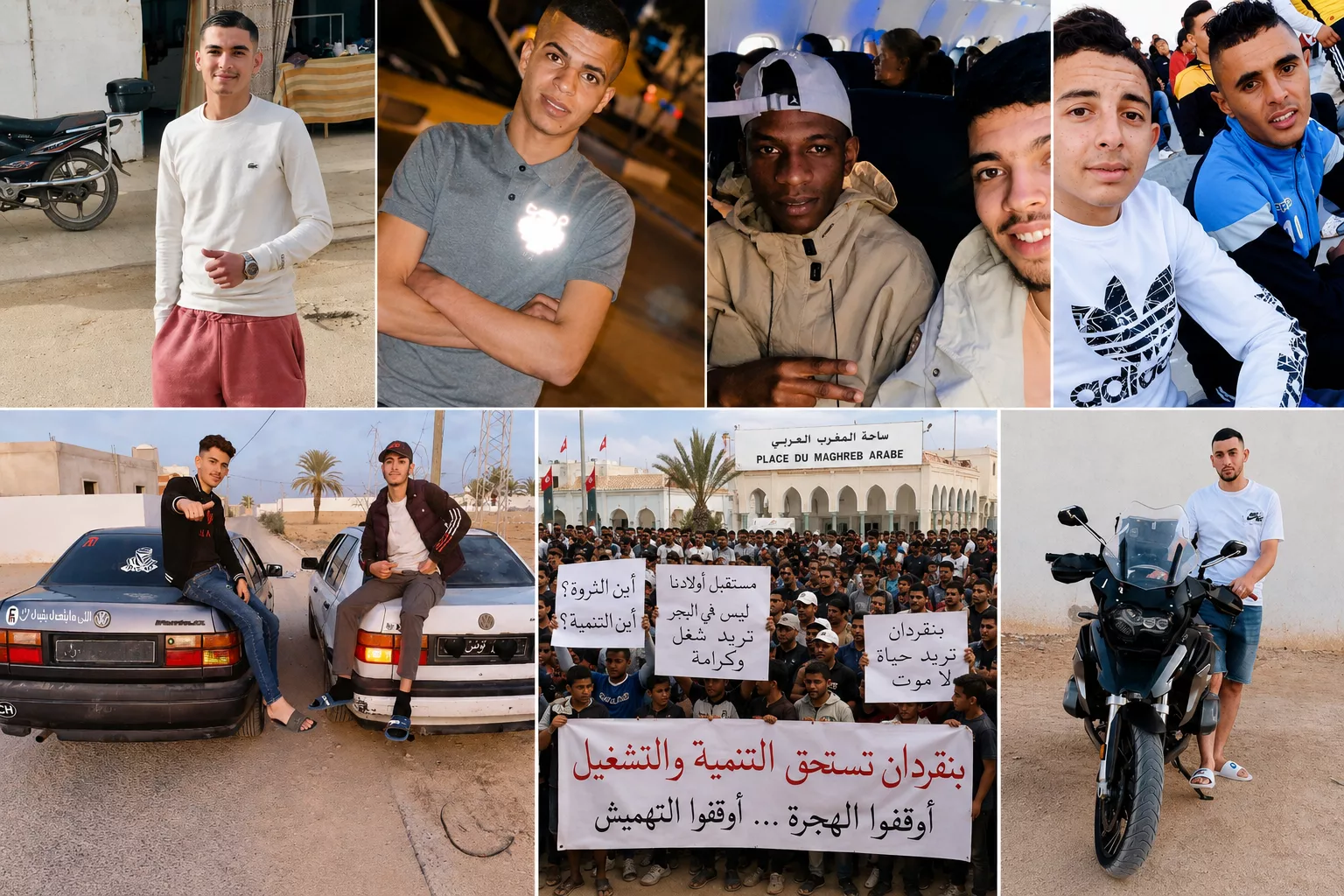
The Committee for the Respect of Human Rights and Freedoms in Tunisia (CRLDHT) expresses its deep sorrow and solidarity with the families and communities of Ben Guerdane and Zarzis, which have been devastated by the sinking of a boat carrying fifteen young Tunisians who were attempting to reach Italy.
According to the latest report released by the General Directorate of the National Guard, twelve bodies have been recovered, two people remain missing, and only one person survived. Fourteen of the fifteen people on board were from Ben Guerdane, and one was from Zarzis. The boat had left the coast on August 19 and sank about 14 nautical miles off the coast of Zarzis.
The CRLDHT extends its condolences to the families of the victims and shares in the anguish of those who are still waiting to learn the fate of their children. It calls for the search to continue uninterrupted until the last two missing persons are found.
But this tragedy cannot be reduced to just another news item about so-called irregular migration.
The question is not just how these young people died. It is also about understanding why these young people—many of whom were between the ages of 18 and 25—felt they had no other option but to set out to sea, risking their lives.
Ben Guerdane: Security Without Development
To understand what is happening today in Ben Guerdane, we must look back at the profound changes this border region has undergone over the past decade.
The fight against terrorism and securing the Tunisian-Libyan border were undeniable necessities, particularly after the events of March 2016: the clashes in El Aouija on March 2, and especially the large-scale attack carried out by ISIS against Ben Guerdane on March 7, 2016.
The people of Ben Guerdane played a decisive role, alongside the military and security forces, in resisting the attackers.
However, the responses to the region's problems have remained primarily security-focused, without a genuine economic and social policy that meets its needs.
The construction and strengthening of border security measures, the intensification of checks, and restrictions on trade have directly affected the cross-border economy, including informal trade, which has long been a vital source of income for many families.
Restricting this economy without simultaneously creating credible alternatives amounted to exposing a growing segment of the population to unemployment, precarious living conditions, and a lack of prospects.
Added to this are the ongoing difficulties at the Ras Jedir border crossing, a vital economic and social artery for Ben Guerdane. Closures, reopenings, restrictions, difficulties in crossing, and ever-changing decisions have further undermined the livelihoods on which many families depend.
Controlling departures cannot replace the obligation to save lives
This tragedy also raises questions about Tunisia’s immigration policies, particularly those implemented as part of its cooperation with the European Union.
For several years now, significant resources have been devoted to coastal patrols, monitoring departure areas, and intercepting boats. These measures are primarily designed to prevent departures.
The CRLDHT emphasizes, however, that the protection of human life and rescue at sea must be an absolute priority.
How can we explain that significant resources are being deployed to monitor the coastline, prevent departures, and intercept boats, yet a boat carrying fifteen people can disappear and a survivor can spend nearly two days at sea before being discovered by a commercial vessel?
The tragedy in Ben Guerdane inevitably brings back memories of the Zarzis shipwreck in September 2022. Four years later, the families remain committed to uncovering the full truth about the boat’s disappearance, the conditions of the search efforts, and the handling of the remains. A new tragedy has now occurred in the same maritime region, once again raising questions about what lessons were truly learned from Zarzis and the effectiveness of search and rescue operations.
But this responsibility does not end at Tunisia’s borders. European migration policies also bear some responsibility for the tragedies and disappearances in the Mediterranean. The effort to prevent people from leaving cannot continue to take precedence over the protection of lives, while thousands of people die or go missing at sea and their families are sometimes left for years without knowing what has become of them.
Political Silence and the Police Response
To date, there has been no significant public statement from the government or the Office of the President regarding this tragedy, its causes, or the situation in Ben Guerdane.
The National Guard has issued a statement on the search operations, noting that they are being monitored at the highest level. But that is no substitute for a political message addressed to the families and the public.
This silence stands in contrast to the response to the protests that broke out in Ben Guerdane. For two nights, residents and young people took to the streets. Their protests were initially driven by anguish over the disappearance of their loved ones, and then, more broadly, by unemployment, the hardships in Ras Jedir, stalled development projects, and a lack of prospects.
In response to this anger, security forces intervened, charged at the protesters, and used tear gas.
The contrast is striking: political silence in the face of the tragedy and its causes, and police intervention when anger spills onto the streets.
Establish Responsibilities
The ongoing judicial investigation is essential, but it cannot be limited to the organizers of the crossing and any potential smugglers. It must also establish the circumstances of the shipwreck, the timeline of alerts and search efforts, the surveillance and rescue resources deployed, and any potential liabilities, including those of institutions. A report on the measures taken since the 2022 Zarzis shipwreck must also be made public. The families have a right to the truth.
At the same time, the CRLDHT is calling for a comprehensive review of policies concerning border regions—particularly Ben Guerdane and Ras Jedir—as well as Tunisian and European migration policies, so that the necessary resources are available to rescue and protect lives.
The twelve victims are not merely “undocumented migrants .” They are young Tunisians who were seeking a different way of life. When cross-border trade dwindles without any alternatives, when unemployment and restrictions mount, and when all avenues of hope close off, the sea eventually appears as a way out—even at the risk of becoming a grave.
One question remains: How did it come to this—that young people from Ben Guerdane see more hope in a rickety boat and the Mediterranean than in their own country?
Committee for the Respect of Freedoms and Human Rights in Tunisia (CRLDHT)
August 24, 2026