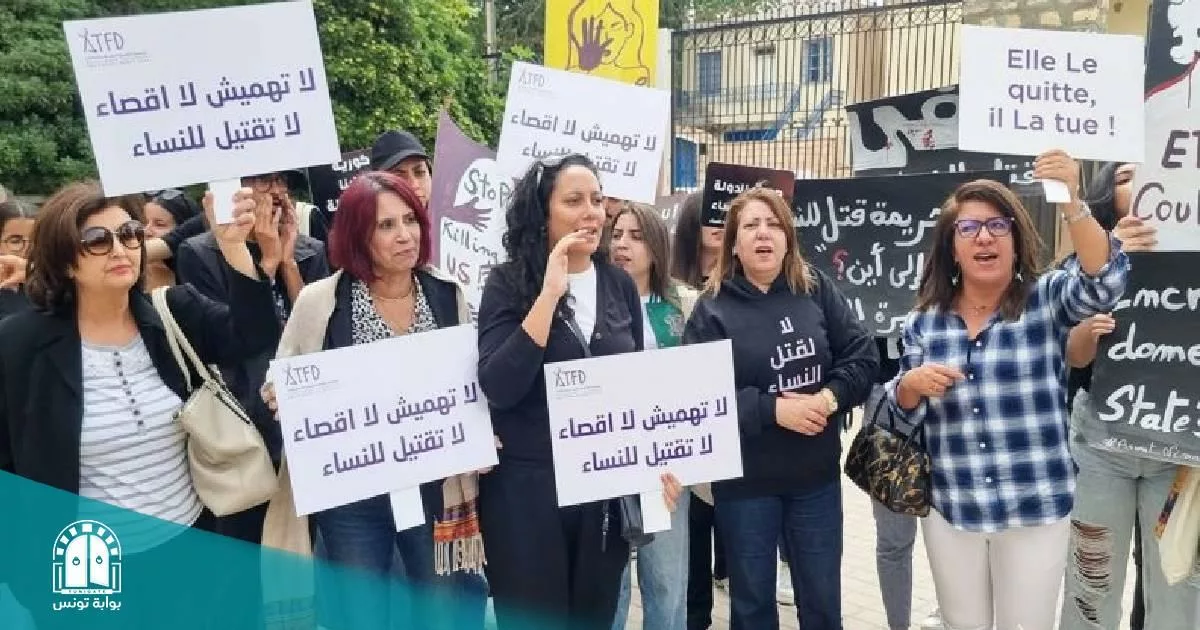
Seventy years after the enactment of the Personal Status Code and nearly nine years after the adoption of Organic Law No. 58 of August 11, 2017, on the elimination of violence against women, Tunisia has a robust legal and institutional framework. However, violence persists, and its most extreme form—femicide—has reached a particularly alarming level.
The figures illustrate the scale of the phenomenon. According to Aswat Nissa, the number of documented femicides rose from 6 in 2018 to 25 in 2023, 29 in 2024, and 30 in 2025. The detailed report presented by the organization in August 2026 records, according to its methodology, 24 murders and 5 attempted murders in 2025. Most notably, nearly 65% of the documented lethal violence occurred within a current or former marital relationship: 14 victims were married and 3 were divorced. The crimes have also spread to 14 governorates, whereas they were previously more concentrated in Greater Tunis.
The data available for July and August 2026 show that this trend has continued unabated. A regional monitoring effort documented two women killed in Tunisia in the month of July alone: on July 5 in Sejoumi, an elderly woman was stabbed to death by her son; on July 15, a woman in her sixties was found stabbed to death at her home in Kalaâ Sghira, in the Sousse Governorate; an investigation has been launched into the possible involvement of her husband and son.
The situation worsened further in August. As of August 17, 2026, Aswat Nissa reported that 16 femicides had already been recorded since the beginning of the year. On that day, in Borj Touil in the Ariana Governorate, a woman was killed by her husband, who stabbed her more than forty times. The organization also reported the murder of Mariem Amer, a mother of two, who was stabbed in the heart by her husband.
Other murders followed, notably in Oum Larayes, in the Gafsa governorate, and then, at the end of the month, in Hay Ettahrir in Tunis, where a woman pregnant with twins and already the mother of a four-year-old child was beaten and then strangled by her husband. (Alchourouk Archive) These successive crimes show that, as of August 30, the toll of 16 femicides reported in mid-August had already been exceeded. However, in the absence of an updated and consolidated official tally, it would be unwise to set a definitive figure for the first eight months of 2026.
This difficulty in determining the exact number of victims is in itself indicative of a major shortcoming in public policy.
An important law, but protection that still comes too late
Tunisia is not starting from scratch, however. Law No. 58 recognizes physical, psychological, sexual, economic, and political violence and provides for prevention, victim protection, support services, and the prosecution of perpetrators. Units specializing in violence against women and children have been established, along with a National Observatory, a helpline ( 1899 ), and a network of shelters.
But the issue is no longer simply a matter of how many institutions there are. The question is whether they are able to prevent a woman who is being threatened from being killed.
Femicide rarely occurs without warning signs. It is often the culmination of a continuum of events: repeated violence, threats, control, economic dependence, harassment, a contentious separation, stalking of the victim after the breakup, or death threats.
A particularly insightful earlier study of 28 cases of femicide committed by husbands found that 27 of them had been preceded by physical or psychological abuse. In the sample studied, 93% of the perpetrators were members of the victim’s immediate family, and 61% were husbands. (Tap Info)
The key question, then, is: How many of these deaths could have been prevented?
A woman who reports repeated violence or a death threat cannot simply be sent home after filing a complaint. She must receive an immediate risk assessment, effective protection, removal of the abuser if necessary, safe housing for herself and her children, and legal, psychological, social, and financial support.
Moving from Protection to Prevention
This is the most important public policy change needed today. We must move from a system that primarily intervenes after violence has occurred to one capable of identifying situations in which a woman is at risk of being killed.
Any complaint involving repeated violence, a death threat, strangulation, a prior attempted murder, post-separation harassment, the perpetrator’s access to a weapon, or a violation of a protection order should trigger a national protocol for assessing lethal risk.
Cases classified as high-risk should then be monitored jointly by law enforcement, the judicial system, health care providers, social services, the Ministry for Women, and specialized agencies. A woman should no longer be able to “fall through the cracks” between multiple institutions, each of which knows only part of her story.
Protective orders must also be evaluated not by their number but by their actual effectiveness: How many are issued? How quickly? How many are violated? What happens when an abuser fails to comply? How many women have actually been brought to safety?
Protection must also be geographically accessible. A woman from Kasserine, Gafsa, or Jendouba must be able to access a shelter, medical care, a lawyer, and police intervention just as quickly as a woman from Tunis. Furthermore, the ability to leave an abuser depends on housing, income, employment, and child care: economic independence is therefore an integral part of protection against violence.
A civil society that documents what the government fails to measure adequately
Given the gaps in public data, civil society organizations play a vital role. On August 12, 2026, Aswat Nissa launched Tunisia’s first digital platform dedicated to tracking, reporting, and documenting femicides. The organization explicitly cites the lack of comprehensive official statistics and a specific national strategy against femicide as the reasons for this initiative. (Tap Info)
This grassroots mobilization represents a step forward, but it also reveals an anomaly: it is largely feminist organizations that identify victims, piece together the circumstances of the crimes, support the women, raise public awareness, and sometimes directly assist in providing them with shelter. The attached document thus highlights how civil society initiatives are filling an institutional gap in documentation and follow-up.
The government must therefore establish a unified national database that cross-references data from law enforcement, the judiciary, health care, social services, and shelters: previous complaints, threats, protection orders, violations of those orders, the relationship between the perpetrator and the victim, recidivism, legal proceedings, and the circumstances of the murder.
After Every Femicide: Understanding Where Protection Failed
Finally, every case of femicide should be subject to a systematic and independent review.
Had the victim previously filed a complaint? Had she reported any threats? Had she sought medical care at a hospital? Had a protection order been requested or issued? Had the perpetrator been prosecuted before? Had she been offered a spot in a shelter? Was any agency aware of the danger?
The annual report on femicides should therefore no longer simply answer the question: How many women were killed? It should address another, far more challenging question: How many of these crimes could have been prevented? This is precisely the shift in approach proposed in the document: moving from counting victims to assessing the entire protection chain.
The events of July and, above all, August 2026 lend this question a particular sense of urgency. Even as Tunisia celebrated the 70th anniversary of the Personal Status Code on August 13, several women continued to be killed, mainly within their family or marital circles. Domestic violence accounts for nearly two-thirds of the fatal incidents documented by Aswat Nissa.
Now that Law No. 58 has been in effect for nine years, the challenge is no longer simply a matter of having legislation, specialized units, or reception centers in place. The challenge is to ensure that all these components work together effectively and at an early enough stage.
The true measure of a policy to combat violence against women should no longer be limited to the number of complaints filed, court orders issued, or centers established.
It should be much simpler and much more demanding: How many women in danger have we managed to protect before they became yet another victim?