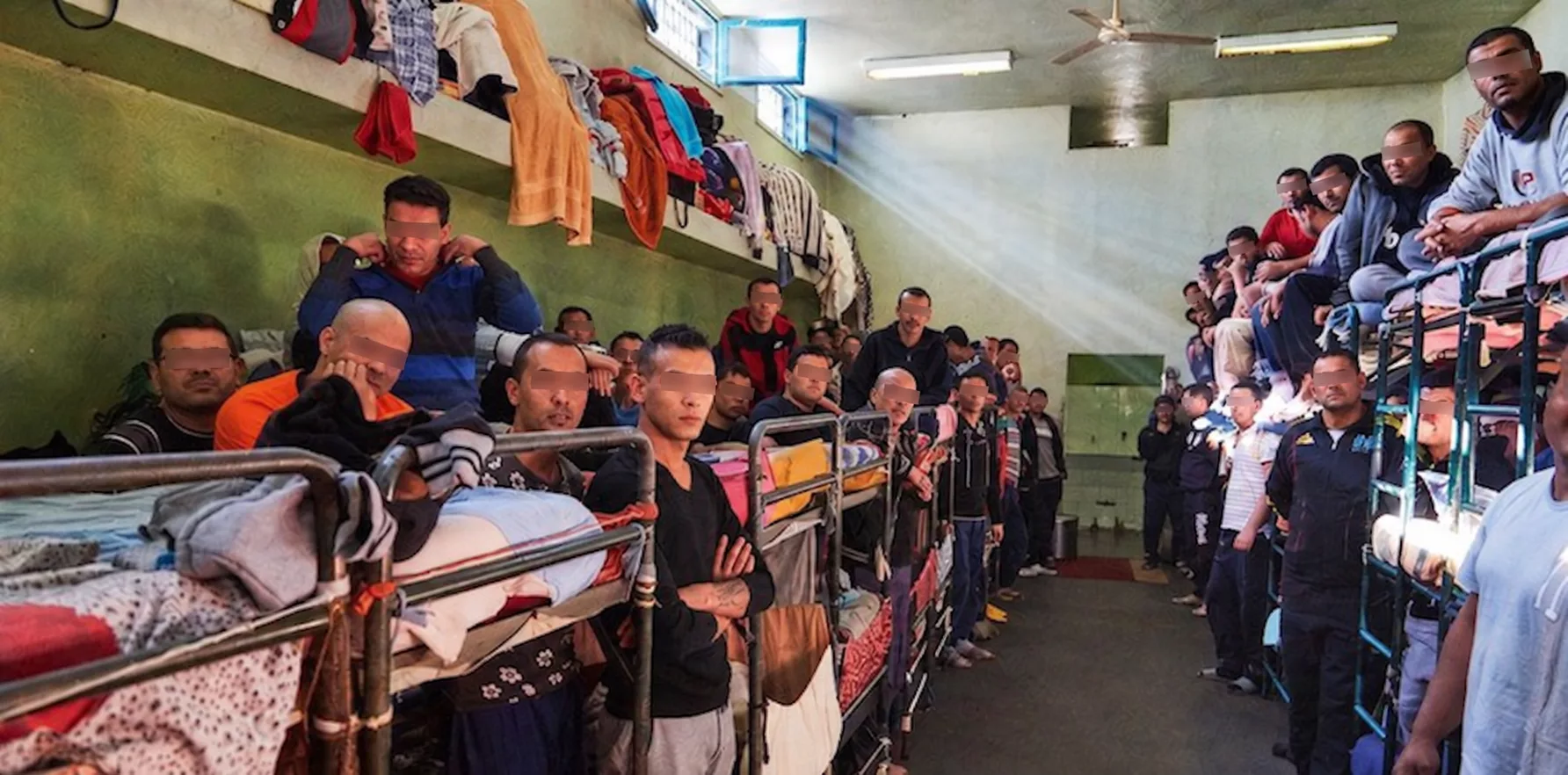
As of August 2026, the situation in Tunisian prisons has become a humanitarian and public health emergency affecting the entire prison population.
The unprecedented heat wave sweeping the country, extreme temperatures, water and electricity shortages and outages, and difficulties accessing healthcare take on a far more dangerous dimension behind prison walls. In overcrowded, overheated, and inadequately ventilated cells, thousands of people are exposed to the heat with no way to escape it.
Inmates who are elderly, ill, disabled, suffering from chronic illnesses, or weakened by long periods of detention are particularly vulnerable. The same is true for those who resort to hunger strikes as a last resort to protest.
Alerts are on the rise
Among political prisoners and prisoners of conscience, several situations are currently causing serious concern.
Rached Ghannouchi, 85, has experienced a concerning deterioration in his health. Ahmed Néjib Chebbi, who is over 80, has suffered from breathing difficulties, exhaustion, and other health issues exacerbated by the high temperatures.
The health condition of Mondher Ounissi, a specialist in nephrology and kidney transplantation and a professor at the Tunis Faculty of Medicine, is particularly alarming. Detained at the Oudhna civil prison and suffering from chronic kidney disease himself, his condition has been deteriorating for several weeks, and he is experiencing significant difficulty speaking: according to information gathered by the organization Intersection, he is now only able to speak in a very faint voice. Transferred to the hospital on August 19, he underwent several tests, but the kidney ultrasound deemed necessary due to his pain reportedly was not performed. His defense team also denounces the conditions of his transport between the prison and the hospital as unsuitable for his health condition.
In late August, Abir Moussi also had to be transferred to the hospital after her condition deteriorated significantly, characterized by pain, breathing difficulties, physical exhaustion, and mobility issues. Her defense team points out that she had previously alerted prison authorities to her exposure to heat stress.
Ghazi Chaouachi had to end a hunger strike due to his health condition.
Chawki Tabib ’s situation also required special attention. Suffering from diabetes and arthritis, among other conditions, he had previously experienced a medical emergency in prison that required his transfer to the hospital in Nabeul. During his hunger strike, which began on August 11, his family also reported that he had been denied access to certain medications and medical devices prescribed by his specialist, particularly for his back pain. He finally ended his hunger strike on August 28, after seventeen days.
Wael Naouar, who has been detained since March along with several activists from the Soumoud Flotilla, was continuing his hunger strike at the end of the month.
In addition to these cases are those of Chaïma Issa, Ayachi Hammami, Jaouhar Ben Mbarek, Issam Chebbi, Khayam Turki, Ridha Belhaj, Ajmi Lourimi, Lotfi Mraïhi, and Saadia Mosbah, as well as those of journalists Mourad Zeghidi, Borhen Bsaïes, and Zied El Heni.
But focusing solely on well-known figures would paint a profoundly incomplete picture of the situation.
Convicts serving sentences for common crimes are exposed to the same dangers
The protection of life and health should not depend on a prisoner's political status or fame.
Convicted felons make up the vast majority of the prison population. They endure the same overheated cells, the same overcrowding, the same shortages, and the same difficulties in accessing healthcare, but their situations are made public much less frequently.
However, several cases documented this summer demonstrate the seriousness of the risks.
These situations demonstrate that the prison crisis does not distinguish between political prisoners and common criminals.
Deaths That Require Us to Stop Waiting and See
Even more seriously, deaths in custody were reported over the summer.
As of early August , the Intersection organization had recorded eight deaths classified as suspicious since the beginning of 2026, including four in the month of July alone.
By the end of the month, the situation had become even more serious: five deaths were reportedly recorded on August 28 alone in prisons in Greater Tunis, according to the president of the Tunisian League for Human Rights, who said he had obtained this information from judicial sources.
No official national report has yet confirmed all of these deaths or, more importantly, determined their causes.
Every death that occurs in custody must be the subject of an independent, prompt, and transparent investigation to determine the medical causes of death, the conditions under which the person was detained, the care provided to them, and, where applicable, who is responsible.
The case ofAnis Charni, 28, illustrates precisely why this transparency is essential. Arrested on July 22 and taken into custody at a police station in Ariana, he was later found by his family at Charles-Nicolle Hospital, where he was on a ventilator. He died on July 28. His family claims to have noticed signs of violence on his face and body and has requested an autopsy. A judicial investigation has been launched to determine the exact circumstances of his death.
We must therefore avoid two pitfalls: downplaying the number of deaths in the absence of official explanations, but also attributing each death to the heat without evidence. What has already been established is sufficient to justify urgent action: extreme temperatures, shortages, overcrowding, sick or elderly inmates, difficulties accessing care, and a growing number of alerts.
We must act before there are more deaths
The situation now calls for more than just press releases and statements of concern.
A person in custody is under the responsibility of the State. The sentence imposed by a court is deprivation of liberty. It must not result in exposure to dehydration, unbearable heat, denial of medication, lack of medical care, or risk of death.
The authorities must therefore immediately take exceptional protective measures in all correctional facilities: ensure constant access to drinking water and sanitation facilities; ensure proper ventilation of cells and uninterrupted electricity supply; strengthen medical staff; conduct an immediate census of elderly, sick, or disabled individuals, as well as those with chronic conditions; provide them with enhanced medical supervision; guarantee immediate access to prescribed medications, medical tests, and equipment; and immediately transfer anyone whose condition requires it to appropriate hospital facilities.
Specific medical monitoring must also be arranged for individuals on a hunger strike.
Above all, it is essential to review without delay the continued detention of elderly individuals, those who are seriously ill, or those whose health condition is incompatible with current conditions of incarceration, as well as the continued use of pretrial detention when an alternative measure is possible. These measures must apply to all detainees, without distinction between political prisoners, journalists, activists, and those charged with or convicted of common-law offenses.
Yet national and international rules are clear. Tunisian law guarantees the right to health care for persons deprived of their liberty. The Nelson Mandela Rules, in particular, require health care equivalent to that available to the general public and the transfer of detainees requiring specialized care to appropriate facilities.
In a prison, unlike in the rest of society, an inmate cannot leave a cell that has become stifling, cannot fetch water on his own, cannot freely see a doctor, and cannot go to the hospital. He is entirely dependent on the prison administration.
That is why the government bears direct and heightened responsibility in this case.
Tunisia is experiencing an exceptional heat wave and shortages. The authorities are now aware of the risks. Families, lawyers, associations, and human rights organizations have alerted them. People have already been hospitalized. Some individuals’ health has seriously deteriorated. Deaths in custody have been reported.
There's no time to wait any longer.
We must act now, before another water outage, a few more hours in an overheated cell, or a delay in administering medication turns a predictable situation into a preventable death.
Protecting prisoners today is neither a favor nor a political concession. It is the state’s obligation and a matter of life and death.