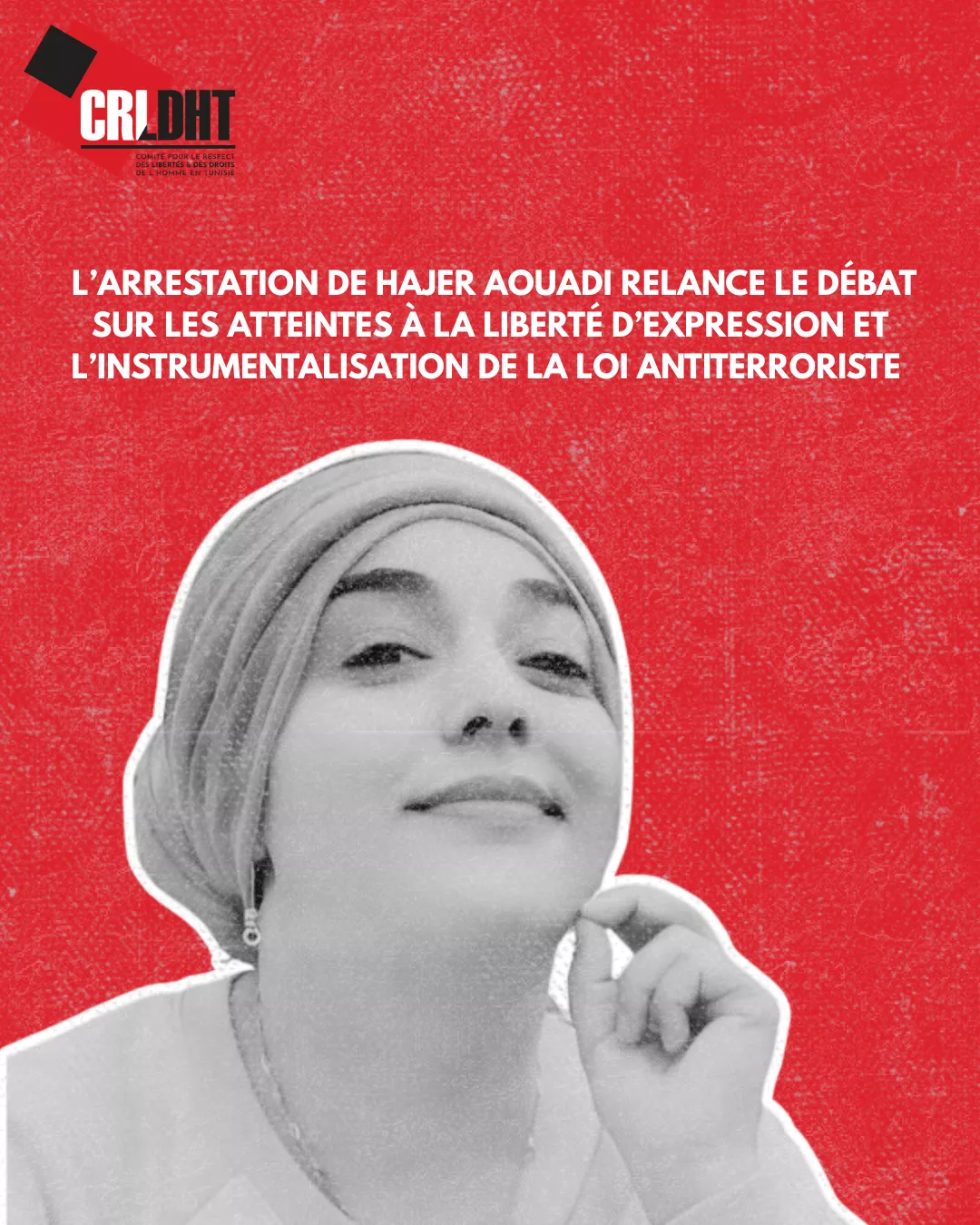
The arrest of activist and blogger Hajer Aouadi on January 24, 2026, at her home north of Tunis before being taken to Tajerouine (El Kef governorate, Kasserine), has sparked serious concern among bloggers and human rights defenders. According to corroborating information shared on social media, this arrest follows Facebook posts in which she critically commented on an anti-terrorism operation carried out a few days earlier in the Majel Bel Abbès delegation.
According to sources close to the security authorities, the public prosecutor's office ordered him to be held in custody for five days under the anti-terrorism law, considering that some of his publications contained elements of "justification," "whitewashing," or "questioning of security measures."
This decision comes at a time when the unfounded use of anti-terrorism legislation and laws regulating online expression is increasingly criticized for its chilling effect on freedom of opinion, which is guaranteed by the Tunisian Constitution and by international conventions ratified by Tunisia.
The Ministry of the Interior announced that it had neutralized a cell composed of four individuals during an operation described as "preventive." The names cited in several local publications are: Ounis Hajji, Saffi Hajji, Boujemaa Hajji, and Bechir Hajji ( who reportedly blew himself up during the intervention). According to the authorities, these individuals were under security surveillance and were linked to "remnants" of armed groups operating in the mountains of western Tunisia.
However, Hajer Aouadi publicly stated that those killed during this operation were not terrorists but smugglers operating in border areas, arguing that the label "terrorist cell" had been used without presenting any verifiable material evidence or clear communication about organizational affiliation.
Whether accurate or not, these statements fall within the scope of political expression and public criticism and raise the question of citizens' right to question official accounts, particularly when they concern operations involving the use of lethal force.
Criticizing a security operation does not mean supporting terrorism.
Hajer Aouadi's supporters point to a fundamental principle: the right to question, analyze, or criticize the actions of the state, including in matters of security, is a matter of freedom of expression. Equating any challenge to the official narrative with an apology for terrorism creates a dangerous confusion between critical opinion and incitement to violence.
At this stage, there is no public information establishing that Hajer Aouadi has called for violence or expressed direct support for armed groups. Her publications appear to be political and analytical in nature, even if they may be considered controversial or disturbing.
This case is part of a broader trend characterized by:
- The increase in lawsuits over online publications,
- the widespread and abusive use of particularly serious criminal charges, particularly those under anti-terrorism legislation,
- a significant narrowing of civic space.
This type of prosecution contributes to a climate of fear, pushing citizens, journalists, and activists toward self-censorship, including on topics of major public interest such as security, governance, and public policy.
Calls are growing for:
- the release of Hajer Aouadi or, at the very least, her prosecution while remaining free,
- strict compliance with fair trial guarantees,
- the end of the criminalization of peaceful expression.
For the fight against terrorism, however necessary it may be, cannot be sustained at the cost of eroding fundamental freedoms.