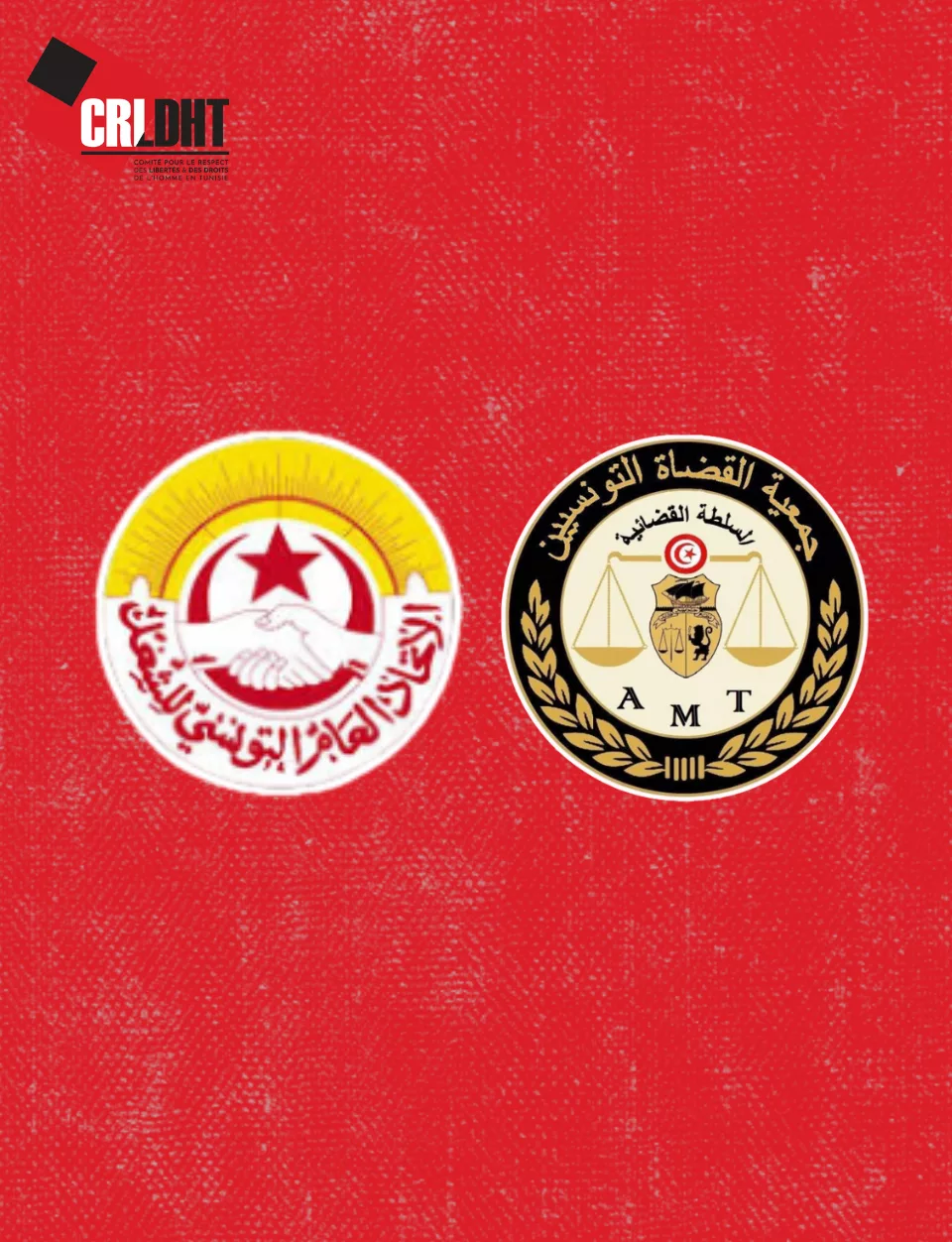
The coming months will be marked in Tunisia by two major congresses: that of the Tunisian General Labor Union (UGTT), scheduled for March 25 and 26, 26 and 27 March 2026, and that of the Tunisian Magistrates' Association (AMT), whose 15th congress will be held on 7 and 8 February 2026 in Hammamet.
Beyond their statutory dimension, these two events constitute major political and democratic challenges in a context marked by authoritarianism, the restriction of public freedoms, and the systematic weakening of intermediary bodies.
Since 2021, Tunisia has been undergoing a phase of authoritarian recentralization of power, accompanied by increasing criminalization of collective action, union activism, and critical speech.
In this climate, autonomous civil society organizations, unions, and independent professional structures are perceived as obstacles to be neutralized rather than as partners in public debate.
The UGTT between internal crisis and confrontation with the government
It is in this context that we see both the deep crisis facing the UGTT and the repeated attacks on the independent judiciary, of which the AMT remains one of the last organized spaces of institutional resistance today.
The March 2026 UGTT congress comes amid a triple crisis:
- crisis of internal democracy, linked to disputes over changes to term limits, divisions within the executive committee, and a loss of confidence among part of the union's membership;
- crisis of social role, in a context of frozen social dialogue, unilateral imposition of wage policies by the executive, and marginalization of the union as a negotiating partner;
- crisis of political role, while the UGTT is simultaneously targeted and circumvented by a populist government seeking to capture the social discourse while neutralizing collective mediation.
The congress thus promises to be a moment of truth: either the organization succeeds in democratically rebuilding itself and clarifying its position, or it risks becoming bogged down, falling apart internally, or suffering a lasting loss of credibility and influence.
The AMT Congress: Independent Judiciary Under Siege
The 15th AMT congress is being held in particularly serious circumstances.
Since the dissolution of the High Council of the Judiciary, the arbitrary dismissals of judges and the direct pressure exerted on magistrates, the independence of the judiciary has been directly challenged.
The AMT, which has historically been committed to the independence of the judiciary and the rule of law—particularly since the early days of the 2011 revolution—is now explicitly targeted.
The smear campaigns, legal threats, and media leaks targeting its president and officials reflect a clear intention: to silence one of the last institutional voices capable of denouncing the subjugation of the judiciary to the executive branch.
In this context, the AMT congress goes far beyond the issue of renewing its leadership. It constitutes an act of collective resistance, a test of internal solidarity, and a signal to both Tunisian society and the international community.
Common challenges and major risks
These two conferences crystallize converging issues:
- the survival of autonomous intermediary bodies;
- the defense of freedom of association, the right to organize, and freedom of collective expression;
- the preservation of institutional checks and balances in the face of hyper-presidentialism.
The risks are commensurate with these challenges: internal fragmentation, political interference, judicialization of conflicts, delegitimization by the media, and even the lasting neutralization of these organizations.
Ultimately, the UGTT and AMT congresses do not only concern their members.
They are crucial to the future of pluralism, the ability of Tunisian society to establish credible collective mediation mechanisms, and the very possibility of a return to effective rule of law.
In Tunisia, where spaces for debate are closing one after another, these two congresses appear to be rare moments when democracy can still be exercised from within. Their outcome will have an impact far beyond the walls of the congress halls.