In 2026, protests are on the rise in Tunisia. They focus on employment, purchasing power, wages, access to water, power outages, health care, education, pollution, and civil liberties. They take various forms: marches, strikes, sit-ins, local rallies, and social media campaigns. Their escalation reveals a crisis affecting both living conditions and citizens’ ability to influence public policy decisions.
The Tunisian Social Observatory (FTDES) recorded 2,882 protests in the third quarter of 2026, compared to 1,316 during the same period in 2025, 752 in 2024, and 680 in 2023. The demands varied from month to month: water and electricity outages in July, water shortages in August, unemployment, and difficulties related to the start of the school year in September. Residents were the main participants in these protests.
Environmental activism is also on the rise. A total of 1,018 protests were recorded during the first eight months of 2026—nearly 350% more than during the same period in each of the three previous years. Demands related to the right to water accounted for 80% of these protests. These struggles are closely linked to living conditions: access to water, health, agriculture, and essential services.
In addition to these demonstrations, there have been actions organized around labor and social rights: rallies by the unemployed, strikes, sit-ins, and protests against problems with public services or environmental hazards. The events of October 21 and 22 in Jebeniana, Agareb, and Ettadhamen reflect a different dynamic: local protests and clashes followed deaths that occurred under disputed circumstances. These incidents do not prove the existence of coordination among the various hotspots, but they do point to a climate of mistrust and social tensions.
October 17: A stepping stone toward expanding the mobilization
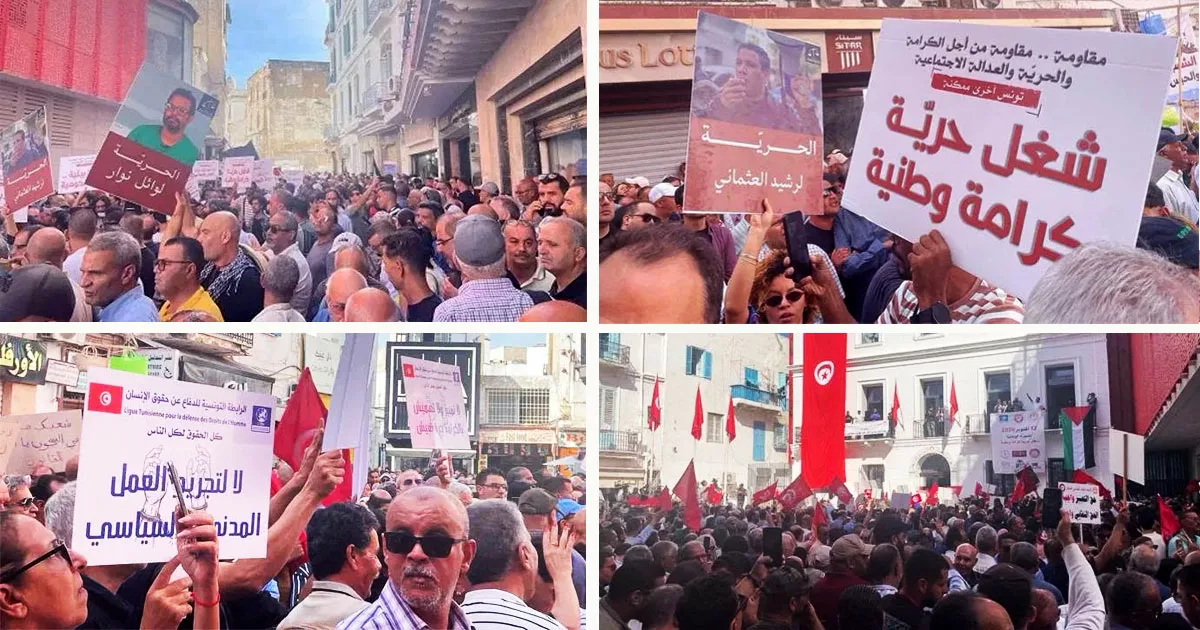
In this context, the national march on October 17 in Tunis marked an important milestone. It was organized by nine organizations: the Tunisian General Labor Union (UGTT), the National Union of Tunisian Journalists (SNJT), the National Bar Association of Tunisia (ONAT), the Tunisian League for Human Rights (LTDH), the Tunisian Forum for Economic and Social Rights (FTDES), the General Union of Tunisian Students (UGET), the Tunisian Organization of Young Doctors (OTJM), the Tunisian Association of Democratic Women (ATFD), and the Union of Unemployed Graduates (UDC). Opposition parties and other actors also supported or joined the mobilization.
Several thousand people marched from Mohamed Ali Square to Habib Bourguiba Avenue. Union members, lawyers, journalists, doctors, activists, and citizens of various political persuasions denounced the high cost of living and the erosion of freedoms, and called in particular for the release of political prisoners. The slogans combined social demands with the defense of civil liberties, particularly under the banner of “Work, Freedom, National Dignity.”
The march demonstrated that organizations and groups that had long been divided can come together in the public sphere around shared demands. It also highlighted the possibility of moving beyond mobilizations that had previously been fragmented. But a single day of rallying is not enough to shift the balance of power: its long-term impact will depend on the ability of the mobilized groups to maintain their connections and incorporate the struggles taking place in the regions.
Regional coordination efforts to connect the struggles
The UGTT has upheld the principle of a general strike and has begun gradual preparations, including sector-specific and regional mobilization plans. The establishment of regional coordinating bodies can give substance to this approach and sustain the momentum from October 17.
These coordinating bodies could bring together regional unions and labor organizations, as well as associations, groups of unemployed people, student movements, professional organizations, and groups advocating for water and the environment. Their role would be to disseminate information, support local actions, link together various demands, and convey residents’ priorities to a national platform.
This organization must be grounded in local realities. Water shortages, unemployment, access to healthcare, and pollution do not manifest themselves in the same way everywhere. Regional coordinating bodies must therefore enable those affected to define their demands and forms of action, and then identify common goals. Regular meetings, a shared schedule, and tracking of demands could provide continuity to the mobilizations.
The preparations announced by the UGTT offer a possible framework, provided that the coordinating efforts genuinely involve social movement actors and are not merely administrative. A march can kick off a series of actions; the regional organization can ensure its long-term sustainability and broaden its social base.
Military Enlistment and Supervision of High School Students
Youth mobilization is growing as authorities step up enforcement of mandatory military service. According to an investigation by Driss Rejichi published by *Le Monde*, young people who have not regularized their status after several recruitment sessions may have their cases referred to military authorities and face up to one year in prison. In January 2025, the Ministry of Defense announced that it had referred 400,000 cases to military courts. In August of that same year, the army reported that 30,000 people had regularized their status, the majority by obtaining an exemption. https://www.lemonde.fr/afrique/article/2026/10/22/en-tunisie-l-armee-tente-de-ramener-les-jeunes-vers-le-service-national_6798618_3212.html?utm_source=chatgpt.com
At the same time, the Ministry of Education announced that, effective October 1, 2026, students will no longer be allowed to leave their schools during off-peak hours, breaks, or when a teacher is absent. The rule applies specifically to middle schools and high schools. The ministry is presenting it as a protective measure and plans to implement supervision and awareness-raising activities in schools.
This provision is not officially a ban on demonstrations. However, it restricts high school students’ movement during school hours and may, in effect, make it more difficult for them to participate in gatherings organized during those hours. It is therefore important to distinguish between the safety objective cited by the ministry and the measure’s potential impact on young people’s ability to mobilize. The lack of staff and suitable spaces in some schools also raises the question of the resources needed to enforce this measure.
Viewed alongside the tightening of military service requirements and the restrictions imposed on high school students’ travel, these measures reveal the government’s distrust of a youth whose capacity for mobilization it fears. While young people are demanding jobs, decent public services, and the right to participate in decisions that shape their future, their movements seem to be more suppressed than recognized as a legitimate expression of their aspirations. Does this desire to control them not, at its core, reflect a fear of seeing young people organize and transform their anger into collective power?
The October 17 march highlighted the possibility of unity. Regional coordinating bodies can provide a broader foundation for this by linking local struggles, amplifying the demands of young people and the affected communities, and bringing them to the national level. It is through this kind of organization, solidarity among movements, and sustained action that we can build the momentum needed to bring about change and meet these demands.