A series of presentations at the conference" Borders, Violence, and Responsibilities: Understanding the Migration System" on February 20 provided an overview of the Tunisian migration system, from the racist and controversial speech by the head of state to the accusations brought against Mediterranean states at the Permanent Peoples' Tribunal (PTT).
Franck Yotdje, former director of the Afrique Intelligence association, pointed out that between 2016 and 2022, Tunisia faced increasing migration flows. Cases of racist violence did occur, but remained isolated incidents.
According to Yotdje, the turning point came after President Kais Saied's openly racist speech. This speech focused on three main points:
- Conspiracy theory: migrants portrayed as a threatening "horde."
- Demographic change: the idea of erasing Tunisia's Arab identity.
- Link between migrants, security, and crime.
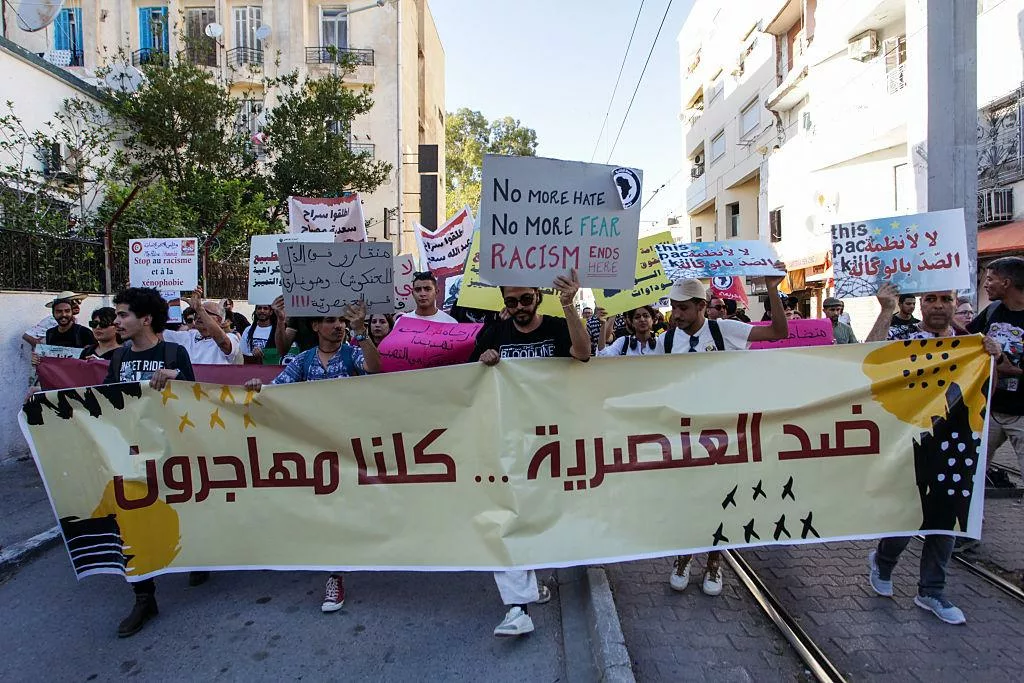
The result has been waves of mass arrests and deportations, depriving people of work, housing, and, for many, their lives. Violence has spread to several cities, pitting a distraught local population against marginalized, abused, and terrorized migrants.
In response to this distress, spontaneous solidarity emerged, driven by associations, organizations, and ordinary citizens. Despite the openly fascist stance of the state, associations, municipalities, and other local actors had set up mediation mechanisms to give sub-Saharan migrants access to healthcare, education, emergency accommodation, and food distribution.
But criminalization quickly backfired on those providing assistance: helping migrants became a crime, as Abdallah Said, an activist from Medenine, testifies. Despite the risks, informal collections and discreet assistance continued to develop. The security threat made them increasingly rare and inaccessible.
The Permanent Peoples' Tribunal (PPT): a symbolic court to break the silence of justice
Brahim Belghith, the second speaker, presented the Permanent Peoples' Tribunal (formerly the People's Tribunal), a court of opinion created in 1979 to enable NGOs and civil society to make their voices heard by the international community. The 56th session took place in Palermo from October 22 to 25, 2025, bringing together 45 associations determined to judge the states of the southern Mediterranean for their migration practices.
Main charges brought
- Illegal refoulement of migrants, forced return to countries where they risk persecution or inhumane conditions.
- Failure to provide assistance and deliberate shipwrecks at sea, deliberate failure to intervene resulting in the deaths of tens of thousands of people.
- Arbitrary detention, torture, and inhumane treatment inflicted on persons arrested off the coast.
- Discrimination and racist criminalization of migration.
- Criminalization of solidarity with migrants.
- Outsourcing of borders, transferring responsibility for protecting refugees to third parties, often at a high human cost.
These accusations are based on poignant testimonies from migrants, as well as international human rights conventions, the Rome Statute, and the classification of these acts as serious crimes against humanity. The tribunal concluded that the violations were deliberate and systematic, condemning both the countries of the northern and southern Mediterranean and emphasizing the shared responsibility of all state actors.
Among the figures mentioned, Maître Brahim Belghith paid tribute to Saadia Mosbeh, who was imprisoned for her solidarity with migrants. Even behind bars, she continues to help migrant detainees, despite the obstacles imposed by the prison administration.
The speakers emphasized that Tunisia is not isolated. The broader context involves Europe and the migrants' countries of origin. The boundaries of responsibility are blurred: the responsibility of the Tunisian state coexists with that of the migrants' countries of origin and that of the European Union.
The TPP's conclusions highlight the urgent need for a coordinated response, both nationally and internationally, to end the criminalization of solidarity and guarantee the protection of migrants' fundamental rights. The international community is now called upon to translate these findings into concrete action, lest the migration crisis continue to unfold in silence.