Tunisia: exceptional justice at the service of political repression.
Mobilization in front of the court and police lockdown
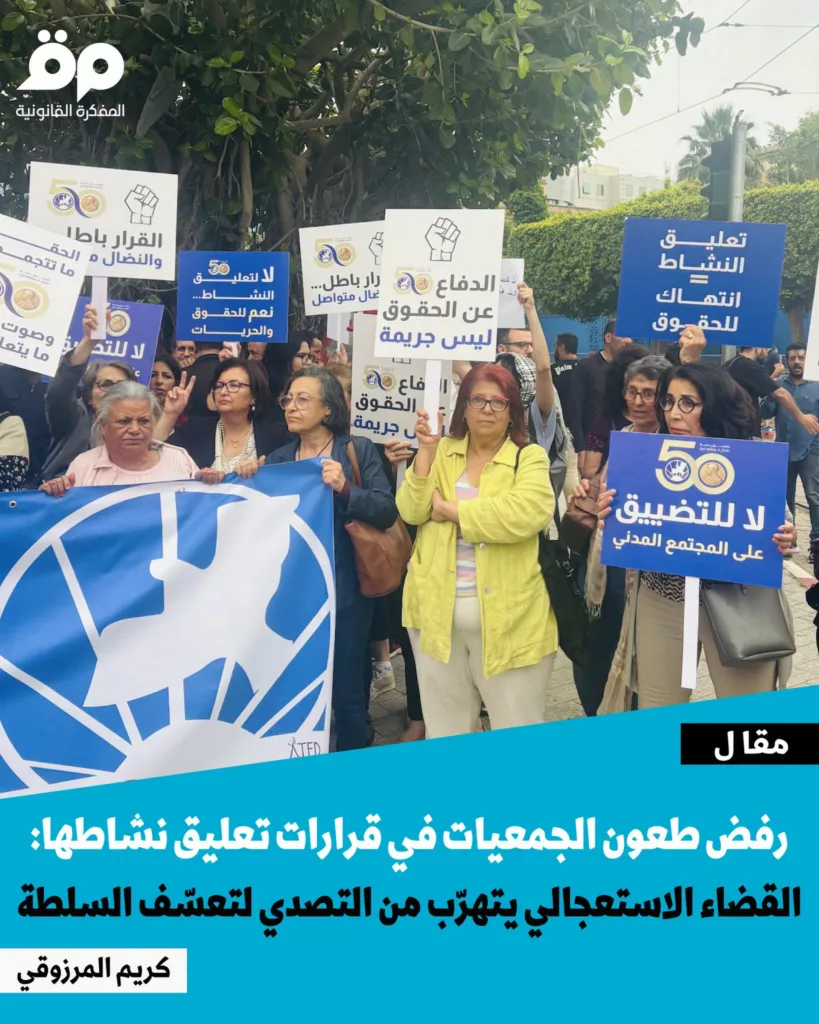
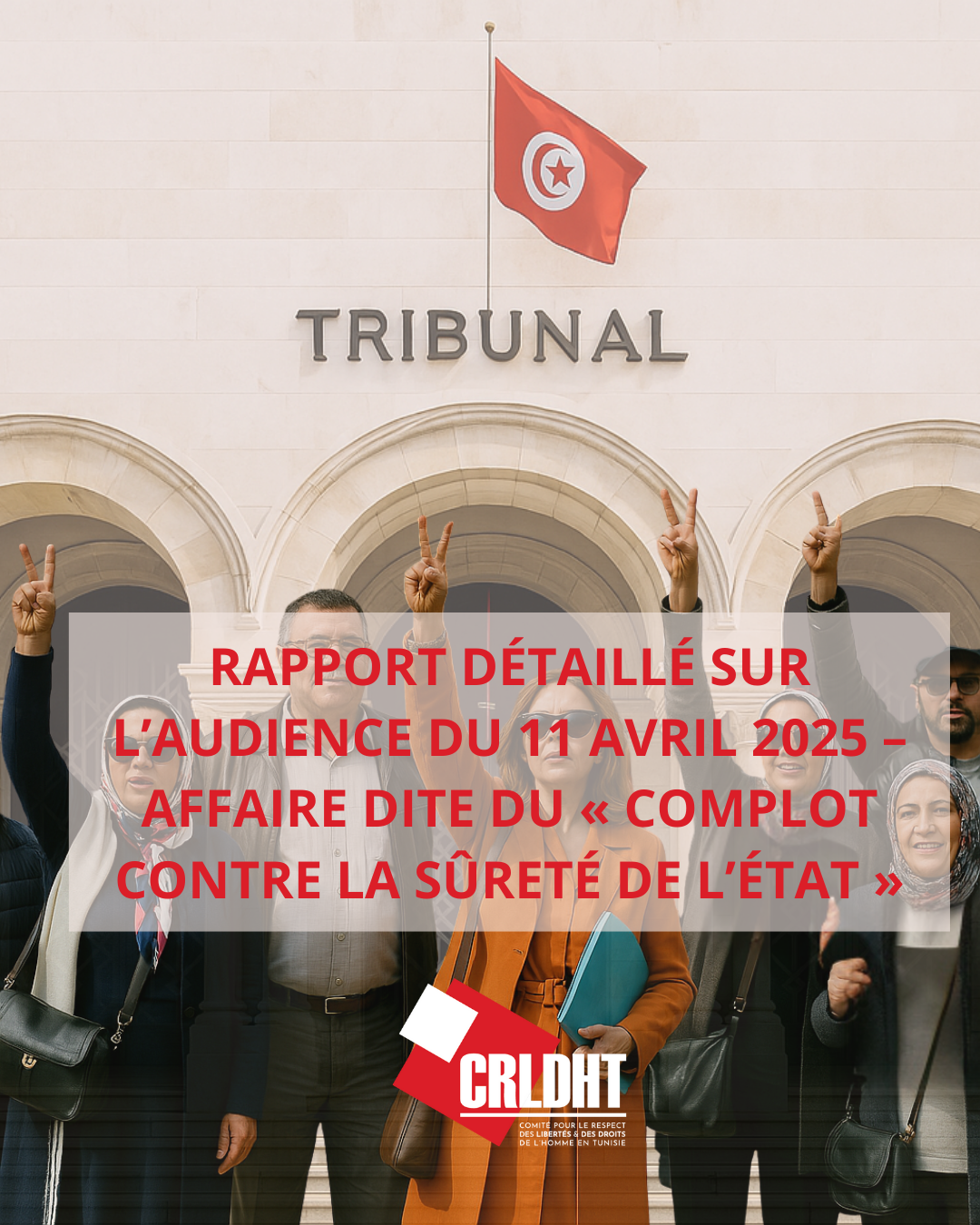
The hearing on April 11, 2025 took place in a heavy atmosphere, symptomatic of a political trial turned into a tug-of-war between the executive power and Tunisia's democratic opposition. While inside the courtroom the judicial debates were supposed to be taking place, outside, the street was abuzz with slogans denouncing a judicial farce.
At dawn, families of political prisoners, opposition figures, civil society activists and journalists gathered outside the Tunis courthouse to denounce the political nature of the trial. However, they were massively denied access to the courtroom, with the exception of one member per family. This discriminatory filtering was coupled with police maneuvers designed to intimidate peaceful demonstrators, notably by tightening the cordon around the courthouse and physically preventing entry.
Cries were heard demanding transparency in the trial, the cancellation of remote appearances and the release of detainees. The protest movement was supported by several political leaders, including Ahmed Néjib Chebbi, who denounced the regime's desire to "terrorize the opposition" and impose a culture of fear.
The demonstrators brandished photos of the detainees and chanted slogans demanding a fair trial, while the lawyers confirmed their refusal to participate in a hearing without the physical presence of the defendants. The judicial authorities maintained the remote-appearance system decided at the first hearing on March 4.
A hearing behind closed doors and hindered by the media
The actual conditions of access meant that the hearing was effectively closed. Several journalists - including Zied El Heni, Khawla Boukrim, Monia Arfaoui and Lotfi Hajji - were prevented from attending.
Representatives of national organizations were also kept away, while only representatives of Western chancelleries were allowed to attend. These included delegates from the embassies of France, Germany, Canada, Belgium, the Netherlands and the European Union. This differentiated treatment was widely perceived as an attempt to control the international image while muzzling critical local relays.
Collective refusal of videoconferencing and procedural paralysis
The hearing was dominated by the refusal of political prisoners to appear remotely from their place of detention. The lawyers unanimously argued that this method violates article 141 bis of the Tunisian Code of Criminal Procedure, in particular the requirement for prior consent from the accused, a written statement of reasons and an individualized judicial decision, all of which are absent in this case.
The remote appearance has been described as a "mock trial", more a political communication operation than a genuine judicial debate.
Me Abdelaziz Essid told AFP: "We refuse to plead under these conditions, and we don't want to be accomplice witnesses to this parody."
Me Ayachi Hammami added: "In solidarity with the detainees, we also refuse to intervene remotely."
Foreign defendants request hearings
Two of the defendants living abroad, Mohamed Kamel Jendoubi and Ridha Driss, who were translated without being heard during the investigation and inquiry phases, asked to be heard in this hearing, both as defendants and as witnesses, by videoconference. They invoked the application of article 73 of the organic anti-terrorism law, which allows this type of procedure if justified by the interests of justice.
Prisoners' plight: hunger strikes and mistreatment
Another highlight of the hearing was Me Dalila Msadek's statement that five detainees in Mornaguia, namely Ghazi Chaouachi, Ridha Belhaj, Khayem Turki, Issam Chebbi and Abdelhamid Jelassi, as well as Jaouhar Ben Mbarek in Belli (Nabeul), are on hunger strike - the latter for over 13 days - to protest against their remote appearance and the ban on speaking before their judges.
This hunger strike is the ultimate expression of their desire to be heard in a trial where the authorities are trying to stifle any dissenting voice. It is also a cry of alarm in the face of inhuman prison conditions.
A trial without judicial or moral legitimacy
The investigation of the case is based on anonymous testimony, accusations without material evidence, spectacular arrests without warrants and a total absence of cross-examination of key witnesses. The former investigating judge, now on the run, and the head of the judicial police, now incarcerated, illustrate the institutional fragility of the case.
The very composition of the court is deemed illegal and unconstitutional. Indeed, the criminal chamber in charge of the case was set up by a simple administrative note issued by the Minister of Justice, in clear contradiction with the provisions of Decree-Law no. 11-2022 on the Superior Council of the Judiciary, which stipulates that judges must be appointed according to independent mechanisms guaranteeing the impartiality of the judiciary.
The defense thus questioned the legitimacy of the entire tribunal board, made up of the following magistrates: Lassâd Chamakhi (president), Moez El Gharbi, Ahmed Barhoumi, Fatma Boukattaya, Afef Betaïeb.
The defense and the experts publicly denounced this composition, asserting before the court that its decisions will be worthless and that this judicial masquerade will inevitably be corrected once legality is restored.
Maitre Bassam Trifi declared: "This trial cannot be called a fair trial. It contains numerous irregularities... Citizens, representatives of civil society, journalists and the families of the accused were prevented from attending the hearing. Public hearings are a fundamental and essential pillar of a fair trial. The people involved in this case, detained and threatened with heavy sentences, are the first to have the right to be present at the hearing. The lawyers have respected the court, but the court has not respected us, because we are asked to plead when our clients are not present in the room.
Under Ben Ali, we witnessed numerous cases where all the defendants were brought in, including some who were transported because of their state of health. Even in the Soliman case, where the defendants had taken up arms against the State, they were brought to the hearing in person. Ditto for other cases such as Bardo or the Imperial Sousse attack... And today, in the "conspiracy" case, the defendants are being refused permission to appear in the courtroom.
This is why we have decided not to go into the substance of the case until the defendants are physically present at the hearing."
Justice instrumentalized for repression
As several lawyers and observers have pointed out, the aim of this trial is not to try real crimes, but to criminalize the political opposition. Charges of "conspiracy", "terrorism" and "undermining state security" are levelled at democratic figures known for their commitment to peaceful political action: lawyers, trade unionists, academics, former ministers and journalists.
Kaïs Saïed's public characterization of the defendants as "terrorists", and his assertion that "anyone who acquits them is their accomplice", undermined in advance any presumption of innocence and any possibility of a fair trial.
The president also accused some of them of "collusion with foreign diplomats", contacts which the defense described as perfectly normal in the context of political and associative work.
Judicial crisis reveals authoritarian drift
Beyond its irregularities, this trial reveals a broader crisis in the Tunisian judicial system: loss of independence, interference by the executive, arbitrary appointment of judges, censorship of the press and criminalization of opinion. It illustrates the descent into hell of the rule of law since the coup d'état of July 25, 2021.
The hearing of April 11, 2025 confirmed that the "conspiracy affair" is a political operation to repress dissent, carried out by means of exceptional laws and botched procedures. This is not just a trial against forty individuals, but a trial against the opposition and the very idea of the rule of law and democracy.
The national and international community must mobilize to demand
- An end to remote appearances
- The release of political prisoners
- Respect for fair trial guarantees
- An end to the repression of opponents
It should be recalled that the African Court of Human and Peoples' Rights ordered Tunisia, in case no. 04/2023, to take interim measures concerning the political prisoner Ghazi Chaouachi since October 28, 2023, relating to the most fundamental rights to defense and medical care. The Tunisian State did not simply ignore this decision: it dared to request the withdrawal of these measures under the pretext of having withdrawn the declaration filed in 2017 within the meaning of article 34.6 of the African Court Protocol.
Furthermore, the Working Group of the United Nations Human Rights Council described the detention of Khayem Turki, Ghazi Chaouachi, Ridha Belhadj, Noureddine Bhiri, Jaouhar Ben Mbarek, Chaïma Issa and Lazhar Akremi as arbitrary, and called on the Tunisian authorities to release them and compensate them.
Shortened hearing, censored truth, standing defense
The Public Prosecutor's Office left it to the chamber to decide whether the defendants should appear at the next hearing, while opposing all requests for their release.
The hearing ended abruptly, even though the lawyers were still pleading for the detainees to remain in the room. It was a day emblematic of the denial of the right to a fair, public and adversarial trial. A day when the regime's fear of the truth was revealed. It was also a day when an attempt was made to abuse the collective conscience of Tunisians.
The trial has been postponed until April 18, 2025.
But above all, it was a day of dignity, supported by the tenacity and exemplary commitment of a defense team that does not back down when defending just causes.