Figures for the first half of this year show that Tunisia has indeed entered a state of structural water emergency. After relative fluctuations between winter and spring (201 reports in January, 317 in February, 204 in March, and 224 in April), June saw 423 reports, driven by a sharp rise in temperatures and a seasonal increase in demand. Water outages were the main problem: sudden interruptions remained the top issue, accounting for more than 80% of all alerts during the first six months. The governorate of Sousse ranked first on the “thirst map” during this period, with an average of 45 reports in February and 43 in June. In addition to outages, the months of June and March saw the highest numbers of water losses and leaks, with 20 and 19 cases, respectively, highlighting the lack of preventive maintenance on the networks and their continued deterioration. In July, record temperatures exceeding 45°C were recorded, while drinking water and electricity outages multiplied in various regions of the country, sparking numerous protests. In this context, how can these repeated water and electricity outages be explained? And how did the government respond to this crisis?
The water crisis is a structural crisis: examples that contradict the official narrative
Last spring, the water situation improved significantly: the reservoir fill rate in the north reached about 67 percent, a positive indicator offering hope for a relative easing of the water crisis, particularly during the summer. However, water rationing continued, and the water shortage even spread to regions that had historically never experienced such crises, foremost among them the Zaghouan governorate, traditionally considered the “water capital.”
This contradiction between the relatively high reservoir levels and the ongoing power outages can be explained by the fact that the crisis Tunisia is facing is neither cyclical nor temporary, nor is it merely technical or technocratic. It is a historical, structural, and chronic crisis, to which both natural and human factors have contributed: declining and erratic rainfall, rising temperatures, the fragility of the water management and distribution system, the widespread adoption of an extractivist agricultural and industrial model, as well as administrative, political, and social corruption.
Regarding the fragility of the National Water Supply and Distribution Company (SONEDE), the majority of Tunisian environmental experts believe it is an exaggeration to speak of a “conspiracy” aimed at pushing Tunisians to stop drinking tap water. They emphasize that a large part of the problem stems from the age of the water distribution networks. According to international standards, the technical lifespan of water distribution systems ranges from twenty to thirty years, whereas SONEDE’s pipes date back to the 1960s—1968, to be precise—that is, to the early years following independence. The annual maintenance rate does not exceed 1% of a distribution network approximately 48,000 kilometers long.
With regard to water harvesting through dams, experience has shown the limitations of this model. After independence in 1956, the Tunisian government very early on adopted a policy aimed at maximizing the use of available water resources to meet the needs of economic sectors and to supply cities, villages, and rural areas with drinking water. The water supply management policy went through three phases. The first, from independence through the late 1970s, was the “dam policy,” characterized by the construction of large-scale structures. The second stage, during the 1980s, saw water resources in the north managed centrally within an integrated system of dams and canals, designed to maximize supply and transfer water from production areas to consumption areas. The third phase, beginning after 1990, focused on managing water supply to make the most of the remaining scarce resources; it continued until the end of the 20th century. However, nearly all such efforts revealed the limitations of this policy. While dams did, at one time, provide drinking water and irrigation—particularly in regions where this vital resource is scarce—as well as generate energy and protect against flooding, their presence is not without negative environmental, health, social, and cultural impacts. They have caused imbalances in ecosystems, contributing to pollution, the emergence of certain diseases, and a decline in biodiversity.
Economically, beginning in the 1970s, Tunisia pursued a liberal economic policy led by Prime Minister Hédi Nouira (1970–1980). This experiment enshrined the principles of the market economy and made the business community a true economic partner of the state. From that point on, many government officials became entrepreneurs, and the state embarked on the commodification of water as part of its opening up to the global capitalist market. This shift expanded with Tunisia’s adoption of the structural adjustment program in 1986—in other words, the Washington Consensus—which subjected the country to the dictates of the World Bank and the International Monetary Fund. These requirements were based, in particular, on trade liberalization, the establishment of a free-trade zone for manufactured goods with the European Union, the modernization of industrial enterprises, and privatization. This new economic model also coincided with the direction adopted by the United Nations at the 1992 International Conference in Dublin, where water was regarded as an economic good that could be bought and sold and should be subject to market mechanisms. Thus, the nation’s water resources were commodified, notably through the transformation of Tunisian agriculture into an extractivist model—contrary to the principles of agroecology and food sovereignty—as well as through the granting of benefits to extractive industries.
In terms of climate, many experts predict that by 2030, temperatures will rise by 0.8 to 1.3 °C. This increase will be more pronounced in continental regions, with more frequent seasonal variations and summer heat waves. They also predict a 5 to 10 percent decrease in average annual precipitation. The report on the Nationally Determined Contribution (NDC) details the effects of climate change on natural ecosystems: an increase in forest fires, a decline in grazing lands, and a reduction in water resources due to falling groundwater levels, which are themselves receiving less replenishment from rainfall.
Furthermore, SONEDE’s failures have contributed to higher household expenses. Faced with the deteriorating quality of tap water—and in the absence, in Tunisia, of a widespread culture of treating tap water at home—per capita consumption of bottled water has risen sharply. It rose from 19 liters per year in 1990 to 100 liters in 2011, and then to nearly 247 liters in 2021, placing Tunisians third in the world in terms of consumption of this product. Herein lies a striking paradox: according to international standards, spending on drinking water should not exceed 3% of a household’s income. However, estimates in Tunisia indicate that a family of five may spend up to 12% of its income on water. Water is therefore treated as a commodity rather than a vital necessity.
It is also important to highlight the link between power outages and water outages. SONEDE relies on approximately 1,500 electrically powered pumping stations, as well as 1,200 deep wells that are entirely dependent on electricity. Any power outage therefore disrupts the water supply system.
The preceding examples thus show that the water crisis is a structural and historical crisis, arising at the intersection of numerous natural and human factors. But “Kaïssist” populism distorts this crisis by linking it to accusations of treason and conspiracy. During his visit on July 18, 2026, to the Ghdir El Golla water complex—operated by SONEDE and located in the Kalâat El Andalous district of Ariana Governorate—Kaïs Saïed stated that the repeated power outages constituted “an abnormal situation.” This narrative is nothing more than a populist ploy from a government that has failed to resolve the water crisis—or any other crisis—since taking office at the Carthage Palace in 2019 and consolidating all powers on July 25, 2021.
Thirst and the Protest Movements
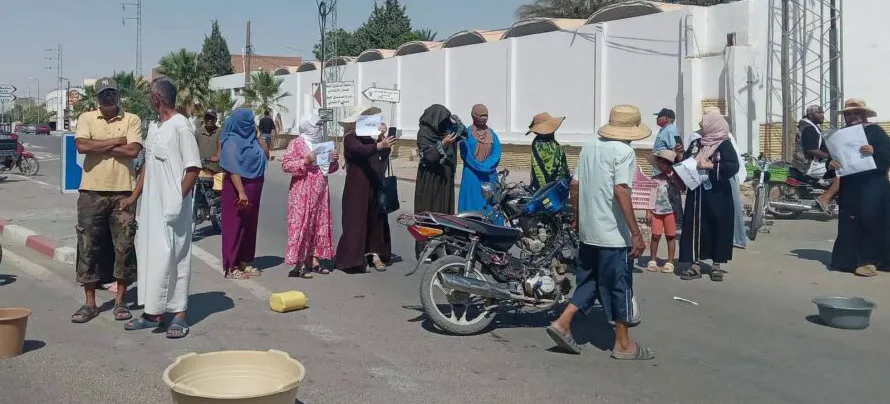
In recent years, water-related protests have shattered the narrative of a peaceful summer. This season, with the arrival of July and record temperatures exceeding 45 °C, water outages have become more frequent in various regions. This has sparked a wave of anger and protests in cities such as Métlaoui in the southwest, Touiref and Jendouba in the northwest, Kairouan in the center, and Thala in the central-west. Residents have blocked roads to draw the authorities’ attention.
It should be emphasized that the movement in Métlaoui—which arose primarily from the impacts of the local extractive industry and the wasteful use of water resources, and was led in particular by women during the first half of July—was the catalyst that spread the environmental protest movement to many other regions. The Métlaoui movement broke the wall of silence, restored trust, and served as a political and sociological driving force in the formation of numerous protest movements related to water scarcity, even though these movements have not yet transitioned from a non-political to a political phase.
These protests stem from the inability of Kaïs Saïed’s regime to address the economic, social, and environmental concerns of Tunisians. Water shortages, the spread of drought during periods of extreme heat, the collective memory of certain local communities—such as the mining community or that of Zaghouan—nurtured by tales of struggles and acts of bravery, as well as the role played by certain organizations and actors in organizing the protests, are all factors that have facilitated the emergence of these movements.
Conclusion
The continued use of the “quota allocation” system has not produced the expected results, given the lack of a clear and transparent mechanism to assess its effectiveness and its actual impact on the sustainability of resources or on meeting citizens’ basic needs. It is therefore necessary to suspend this system and conduct a comprehensive and independent assessment. Maintaining it without publishing scientific findings that establish its relevance perpetuates the lack of transparency surrounding the water situation and exacerbates the suffering of the population.
A structural reform of the water system is essential. It must give top priority to the maintenance and renewal of the networks in order to reduce the significant levels of water loss.
Environmental issues—like all others—must be addressed seriously from scientific, practical, political, technical, and even cultural perspectives. The accusations of treason leveled by President Kaïs Saïed, who attributes the repeated water outages to traitors plotting against the security and stability of the state, are nothing more than empty rhetoric and meaningless platitudes. They exacerbate the water and environmental crisis, expand the reach of thirst and marginalization, and risk destabilizing many local communities. They may also pave the way for the repression of these protests, given that the current political system is authoritarian and tends to criminalize civil, political, and protest activities.
References:
• WatchWater .
• TAP , article on improving dam fill rates.
• “ The Thirsty Classes in Tunisia,” Al-Khatt.
• Abdelkrim Daoud, “Fifty Years of Water Resources Management Policy in Tunisia: From Supply Management to Territorial Equity,” *Gouvernance*, vol. 3, no. 2, September 2021, pp. 9–35.
• Raja Kessab, “The Environmental, Social, and Cultural Effects of Dams,” in Large Dams: Development or Domination?, ed. Abdelmaoula Ismaïl, Dar Sefsafa, Egypt, 2021, p. 13.
• Ali Bouattour, “Climate Change and Its Impacts on the Livestock Sector in the Maghreb,” Health and the Environment in the Mediterranean Basin, Tunisian Academy of Sciences, Letters, and Arts, Beït al-Hikma, Tunis, 2011, p. 94.
• Haythem Kacem, “Climate Change and Technology in Tunisia: A New Green Revolution?” in *The Right to Resistance: Stories from Tunisian Farmers on Climate Justice*, Observatory on Food and Environmental Sovereignty, 2024, p. 10.
• “ Huge Profits and Market Monopoly: The Other Side of Water Resource Depletion by Water Bottling Companies in Tunisia.”
• WatchWater , Annual Report on Reports – Thirst Map 2025.
• Legal Agenda, “Heat Wave and Drinking Water Cutoffs: Thirst as State Policy.”
• Tunisian Water Observatory , Facebook post about Métlaoui.
• Legal Agenda, “Thirst in the Mining Villages.”
• “ The Thirsty Classes in Tunisia,” Al-Khatt.