Strikes, road blockades, spontaneous gatherings, burning tires, nighttime protests, environmental campaigns, and calls to action: July 2026 in Tunisia was marked by a series of movements that, despite the diversity of their demands, all expressed the same frustration with the deterioration of living conditions and the authorities’ inability to provide lasting solutions.
Far from being a mere juxtaposition of local or labor disputes, these protests are part of a nationwide resurgence of social protest. According to the Tunisian Forum for Economic and Social Rights’ barometer, 1,884 protests were recorded in the second quarter of 2026, compared to 1,310 during the first three months of the year—a 44% increase. The month of June alone saw 867 protests. Employment and labor demands remain the main reasons for protests, but protests related to water, electricity, and the environment are becoming increasingly prominent.
Metlaoui, a Symbol of Anger Over the Water Shortage
It was in Métlaoui, in the Gafsa Governorate, that anger over the water cuts was most visibly expressed.
On July 8, residents took to the streets and blocked several major roads to protest prolonged interruptions in the drinking water supply. Three days later, on Saturday, July 11, the protests spread to the neighborhoods of El Mziraâ and Cité des Jeunes. Fed up with several days of outages in the midst of a heat wave, residents blocked the city’s entrances and set tires on fire.
They denounced a situation that had become unbearable: the inability to meet even the most basic household needs, hygiene issues, disruptions to the water supply, and the lack of a clear response from the National Water Supply and Distribution Company.
There were at least three roadblocks in Métlaoui during the same week, a sign of persistent mobilization rather than a mere one-off reaction. In a town already plagued by unemployment, economic insecurity, mining pollution, and a sense of abandonment, the water issue has thus become the focal point of a much broader social discontent.
From Kef to Nabeul, roads are closed to secure (water)
The protest also spread to other regions.
In Ladhyab, in the Touiref district of the Kef governorate, residents organized a peaceful protest in mid-July and blocked the road to protest several weeks without drinking water. They called for urgent action by SONEDE (the National Water Supply and Distribution Company), repairs to the infrastructure, and the restoration of a regular water supply.
On July 21, in the towns of Nachaâ and Karmania and the surrounding villages in the Haouaria district, residents blocked the road connecting Haouaria to Tunis. The protest was in response to prolonged interruptions in the water supply and repeated malfunctions at the local water system.
The shortage did not affect only families. It also affected farmers and ranchers, particularly poultry farmers, who were faced with the shutdown of wells, pumps, and other equipment that relied on electricity.
On July 23, new road closures were reported in several towns in the Nabeul Governorate after several days without water or electricity.
Other protests were reported in Ben Arous, Djerba, and various rural and suburban areas. It was not possible to date or pinpoint the location of all of them with precision, as initial reports often circulated via videos, local Facebook groups, and posts by citizens.
Power outages are fueling anger and sparking nighttime protests
Starting on July 12, the water crisis was compounded by an increase in power outages.
In the midst of a heat wave, as temperatures reached or exceeded 49 degrees in some areas, several cities experienced repeated power outages, sometimes lasting several hours. These outages affected homes, businesses, pumping stations, agricultural facilities, and people who rely on medical equipment.
Between July 21 and 23, spontaneous gatherings and nighttime protests were reported in several regions. Residents took to the streets, blocked traffic, and demanded the immediate restoration of electricity and water service.
The lack of a transparent schedule for power outages and the unpredictable nature of the outages exacerbated residents’ sense of being abandoned. Residents did not know when the power would be cut off, how long the outage would last, or what time service would be restored.
Social media played a central role in this mobilization. Videos showed neighborhoods plunged into darkness, citizens protesting in the streets, and shopkeepers lamenting the spoilage of their merchandise.
The backlash was also fueled by official explanations that were deemed insufficient or out of touch with reality. A statement by an official from the National Agency for Energy Management attributing part of the crisis to “technological progress” and the proliferation of electrical appliances sparked a wave of sarcasm and anger online.
After more than ten days of disruptions, Kaïs Saïed convened a meeting with the key officials involved. However, his insistence on the allegedly “abnormal” nature of certain outages and on the possibility of acts intended to stoke public anger was perceived as an attempt to pin criminal blame rather than to explain the network’s technical, financial, and structural failures.
Delivery drivers for online platforms are launching a nationwide strike
Social unrest was not limited to public services.
Over the weekend of July 11 and 12, delivery drivers working for food delivery platforms staged a nationwide strike. They protested their low wages, the lack of social benefits, rising fuel prices, the cost of maintaining their motorcycles, and the cost of the phone service essential to their work.
In particular, the delivery drivers were calling for the establishment of a minimum rate of three dinars for trips between zero and three kilometers, separate payment for each order, and an end to the practice of combining multiple deliveries into a single payment.
They also demanded genuine freedom to log in and out of apps, as well as a contractual guarantee of a minimum daily wage of 80 dinars for eight hours of actual work.
This movement has shed light on a category of workers who are often portrayed as self-employed but who, in reality, remain heavily dependent on the platforms’ unilateral decisions: changes to rates, assignment of rides, ratings, account suspensions, and a lack of coverage in the event of an accident.
The delivery drivers’ strike thus raised—beyond the issue of pay—the question of the legal status and social protection of workers in the digital economy.
Taxis, shared rides, and rural transportation on strike
On July 13, a nationwide general strike took place in the non-scheduled public passenger transportation sector.
The strike, scheduled to take place from 5 a.m. to 9 p.m., involved private and shared taxis, tourist taxis, hire cars, and rural transportation services. The drivers were protesting the authorities’ failure to honor the commitments made in the spring, the stalling of their professional applications, and the lack of a fare adjustment despite rising operating costs.
In particular, industry associations were calling for rates to be adjusted to reflect the actual costs of fuel, maintenance, replacement parts, insurance, and vehicles.
However, participation varied by city and category. Some stations remained deserted, and passengers faced significant difficulties getting around, while in other regions, taxis and shared-ride vehicles continued to operate. The strike therefore did not result in the nationwide shutdown that had been predicted, but it did confirm the depth of the discontent within the sector.
An initial strike had already been reported on July 3 among the same professions, prior to the resumption of the national mobilization on July 13.
Gabès: The Fight Against Pollution and Poisonings
In Gabès, the protests have taken on an environmental and health dimension.
Following several incidents of Ghannouch poisoning, dozens of cases of choking were reported during the night or at dawn on July 22 in Chott Essalem. Gas emissions from the Chemical Group’s facilities are also said to have affected several neighborhoods in Gabès City, Gabès-Sud, Bouchemma, and Chott Sidi Abdel Salam.
The Stop Pollution campaign denounced yet another threat to residents’ health and called for continued grassroots mobilization. It demanded the launch of a thorough and independent investigation, the disclosure of the nature of the substances released, the immediate shutdown of hazardous facilities, and the enforcement of the June 29, 2017, decision calling for the dismantling of polluting facilities.
For activists, these poisonings are neither accidental nor isolated incidents. They are the result of an outdated industrial system and years of broken promises.
The campaign noted that the residents of Gabès had already organized major protests the previous year to demand the shutdown of the most polluting facilities and the adoption of a development model that respects health, the environment, and human dignity.
His slogan summed up the local sentiment: “Gabès is suffocating, but Gabès will not be silenced.”
In Tunis, protesters are calling for an end to the chaos and arbitrary rule
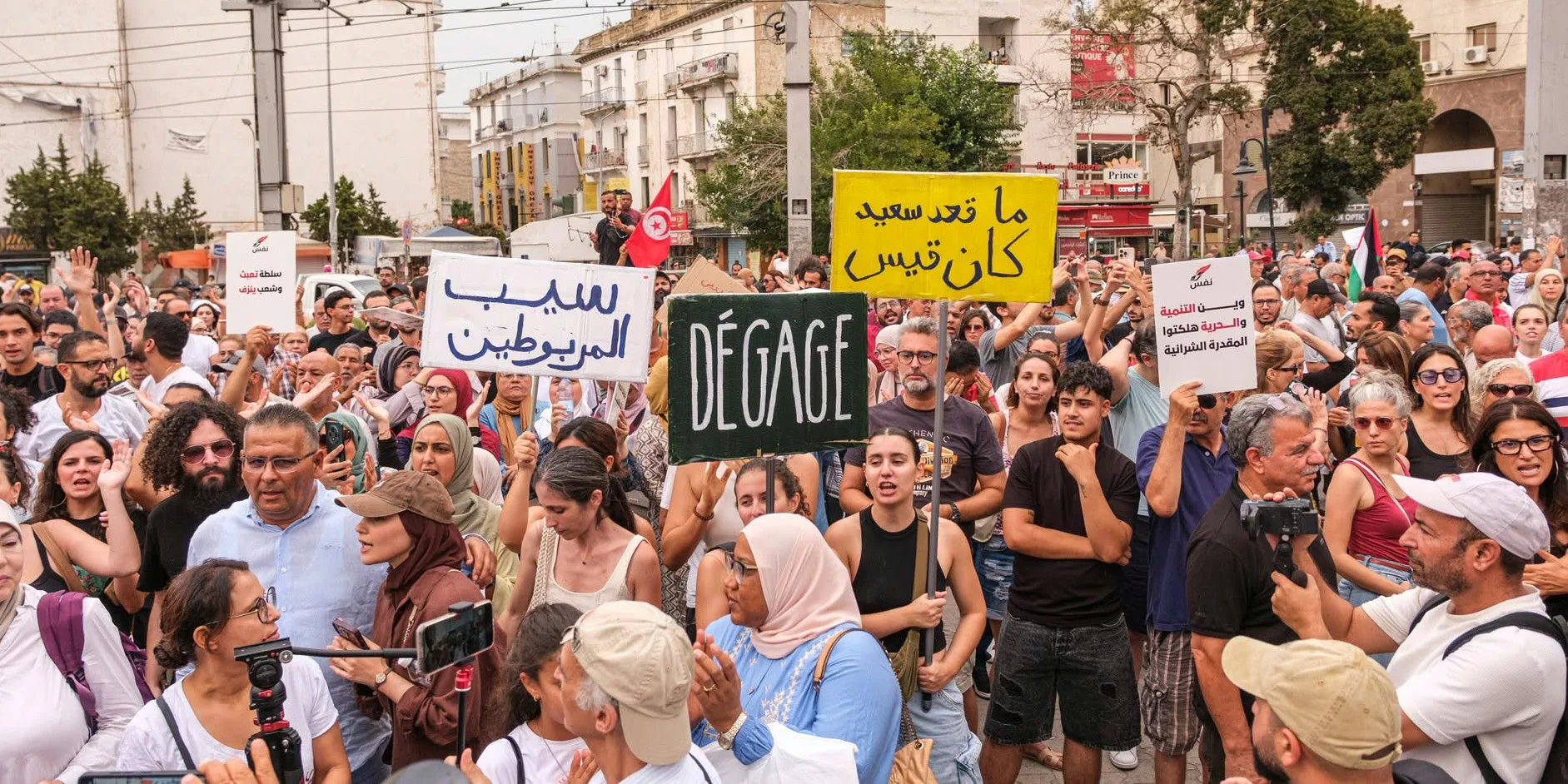
On July 25, 2026, several thousand people demonstrated in downtown Tunis at the call of Nafas Tounes, joined by political parties, civil society organizations, and the families of political prisoners. Held under the slogan to put an end to the “العبث” (nonsense) —denouncing both political arbitrariness and poor governance that are plunging the country into an unprecedented crisis—the march combined democratic and social demands. The demonstrators demanded the release of political prisoners, the restoration of civil liberties, an independent judiciary, and a return to the rule of law. They also expressed their frustration over water and electricity outages, the deterioration of public services, the high cost of living, and the lack of solutions to their daily hardships. To chants of “Freedom! , ” “Get out!, ” “The people want the regime to fall, ” “Water is a right, not a privilege, ” “No to power outages, ” and “Jobs, freedom, national dignity, ” the demonstrators turned July 25 into a day of protest against five years of authoritarianism and what they deemed disastrous governance of the country.
The municipal sector is gearing up
In the municipal and waste management sectors, the General Federation of Municipal Workers, affiliated with the UGTT, has denounced the breakdown in dialogue with the supervising authority and the accumulation of unresolved labor, social, and financial issues.
She drew attention to the aging vehicle fleet, the dangerous condition of the equipment, the lack of protective gear, the rising number of workplace accidents, and the uncertainty surrounding the future of employees in the waste management sector.
The Federation has called on local and regional unions to hold meetings with employees to identify their demands and to establish a sector-specific administrative committee tasked with determining the forms of action to be taken.
At this stage, it is more a matter of preparing for action than of an actual strike. But the statement indicates that a new social front could emerge if negotiations do not resume.
Social demands that affect all sectors
Beyond the most visible movements, data from the FTDES reveal a much broader wave of protest.
Unemployed graduates continue to demand employment and the implementation of regularization agreements. Doctors and healthcare workers are speaking out against their working conditions. Employees of banks, public companies, and government agencies are protesting against late payments, insufficient wages, and the failure to implement agreed-upon collective bargaining agreements.
Farmers are taking action to secure access to irrigation water, while residents in several regions are speaking out against sanitation problems, industrial pollution, and inadequate public services.
In addition to these economic and social demands, there have been demonstrations in support of civil liberties: rallies in support of political prisoners, protests against trials and arrests, and campaigns for freedom of expression, freedom of the press, and freedom of association.
The movements have not yet coalesced into a coordinated national mobilization. Each sector is acting on its own priorities. But the accumulation of these actions reveals a common phenomenon: a growing segment of the population no longer believes that standard administrative procedures can provide solutions.
From Individual Complaints to Street Protests
What sets July apart is the rapid transition from complaint to class-action lawsuit.
Citizens often start by posting photos, videos, or appeals on social media. When authorities or public entities fail to respond, the protest moves to the streets: road blockades, rallies in front of government buildings, burning tires, strikes, or work stoppages.
The road thus becomes a means of forcing the authorities to listen to communities who feel they have no one else to turn to.
This trend is particularly evident in water-related movements. What was once portrayed as a temporary technical glitch is now seen as a violation of the right to live with dignity and as the result of years of underinvestment, mismanagement, and regional disparities.
A scattered anger, but one that is becoming less and less contained
The protests in July remain, for the most part, local, sector-specific, and defensive. Residents are demanding water and electricity; delivery workers are calling for fair pay; transport workers want a revision of fares; municipal workers are demanding safe equipment; and the residents of Gabès are defending their right to breathe.
There is not yet a national coordinating body that brings these various movements together under a common platform.
But the fact that these events are occurring simultaneously is politically significant. It shows that discontent is no longer limited to political, labor union, or civic circles. It is spreading to a wide variety of groups, many of which are mobilizing outside traditional frameworks.
The heat wave served as a wake-up call. It did not cause the water, electricity, transportation, or pollution crises. Rather, it made their consequences immediate, physical, and sometimes dangerous.
In homes without water, in neighborhoods plunged into darkness, on the blocked roads of Métlaoui and Haouaria, among motorcycle delivery drivers, taxi drivers, and the suffering residents of Gabès, a shared conviction is taking hold: the hardships are no longer temporary, and promises are no longer enough.
The streets are thus once again becoming one of the main venues for expressing social discontent. Behind the diversity of demands, a single call is being heard: the right to water, electricity, decent work, health care, a livable environment, and public services capable of meeting the basic needs of the population.