Introduction
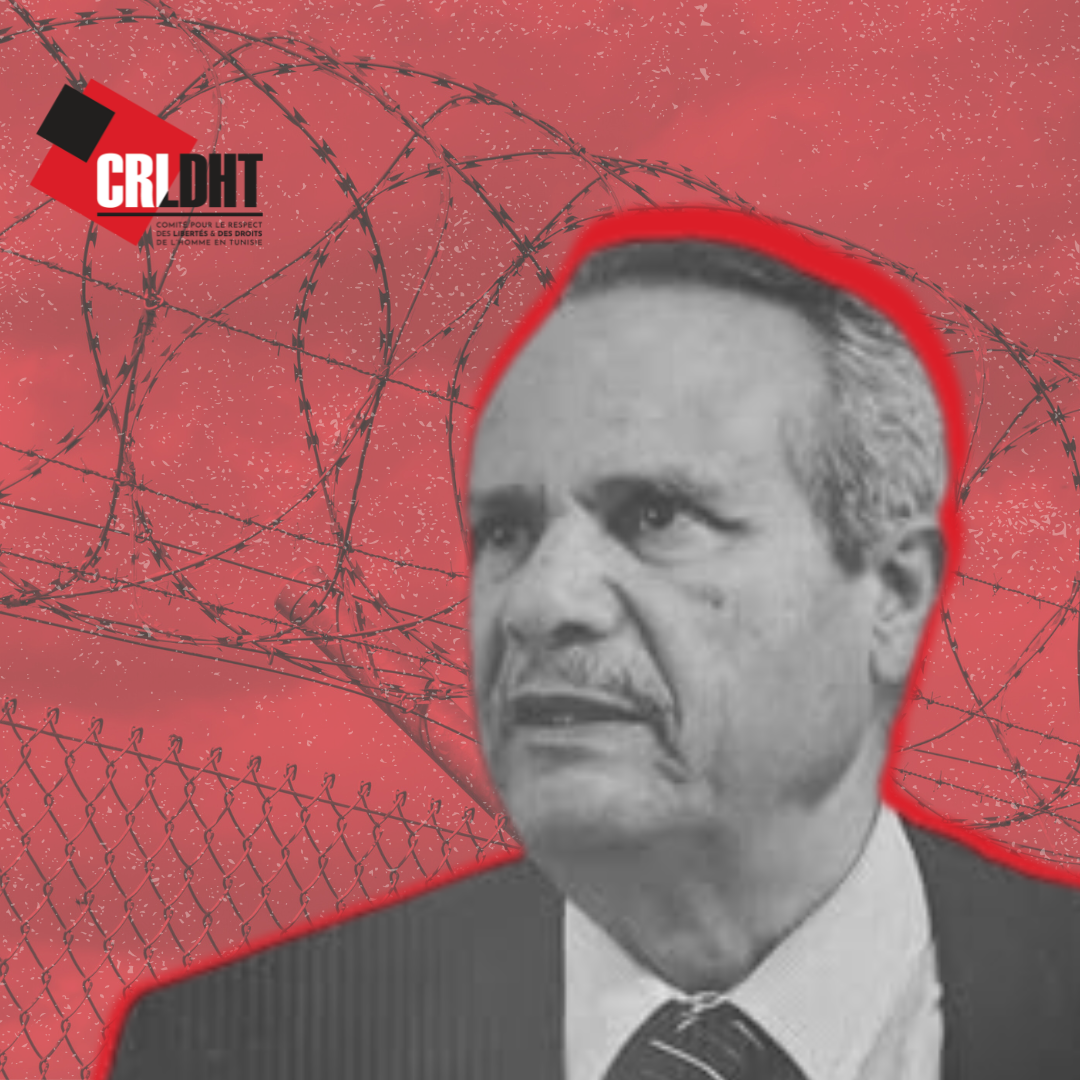
In May 2024, Mustapha Jemmali, a Tunisian humanitarian activist and President of the Tunisian Refugee Council, was arrested and charged with offences relating to the provision of assistance, including accommodation, to sub-Saharan migrants. His arrest, in a context of increasing repression against human rights defenders, symbolizes the systematic criminalization of solidarity in Tunisia since the authoritarian drift set in motion by President Kaïs Saïd.
A commitment to human rights
A lawyer by training, Mustapha Jemmali is a graduate of the Sorbonne University in Paris. He has dedicated more than two decades of his professional life to the protection of refugees within the United Nations. An international official with UNHCR for 24 years, he held a number of positions of responsibility around the world, before becoming Director of the Office for Central Asia, South-West Asia, the Middle East and North Africa until 2004. He was also Special Advisor to the United Nations High Commissioner for Refugees.
After leaving the United Nations, he continued his commitment as Regional Representative for the Maghreb of the International Centre for Migration Policy Development (ICMPD). In 2016, he founded the Tunisian Refugee Council (CTR), which he has headed ever since, with the mission of guaranteeing protection, dignity and rights for exiled people in Tunisia.
... now a crime...
Mustapha Jemmali is well known for his work on behalf of exiled people, particularly refugees and asylum seekers abandoned on the margins of Tunisian society. His NGO provided vital support: accommodation, legal assistance, access to healthcare and psychological support. On May 3, 2024, it was precisely this humanitarian mission that led to his being remanded in custody on the orders of the public prosecutor's office, on charges of "forming a conspiracy to facilitate the illegal entry of migrants into Tunisia".
According to the Tunisian authorities, the arrest was linked to the publication of a call for tenders by the association for the rental of a hostel for asylum seekers. This pretext, which proves that the association's action was legal and transparent (administrative), masks poorly (reality) the clear desire to silence a disturbing voice in a country where the defense of migrants is assimilated to a form of political subversion.
... in a context of systemic repression
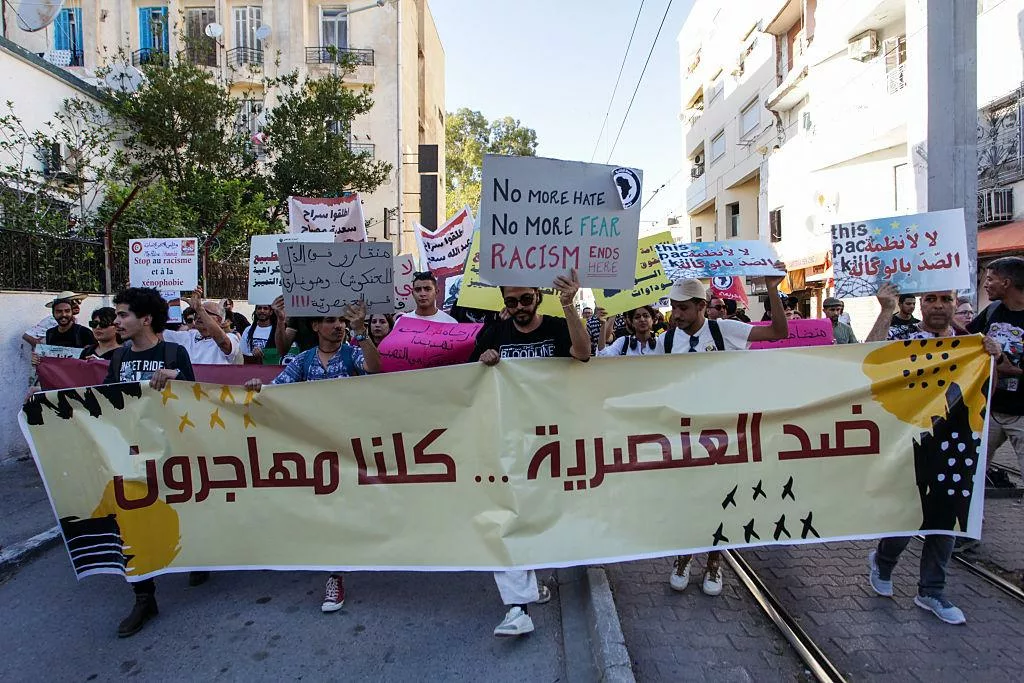
Since 2021, and more particularly since President Kaïs Saïd's xenophobic speech in February 2023, Tunisia has entered a phase of systemic repression against sub-Saharan migrants and those who come to their aid. Raids, mass expulsions to the Libyan desert, racist attacks and police violence have multiplied, creating a disastrous humanitarian situation condemned by the United Nations, the European Union and numerous international NGOs.
But instead of heeding these warnings, the Tunisian authorities stepped up their repression. Civil society figures such as Saadia Mosbah, Abdallah Saïd, Mustapha Jemmali and Cherifa Riahi were arrested. Some associations were forced to close.
A diplomatic double standard
In parallel with this policy of terror, the Tunisian state continues to boast, in its reports to international bodies, of its commitment to human rights and its cooperation with civil society. In an official communication to the United Nations (HRC/NONE/2025/SP/3), the authorities claim that Mustapha Jemmali benefited from all legal guarantees, and that his arrest was based on duly established facts. This line of defense, which is purely formal, conceals the political context of repression and the objectives of dissuading activists.
The complicit silence of the European Union
This climate of repression is fuelled by the unconditional support of the European Union, which has provided Tunisia with over 150 million euros under migration agreements. A damning report, State Trafficking, showed that these funds were used to finance experiments in "migrant hunting", collective deportations to Libya, and even the sale of migrants to Libyan militias. In this system, NGOs are seen as obstacles to progress.
Conclusion: solidarity on trial
Mustapha Jemmali should not be in prison. He should be protected, supported and recognized for his commitment. His incarceration is not a judicial accident, but the expression of a political strategy of terror aimed at disarming solidarity.
The examining magistrate has repeatedly refused his provisional release, despite his age (over 80), his state of health (chronic illness) requiring appropriate medical treatment that the prison administration cannot provide, and the fact that he presents no danger to society.
Given the lack of factual evidence against him, we are led to believe that he is being repressed for his humanitarian work and UN career, which make him a prime target for a regime that prides itself on harassing human rights activists.
Nothing other than inhuman treatment can explain why Mr. Jemmali is deprived of his liberty, when the expert report and the entire case file attest that no offence can reasonably be imputed to him. On the other hand, he is deprived of medication and treatment appropriate to his state of health, which is deteriorating, not least as a result of the mental torture to which he is subjected. For example, he has been refused glasses to prevent him from reading.
The examining magistrate in charge of the case persists in refusing any request for provisional release and does not hesitate to threaten him with xenophobic and racist remarks, as was the case on March 25, 2025, in order to increase his moral torment.
The unjustified adjournment of the confrontation hearing to April 7, 2025 is a further manifestation of this unprecedented persecution of human rights activists.
It's time for the international community to demand his release, to suspend the aid that fuels repression, and to recognize that what is at stake in Tunisia is not just a matter of foreigners' rights, but a universal struggle for human dignity.