Since 2021, the migration question has become a central issue not only in Tunisia's external relations, notably with the European Union (EU), but also in its internal political dynamics. The instrumentalization of this issue by the Tunisian government has resulted in the criminalization of solidarity with migrants and the repression of associations and government critics. Through this double reading, the management of migratory flows becomes a barometer of the state of fundamental freedoms in Tunisia.
I. Migration: a central theme in Tunisia-EU relations
Cooperation between Tunisia and the EU has strengthened in recent years, with migration as a focal point. The EU has stepped up initiatives to outsource border control to Tunisia, through funding agreements and strategic partnerships. In July 2023, a memorandum of understanding was signed, allocating 150 million euros to strengthen Tunisia's capacities in border control and the fight against irregular migration. However, this agreement drew criticism, notably from the European Parliament, which pointed to the absence of a human rights impact assessment (HRIA) prior to its implementation.
This cooperation has reinforced the militarization of borders and the outsourcing of migration management responsibilities, but it has also resulted in systematic violations of migrants' fundamental rights. Forced displacements, arbitrary expulsions and acts of violence against sub-Saharan migrants have been documented by numerous NGOs, such as Human Rights Watch and the Tunisian Forum for Economic and Social Rights (FTDES). These practices reached a climax in 2023, when several hundred migrants were abandoned in dangerous border areas with Libya and Algeria.
II. Xenophobic discourse and migration policies
The major turning point in Tunisian migration policy came in February 2023, with an openly xenophobic speech by President Kaïs Saïd. At a meeting of the National Security Council, he claimed that sub-Saharan migrants were part of a plot to alter Tunisia's demographic composition. This speech, inspired by the conspiracy theory of the "Great Replacement", had immediate and serious consequences: an increase in racist attacks, forced expulsions and a tightening of security measures.
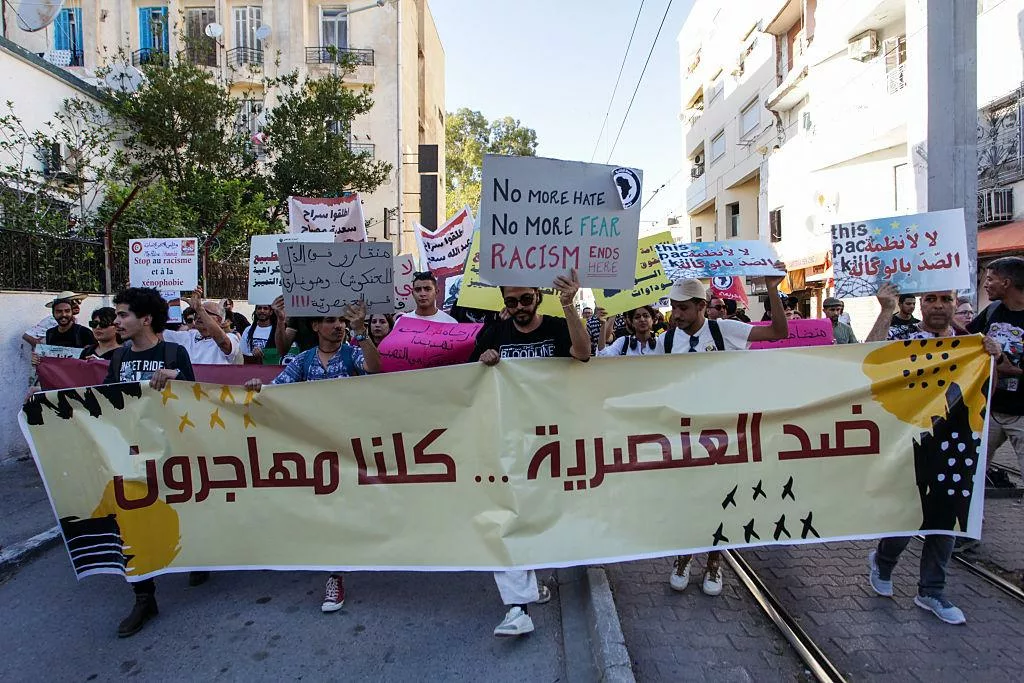
Despite the President's attempt to backtrack, stating in March 2023 that his words had been misunderstood, violence against migrants continued. The creation of militias, mainly in regions such as Sfax, led to migrant-hunting campaigns, often encouraged by official statements. At the same time, civil society associations such as Mnemty and Tunisie Terre d'Asile condemned the violence and denounced the government's racist policy.
III. The criminalization of solidarity with migrants: a tool of repression
The fight against irregular migration has also become a pretext for repressing opponents of the regime. The criminalization of solidarity has manifested itself in the arbitrary arrest of activists and association leaders, on spurious charges such as undermining state security or aiding illegal immigration. Among the emblematic figures affected are Saadia Mosbah and Mohamed Jouou, (you can name others like Riahi ...) who were detained for providing humanitarian support to sub-Saharan migrants.
Tunisian laws, particularly repressive penal provisions such as Decree-Law 54 of 2022, have been widely used to muzzle dissenting voices. This decree, initially intended to combat false information, has become a tool of massive repression against journalists, lawyers and activists. In 2024, more than 1,700 people were prosecuted under Article 24 of this decree, including activists engaged in actions in solidarity with migrants.
IV- Migration and the erosion of human rights: a systematic erosion of freedoms
The authoritarian management of migration in Tunisia is closely linked to the regression of human rights. Kaïs Saïd's coup d'état on July 25, 2021 led to a series of restrictive measures that dismantled democratic institutions and reduced the space for freedom. The dissolution of the Supreme Council of the Judiciary in February 2022 and the concentration of judicial and legislative powers in the hands of the President made it impossible to control authoritarian excesses.
In this context, migration has become an indicator of the degree of freedom and democracy in Tunisia. The absence of a clear legal framework for the protection of migrants, combined with repressive criminal laws, has created an environment conducive to systematic human rights violations. Sub-Saharan migrants, often forced to live in precarious conditions and deprived of access to essential services such as health and education, are victims of de facto segregation.
V- International reaction: a timid mobilization
Faced with authoritarian excesses and human rights violations, several international organizations have reacted by calling on Tunisia to respect its international commitments. In 2023, the Office of the United Nations High Commissioner for Human Rights denounced the Tunisian government's racist and discriminatory practices, calling for an immediate halt to collective expulsions and violence against migrants. The World Bank temporarily suspended its cooperation with Tunisia following Kaïs Saïd's xenophobic speeches.
However, international mobilization remains insufficient in the face of the scale of the violations. Diplomatic pressure must be stepped up by making financial aid conditional on effective respect for human rights. In addition, the EU must assess the impact of its migration policies on the human rights situation, and adopt stricter control mechanisms to ensure that its partnerships do not encourage abuses.
Conclusion: migration and freedom, an interconnected struggle
The migration issue in Tunisia goes far beyond the framework of policies for managing the flow of people. It has become a human rights issue, a barometer of freedoms and an instrument of political repression. The erosion of freedoms in Tunisia today is a global phenomenon in which the fight against irregular migration is used as a pretext to muzzle critical voices and reinforce authoritarian power. Restoring democratic gains in Tunisia therefore requires both national and international mobilization, together with increased support for human rights defenders and the most vulnerable populations.