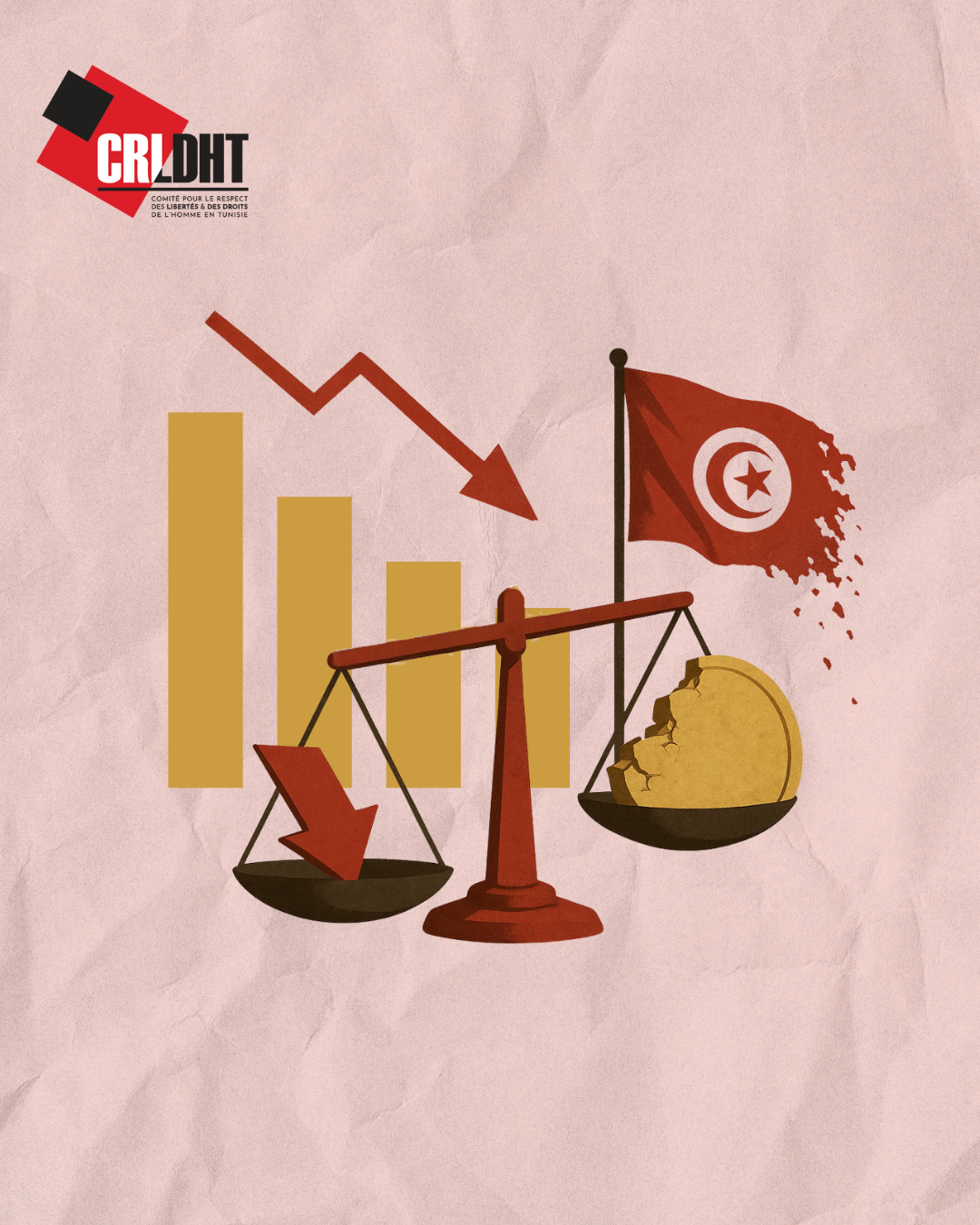
The Tunisian trade deficit reached 8,367.2 million dinars at the end of May 2025. This compares with 6,548.6 million for the same period in 2024, and 6,561.1 million in 2023. In two years, this means an additional net loss of almost 2 billion dinars for the country, at a time when every millime counts. But this figure alone doesn't tell the whole story: it's not just a worrying economic indicator - it reflects a deeper imbalance, the collapse of the productive apparatus and the failure of an economic policy without a compass, exacerbated by the authoritarian personalization of power.
What does this deficit really mean?
The first obvious fact is that Tunisia continues to consume more than it produces - and produces poorly. To a certain extent, a trade deficit can be explained by investment choices, or by temporary external constraints. But in this case, the steady increase in the deficit over the past three years is not backed by any industrial strategy, any move to upscale exports, any effort at structural transformation. It's a spiral of dependence.
In detail, imports grew faster than exports, with an energy balance of -3,918.2 MD) continuing to plague external accounts. Even more striking, exports from the agricultural sector - an area in which Tunisia has real potential - fell by -22.6% in one year. In concrete terms, this means that we are importing more manufactured goods, energy and even foodstuffs, while Tunisian products are losing competitiveness.
In short, Tunisia doesn't sell enough, buys too much and has neither an industrialization plan nor a trade policy worthy of the name. The country is structurally in deficit - and politicians are looking the other way.
And what do the powers that be say?
On the government side, the discourse remains vague, sometimes even incantatory. Since his coup de force in July 2021, Kaïs Saïed has said little about economic issues. When he does talk about them, it's often to designate scapegoats ("traitors", "corrupt", "speculators") or to put forward symbolic watchwords - like the now-famous slogan "البناء والتشييد" (construction and edification), supposed to embody a phase of national refoundation.
But this slogan, hammered home in official speeches, is cruelly at odds with the reality on the ground: no structuring projects, no massive public investment, no clear vision for reviving the industrial fabric. There's talk of building, but nothing is being built. A renaissance is proclaimed, while indicators plunge. The contrast is striking: the more the rhetoric claims to mobilize, the more the facts reveal inaction, fragmentation of the State and economic stagnation.
The regime's rhetoric is based on an implicit promise: to give power back to the people and get the economy back on track. But four years after the authoritarian turn, no structural reforms have been undertaken: no tax reform, no civil service reform, no real boost to public or private investment. Worse still, relations with international donors are at a standstill. The IMF remains deadlocked, and the State is multiplying its appeals to the diaspora to find liquidity. Promises are being sold where there should be a vision.
An economic crisis or a regime crisis?
It would be a mistake to separate these figures from the political context. Here, the trade deficit is not simply a macroeconomic statistic: it reveals a closed system, in which all checks and balances have been dissolved, the government has been reduced to a docile administration, and economic decisions are made in a climate of opacity. Kaïs Saïed has opted for solitary, vertical governance, distrustful of both economic elites and international institutions. But this stance has led to paralysis: no one is making decisions, no one is investing, no one is anticipating.
The truth is that the Tunisian state is now operating in permanent crisis management mode, with no horizon. The economy, for its part, responds to this unpredictability with a headlong rush: imports to satisfy domestic demand, disengagement from productive sectors, and marginalization of small producers who no longer have public support.
What it means
The widening trade deficit in 2025 represents a regime in crisis. As long as Tunisia does not regain a clear, democratic political framework capable of re-engaging with credible partners, no economic revival will be possible. The balance of trade is unbalanced because the country is unbalanced. Distrust - on the part of investors, partners and citizens themselves - is evident in every dinar lost.