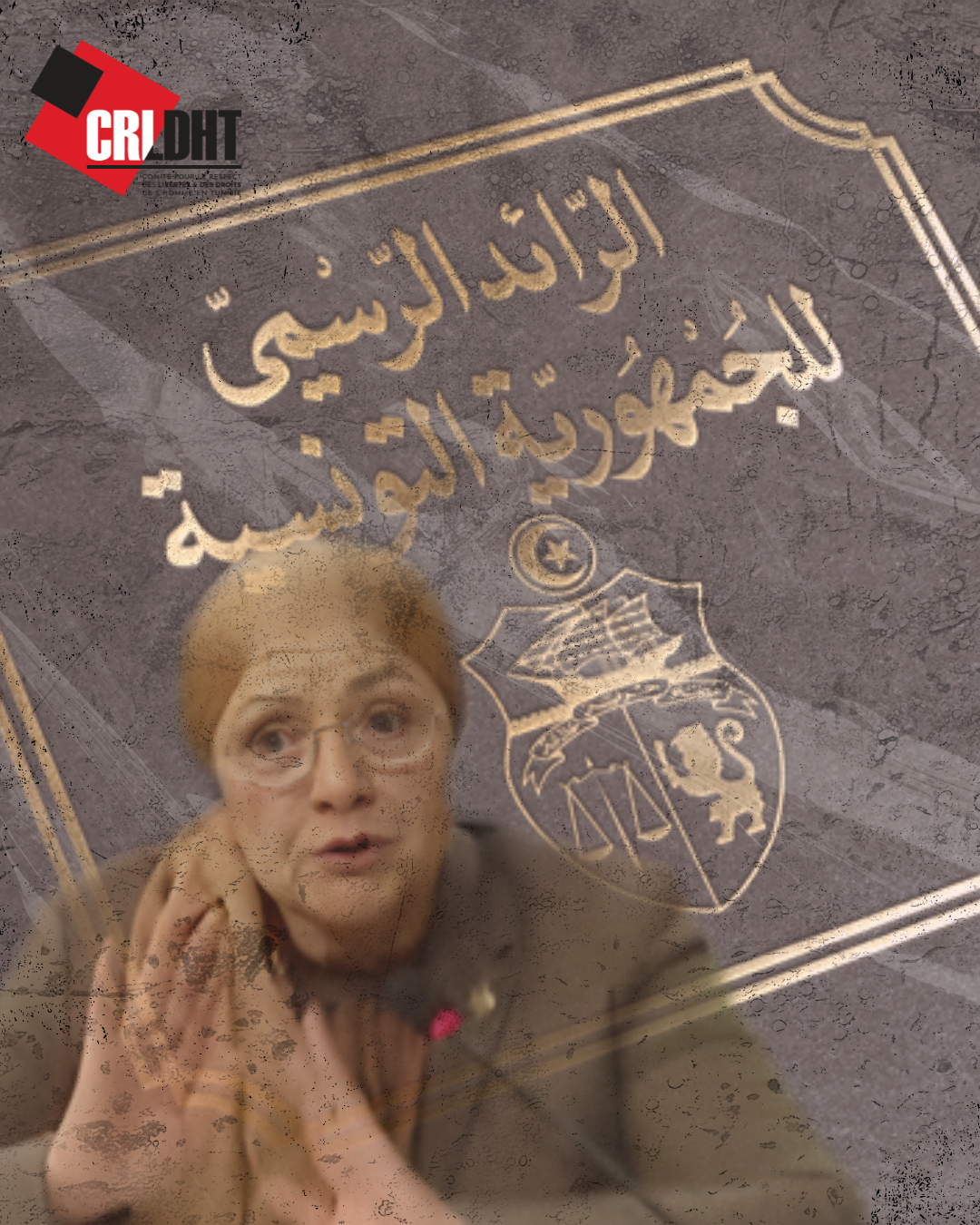
A few days after Minister of Justice Leila Jaffel's irresponsible and indecent statements to the Assembly of People's Representatives, here she is with this decree n°464/2025 of November 24, 2025, published on the 25th of the same month in the Official Gazette of the Tunisian Republic, which calls into question the survival of the institution of the Superior Council of Magistrates (CSM).
This is, of course, the provisional High Council of the Judiciary set up by Presidential Decree-Law no. 11/2022, which dissolved the legally elected High Council and repealed an organic law organizing it. Needless to say, this was in violation of the 2014 Constitution in force at the time, flouting the principle of the hierarchy of legal norms and the principle of parallelism of forms on the basis of Presidential Decree 117/2021. The African Court of Human and Peoples' Rights therefore rightly ordered the annulment of presidential decree 117/2021 (aff. B.Belghith Vs republique Tunisienne 17/2021 du 22 sep 2022) and decree-law 11/2022 (aff.S.Zorgati Vs republique Tunisienne 16/2021 du 24 nov 2024) and ordered the suspension of the application of presidential decree-law 35/2022 and decree 516/2022 relating to the dismissal of judges by the President of the Republic as provisional measures (aff. H.Rahmani et al Vs republique Tunisienne le 03 oct 2024).
Of course, the Kais Said regime has not complied with any of the aforementioned African Court rulings, or even the decisions to stay execution of decree 516/2022 ordered by the first president of the administrative court.
Article 117 of the 2022 constitution drafted by Kais Said stipulates that the judiciary is independent, even when reduced in function. This seems to confirm the decree-law 11/2022 establishing the provisional CSM and the new text governing the professional career of magistrates. Article 14 of the decree-law states: "Each Provisional Council deliberates on matters falling within their remit, and on all matters concerning the functioning of justice within their remit. "Article 15 paragraph 1 deals precisely with the competence of the provisional councils: "Each provisional council of the judiciary is responsible for preparing the annual movement of magistrates, i.e. appointment, assignment, promotion, transfer and dismissal, as well as requests for waiver of immunity and resignation." Promotion, in particular change of rank, is the exclusive competence of the council responsible for magistrates affected by the Minister's decree, i.e. the provisional council of the judiciary. As regards procedures, article 18 states: "Each of the three Councils prepares the movement of the judicial, administrative and financial magistracy and then forwards it to the President of the Provisional Higher Council of the Magistracy, who in turn forwards it to the President of the Republic, within a period not exceeding ten (10) days...". The President of the Republic signs the movement and publishes the decisions if he does not object to them within the meaning of article 19 by presidential decree, as specified in article 21.
Does this mean that Kais Said has insisted on implementing his own 2022 constitution and its decree laws against all odds?
The answer can only be negative, for both factual and political reasons.
De facto Kais Said does not respect his texts
First of all, it should be noted that the text published in the JORT is merely a decree issued by the Minister of Justice, not a presidential decree as required by article 21 of Presidential Decree-Law 11/2022. Moreover, there is no mention in any article of the publication by ministerial decree of a decision concerning the professional careers of magistrates.
As to the substance, the more or less exclusive powers of the provisional CSM imposed by Kais Said in decree-law 11/2022 can only be exercised if the quorum required for each provisional council to reach a decision is possible, whereas the provisional council of the judiciary cannot hold its meetings for lack of a quorum as defined in article 27 of decree-law 11/2022, i.e. 5 members. As pointed out in the press release issued by the magistrates' association on November 24, 2025, the positions of First President of the Court of Cassation, the Advocate General of the Court of Cassation, the President of the Real Estate Court and the Director of Judicial Services are vacant, paralyzing the Higher Council of the Judiciary. The idleness of the President of the Republic with regard to these shortcomings can only be a deliberate choice, if not a policy.
Disrespect for these texts is a policy of the regime
Although she is a magistrate by training and career, she did not seek in her speech to distance herself from the courts or magistrates by replying to the more or less virulent criticisms of the deputies. On the contrary, she responded by assuming responsibility for the criticized judicial decisions, as much as to say that she was at the origin of them.
For the Minister, a Higher Council of the Judiciary is no guarantee of justice, arguing that when there was a CSM before 2021, there was no justice. It's not hard to recognize Kais Said's populism in the Minister's remarks, but what's more serious is that she seems to be advocating the dissolution or freezing of this provisional CSM, which is in no way independent.
Order 464/2025 and the fate of the CSM
Decree 464/2025 apparently sounds the death knell for this provisional CSM, abandoned by its creator, who prefers more prosaic control of magistrates using the old recipe of stick and carrot politics. The stick, of course, comes in the form of the dismissal of a magistrate by presidential decree, with all the judicial and media harassment that this entails, or, more frequently, in the form of memos from the Minister of Justice, who has no hesitation in transferring or freezing any magistrate who dares to defy the instructions of the executive. These memos have also promoted the most docile and loyal magistrates in the service of the regime, and for promotions in rank, this decree fills this prerogative of the CSM, doomed to disappear, and provides the carrot for the regime's protégés.
The most blatant case of course is Farouk Bouassker, president of the elections authority ISIE, for his sincere and loyal services to Kais Said, who distorted the presidential elections of October 06, 2024, reducing them to an expression of allegiance to the president, the only true candidate tolerated. Under the presidency of F. Bouassker, the ISIE has not ceased to lodge complaints on the basis of article 24 of the decree-law against all dissidents or those who criticize the violations that the ISIE has perpetuated.
But apart from the president of the ISIE, who has risen to third place, there are also quite a few magistrates who have ruled on and carried out the Minister's instructions in trials politicized in favor of Kais Said's conspiracy narrative, some of whom were even the Minister's spearhead with a sulphurous reputation, such as Hanen Kadess, who was at the public prosecutor's office of the anti-terrorist pole of the Tunis court of first instance.
Admittedly, some magistrates have had access to their normal right to promotion, but the form is lacking.
There is a real risk that the CSM, even in the bad version conceived by Kais Said, will become a distant memory of the period when the counter-revolution needed to show its credentials.