Kaïs Saïed's police continue to kill with impunity
Violence committed by police officers did not begin with Kaïs Saïed. Under Bourguiba, it was difficult to document such incidents outside of major political and social crises. Under Ben Ali, torture and violence against opponents became systematic, and the rise of the Internet and independent media helped bring these abuses to light.
After the 2011 revolution, the authorities promised security that respected human rights. Reforms were proposed, but they did not bring about lasting changes in practices. The corporatist nature of the security forces, pressure from their unions, and the lack of firm judicial responses limited the reforms’ impact. The case of Omar Labidi, who died in 2018 after being chased by police officers, remains emblematic of the difficulties in establishing accountability and obtaining justice.
Since July 25, 2021, official statements have emphasized the authority of the state and the role of its security forces. But authority cannot be reduced to command alone: it also involves preventing abuses, overseeing officials, and ensuring accountability. The deaths that occurred on October 20 and 21, 2026, under different circumstances, demonstrate just how urgent this need is. Two cases, in Jbeniana and Ettadhamen, directly implicate police actions. To date, the accounts remain disputed and responsibility has not been established.
Jbeniana: Aoun Salhi Dies After a Police Chase
On October 21, 2026, Aoun Salhi, 24, died in Jbeniana, in the Sfax Governorate, following a police chase while he was riding a motorcycle. According to eyewitness accounts reported by Nawaat, the motorcycle was struck from behind by a police vehicle. Aoun Salhi reportedly lost his balance, fell, and was then run over. His family and local medical sources reported serious injuries. However, the circumstances must be determined by an investigation. Nawaat
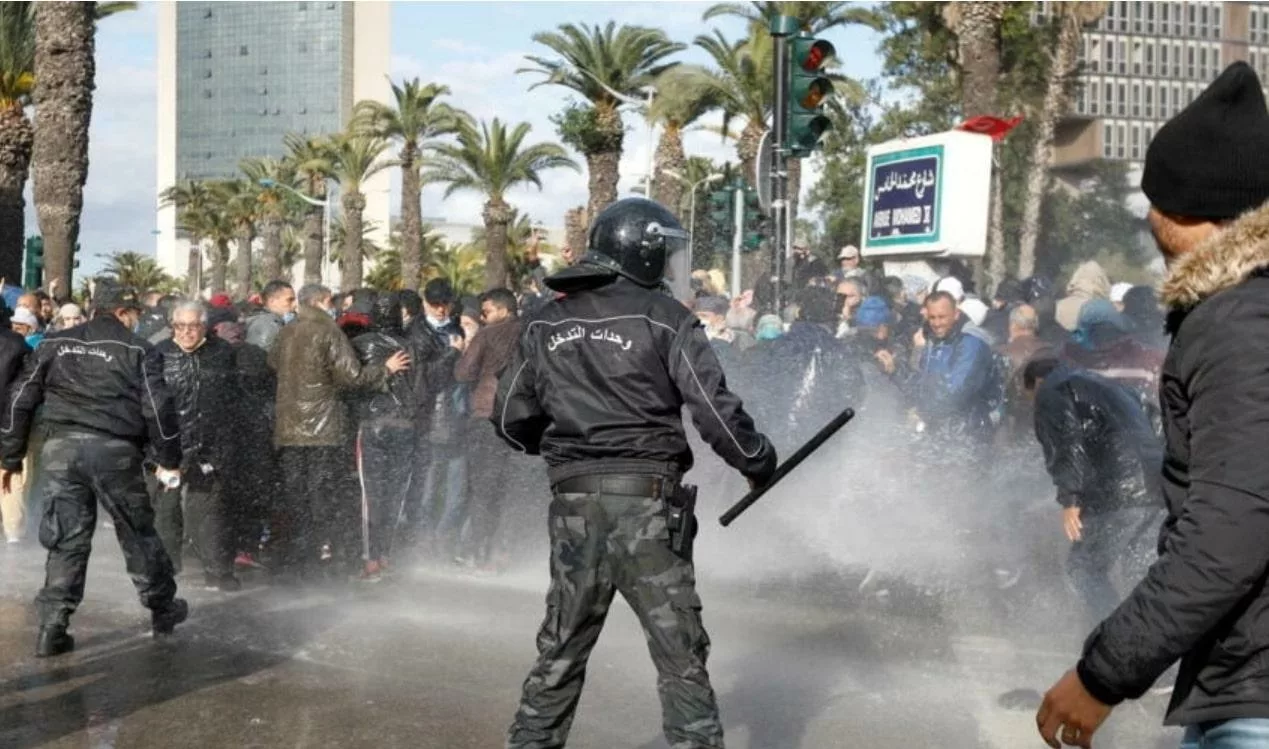
The young man’s death sparked protests and clashes with law enforcement. Residents called for a thorough investigation, the publication of its findings, and the identification of those responsible. Classes were suspended at several schools, and businesses closed, largely due to the use of tear gas. The funeral took place on October 22.
The outrage also stems from a painful precedent: in December 2018, 19-year-old Oussama Al-Atr died following a police chase in Jbeniana; another young man, Rami Tiss, was seriously injured. The recurrence of such tragedies makes an independent investigation and public disclosure of the legal proceedings all the more necessary.
Ettadhamen: Two Conflicting Accounts of a Man’s Death
On October 21, 2026, a man whose name has not been made public died at the local hospital in Ettadhamen, in the Ariana Governorate, following a police raid on his home as part of a drug-related investigation.
His father claims to have witnessed police brutality during the operation and accuses the officers of striking his son. The account provided by a law enforcement source differs: the suspect allegedly swallowed the drugs he was carrying to prevent their seizure; his condition then reportedly deteriorated at the police station before he was transferred to the hospital. An investigation has been announced to determine the circumstances and causes of death. The publicly available information does not allow for a definitive conclusion between these two accounts. Mosaique FM
The death sparked protests in Ettadhamen on October 22. Residents blocked roads and burned tires; law enforcement used tear gas. The priority must be to preserve evidence, interview witnesses, and report the findings of the investigation.
Five deaths in just a few days, but under different circumstances
These two cases are part of a series marked by five deaths that occurred in several regions around October 20 and 21. Not all of them are related to police violence:
- Salah Essid, about 45 years old, died on October 21 after setting himself on fire the day before in front of the Agareb delegation’s headquarters. The reasons for his actions are not clear from the available information. businessnews.com.tn
- Rahma Dziri, a student at ISET in Sfax, died during the night of October 21 at the Sidi Mansour university dormitory after suffering a heart attack. Female students have criticized the delay in emergency response and the lack of round-the-clock medical care; the available information does not allow for a determination of whether these shortcomings caused or contributed to her death. lebrief.ma
- A man in his sixties, whose name has not been released, died on October 21 in Menzel Bouzelfa, in the Nabeul Governorate, after being struck by a freight truck in front of the controversial industrial site known as the “black flies factory.” The accident occurred during a protest against the opening of the factory. An investigation has been announced; the exact circumstances are yet to be determined. Mosaique FM
This series of deaths, protests, and law enforcement interventions does not allow us to conclude that every death is the result of police violence. It does, however, reveal situations in which families and residents are demanding explanations, sometimes without confidence in the institutions’ ability to provide them.
Impunity is combated through investigations and accountability
Allegations made by families must be taken seriously; however, this does not preclude the need to establish the facts. In the cases of Jbeniana and Ettadhamen, there must be an independent investigation, witness protection, forensic reports made available to the families, and the publication of the findings. If officers committed acts of violence or denied medical care, they must be held accountable for their actions in court.
The trivialization of complaints, the lack of transparency in procedures, and the absence of visible follow-up reinforce the belief that security forces are above the law. This is how impunity persists: abuses are rarely documented, victims are afraid to speak out, and the authorities fail to provide a credible response.
The state has an obligation to protect life, including during a pursuit or arrest. It must also guarantee the right to protest and ensure that the force used is necessary and proportionate. Without effective oversight, justice, and redress for the families, such violence is likely to recur, and trust between the public and institutions will continue to erode.