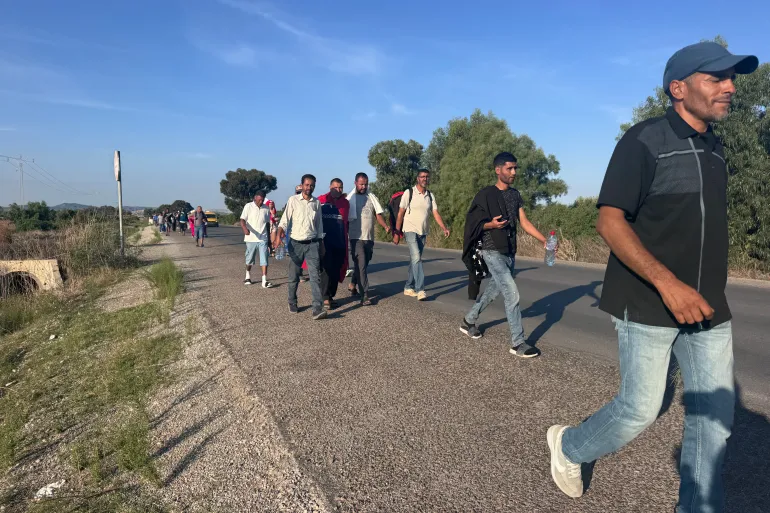
On September 27, 2026, dozens of unemployed college graduates set out from Menzel Bouzaiane, in the governorate of Sidi Bouzid, to walk to the Carthage Palace. More than 300 kilometers separated them from the seat of power. They gave their protest a name that captures its essence: the March of Dignity.
Alongside them, fathers, mothers, loved ones, and—as the march progressed—supportive citizens chose to join the march. The presence of these families gave the demonstration a special strength. It serves as a reminder that long-term unemployment is neither an individual failure nor merely a matter of statistics. It is a social scourge that affects entire families, delays adults’ independence, weakens households, and destroys trust in schools, universities, and the government’s promises.
The slogans chanted along the road—“Work, freedom, national dignity” and “My right to work is a duty”—echo one of the revolution’s central promises. Fifteen years after it began, right here in Sidi Bouzid, that promise remains unfulfilled for a significant portion of the young, college-educated population.
A law that has been passed but has yet to take effect
The march called for the enforcement of Law No. 18 of 2025, which was enacted on December 22 and published in the Official Gazette on December 23, 2025. This law provides for the exceptional and phased hiring of college graduates who have been unemployed for an extended period into the public sector and civil service.
The bill provides for a registration platform, a ranking system based on age, the length of time since graduation, and socioeconomic status, as well as phased recruitment over a maximum period of three years. However, nearly ten months after its enactment, the announced platform has still not been launched, the measures necessary for its implementation have not been published, and no public recruitment schedule has been released.
That is where the scandal lies: the government has recognized, by law, the existence of a major social injustice; yet it has allowed that recognition to remain without any concrete effect. Waiting thus becomes a policy. Promises replace rights, statements replace hiring, and unemployed graduates are told to wait even longer—even though many have already been waiting for ten, fifteen, or twenty years.
From the Kasbah to the Regions: The Anger Has Spread to a Larger Scale
The March for Dignity did not come about suddenly on September 27. It is the culmination of a long series of protests.
On June 11, a rally of unemployed graduates in Tunis was heavily monitored by security forces. Two activists were detained and then released. Following this protest, a delegation met with Kaïs Saïed, who pledged to create “as soon as possible” the platform designed to organize hiring.
On July 8, the movement returned to the Kasbah to demand that this commitment finally be fulfilled. As July 25 approached, graduates also gathered and attempted to stage a sit-in in front of the Tunis Municipal Theater.
September 1 marked a turning point. After a rally at the Kasbah, the protesters announced a sit-in in front of the Municipal Theater. According to accounts gathered from participants, security forces brutally dispersed the gathering, beat and harassed protesters, and then pushed them toward the bus stations to send them back to their home regions. Contemptuous remarks targeting those who had come from the interior of the country were also reported.
This scene carries deep political significance. Driving graduates who have come to demand the enforcement of a law out of Tunis amounts to telling them that their place is far from the seats of power. It is the old logic that pits the center against the regions, the capital against the periphery, and treats the victims of failed public policies as a nuisance to be removed.
Instead of discouraging the movement, this violence had the opposite effect. The protests spread to Meknassi, Menzel Bouzaiane, Gafsa, Béja, Sfax, Zaghouan, Mezzouna, Sidi Bouzid, Kairouan, Sousse, Kasserine, and other towns. The movement reconnected with its grassroots and regional base; it brought families more deeply into the movement and gave the right to work a broader dimension: that of the right to equal citizenship.
A grueling march that was halted at the gates of Tunis
The march set out from Menzel Bouzaiane on September 27 and had to come to a temporary halt in Jelma on September 29. Several participants, exhausted and suffering from foot injuries, required medical attention after the first few days of walking. But this pause did not mean giving up: the march resumed the very next day.
As the march progressed, graduates from other regions, as well as parents, joined the marchers. The movement has come to represent not only the unemployed, but also families humiliated by years of precarious living conditions, neglect, and empty promises. The fact that women and men—sometimes at the expense of their health—had to walk more than three hundred kilometers to demand the enforcement of a law demonstrates the extent of the social impasse.
After nine days of marching, on October 6, the participants reached Borj Cédria, just south of Tunis. It was there that security forces prevented the march from continuing as a group toward the capital and the Carthage Palace. The marchers were faced with an unacceptable choice: to disperse or to travel to Tunis individually, thereby abandoning the collective nature of their action.
The march was thus prevented from reaching its goal. It did not stop because its demand had been met, nor because the marchers had given up, but because security measures blocked access to the capital for those who had come to demand respect for a right enshrined in law.
Incidents of violence against two participants near Kendar have been reported. In Borj Cédria, activist Noha Ben Nasr was also detained for several hours before being released. These incidents, as well as the regionally biased and humiliating remarks and behavior reported by the participants, must be the subject of a serious, independent, and public investigation.
A planned meeting, replaced by an envoy
The end of the march revealed another form of contempt: the substitution of an opaque arrangement for genuine dialogue.
There had been talk of a meeting with the President of the Republic in Radès. In the end, it did not take place. According to information provided by representatives of the movement, the President’s office dispatched a special envoy to Borj Cédria. This meeting with an envoy cannot be presented as a response to the march, much less as a successful negotiation.
No firm date for the platform’s launch, no verifiable recruitment schedule, no number of positions, and no first round of hiring have been announced. On October 5, the presidency referred to the “steps” involved in implementing Law No. 18, but unemployed graduates are waiting for action, not more empty promises.
Comments regarding alleged “infiltrations” or political calculations surrounding the march must not divert attention from what really matters. They cannot erase the hundreds of kilometers walked, the injured feet, the nights spent on the road, and the dignity of those who marched. The question is not who might have wanted to control, co-opt, or neutralize the protest. The question is why the government allowed these young people and their families to travel all that way, when it could have sent officials to Menzel Bouzaiane to hear their demands and publicly account for its enforcement of the law.
Karim Teraâ: Prosecuting an Activist to Intimidate a Movement
The arrest of Karim Teraâ, a longtime activist for unemployed graduates in Bizerte, is part of this attempt at intimidation. Arrested on September 19 following posts about the situation of the unemployed, he was charged under Decree-Law No. 54 and placed in custody.
On October 6, Karim Teraâ was sentenced to a three-month suspended prison term and released. His release is a relief for his loved ones and for the movement. But the conviction stands: it maintains unjustifiable legal pressure on an activist whose only “offense” is having refused to give in and, along with others, having championed the demands for the right to work, regional development, and dignity.
Karim Teraâ is not being targeted because he poses a threat to society. He is being targeted because he embodies a voice that refuses to separate unemployment from regional inequality, freedom of expression, and the right to a dignified life. His prosecution thus appears to be a warning to the entire movement.
Violence is not a social policy
The reports of violence during the protests, the arrests, the intimidation, the forced return of protesters to their regions, the halting of the march in Borj Cédria, and the legal proceedings against leaders of the movement will not solve anything. They will not create any jobs. They will not heal regional divisions, alleviate the hardships faced by families, or erase the sense of humiliation that has built up over the years.
Responding to unemployment with police force is an admission of failure. Preventing a peaceful march from entering the capital is a political and moral mistake. Sending an emissary without a timeline or concrete commitments cannot serve as a social response.
The government must stop treating unemployed graduates as a public order issue. It must listen to what they are saying: work is not a favor, dignity is non-negotiable, and equality among regions cannot remain just a slogan.
The March for Dignity calls for an immediate action: the transparent and verifiable implementation of Law No. 18, through the launch of the platform, the publication of a public timeline, the establishment of clear criteria, and the actual launch of the first rounds of recruitment. It also makes a deeper demand: that the government stop humiliating those whom it has asked to study, wait, and hope.
Solidarity with the marchers.
Solidarity with Karim Teraâ and with all those whose struggle is being criminalized.
No to the repression of social protests.
The right to work and to dignity must be respected