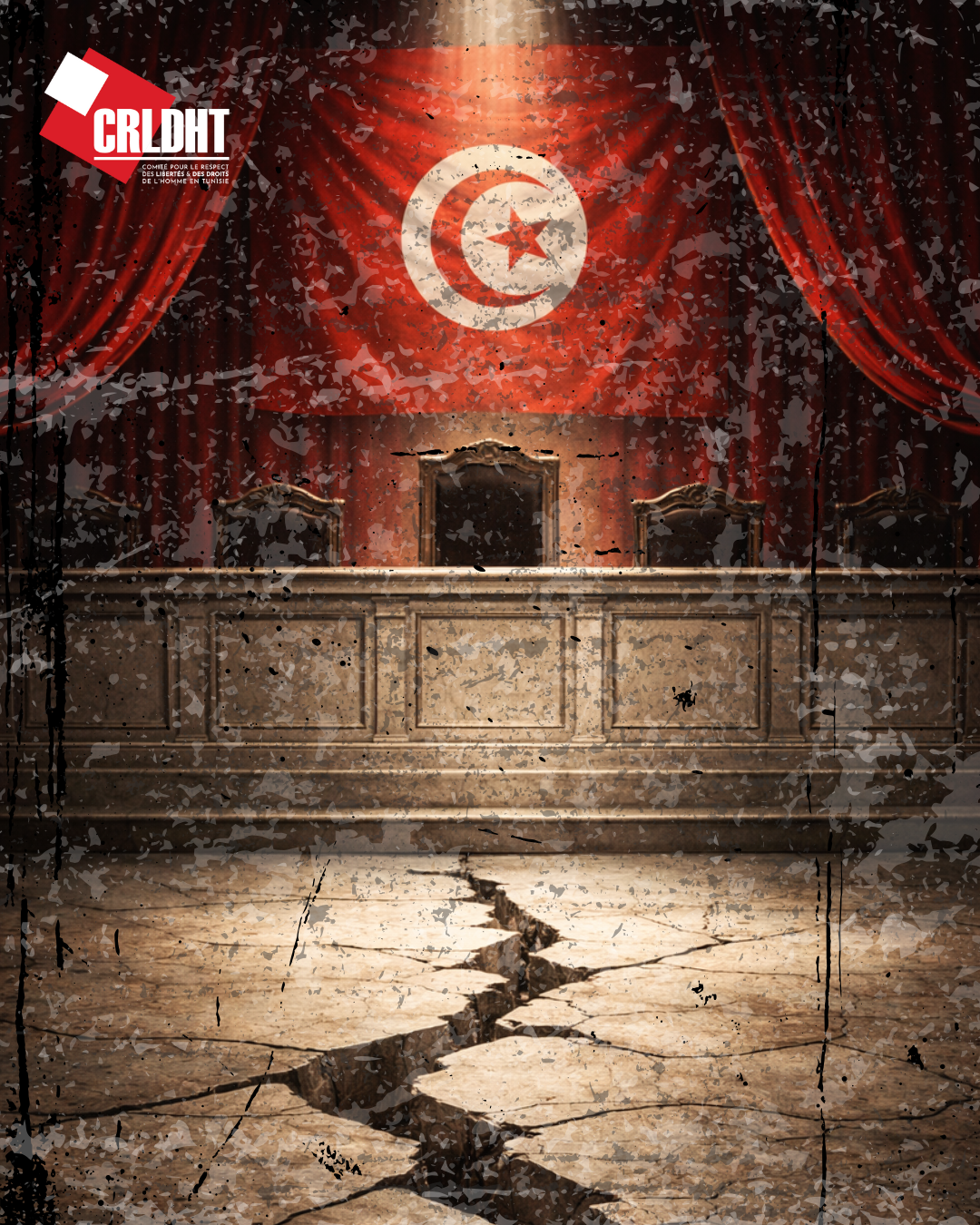
On December 4, 2025, the African Court on Human and Peoples' Rights condemned Tunisia for the third time for its lack of a constitutional court, in its deliberation on case 61/2019 Elyssa (a pseudonym) v. the Republic of Tunisia. The applicant was recognized as a victim of a violation of her right to a fair trial because she was unable to challenge the constitutionality of Article 236 of the Criminal Code, an article that punishes adultery without defining the material element of the crime, which is contrary to the principle of legality of crimes and penalties.
Tunisia had already been condemned by the African Court on Human and Peoples' Rights on September 22, 2022, in case 017/2021 Brahim Belghith v. the Republic of Tunisia. The Court had then ordered the Tunisian State to effectively establish and operate a Constitutional Court as an independent judicial body, as a structural measure to prevent the repetition of the violations found, within two years of the delivery of the judgment.
On November 13, 2024, the African Court reiterated its judgment in the deliberation of the case of Samia Zorgati v. the Republic of Tunisia, with a shorter deadline for enforcement, namely six months from the date of notification of the judgment.
On three occasions, therefore, the Court demanded the effective and functional establishment of the Constitutional Court, to no avail. The State's legal representative, in his implementation report on case 017/2021, claimed that with the election of the people's representatives, the text necessary for the establishment of a Constitutional Court would be imminent, a claim also echoed by President Kaïs Saïed himself when he promulgated his 2022 Constitution. The applicant replied that, in addition to the absence of any budgetary provision for the creation and operation of this Court in the successive budgets of recent years, Kaïs Saïed's Constitution had completely disfigured the Constitutional Court, which cannot, by its very design, be either independent or functional.
The Constitutional Court of Kaïs Saïed
The Constitutional Court, as governed by the 2022 Constitution, differs substantially from that conceived in 2014, where members of the Court were elected or appointed by the High Council of the Judiciary, the Assembly of People's Representatives, and the President of the Republic. In the 2022 Constitution, members are appointed by decree, presidential of course.
The first third of the members are the most senior presidents of chambers at the Court of Cassation, the second third are the most senior presidents of cassation chambers or advisory chambers within the Administrative Court, and the final third are the most senior members of the Court of Auditors.
This means that the President of the Republic, thanks to the powers he has assumed through Decree-Law No. 11/2022, has complete control over the composition of this Court. Moreover, Ghazi Chouachi's wife, who is a chamber president at the Court of Cassation, was illegally transferred by a memo from the Minister of Justice in order to prevent her from participating in the composition of the Court, and this is just one example among many.
The Court's extrajudicial powers have been eliminated by the new Constitution. It no longer arbitrates disputes between the President of the Republic and the Prime Minister, which can be explained by the single-headed structure of the executive branch established by the 2022 Constitution, whereby the government is reduced to a kind of secretariat of the Presidency of the Republic, responsible for implementing policies and programs according to its instructions, as clearly stated in Article 111.
Unlike the 2014 Constitution, and as evidence of the abusive authoritarianism of the 2022 Constitution, members of the House of Representatives can no longer issue a reasoned motion to terminate the presidential term for serious violation of the Constitution, as provided for in Article 88 of the 2014 Constitution.
It is therefore clear that this Court, as conceived in the 2022 Constitution, cannot be described as an independent judicial body, given the direct interference of the executive branch in its composition and the drastic reduction of its powers. At best, once established, it would be nothing more than a formal, compliant, and docile court, offering a mere pretense of respect for the rule of law and the Constitution.
How to explain Kaïs Saïed's recalcitrance
If the Constitutional Court, as defined in the 2022 Constitution, is entirely controllable by the current regime, how can we explain this persistent delay, or even outright refusal, to establish said Court?
Article 109 of the 2022 Constitution sheds light on this attitude. This text states:
"In the event of a vacancy in the Presidency of the Republic due to death, resignation, absolute impediment, or any other cause, the President of the Constitutional Court shall immediately be provisionally invested with the functions of President of the State for a period of at least forty-five days and at most ninety days..."
Kaïs Saïed knows full well that the Constitutional Court, as conceived in his Constitution, does not pose a threat to his exercise of power. On the other hand, when it comes to the possibility of vacancy or removal from office, no concessions are possible. He is aware that the longevity of his reign, despite its lack of any lasting institutional foundation, depends on the absence of a credible alternative to succeed him. This explains the scale of the violations he has committed and continues to commit in order to prevent the emergence of any political alternative that could destabilize him and, above all, capture the attention or support of rigid internal forces and influential foreign actors.
The refusal to establish a Constitutional Court, which at first glance seems incomprehensible, is therefore not linked to fears about its judicial role, but to the fact that by refraining from setting it up, Kaïs Saïed is protecting himself against any possible application of Article 109, including by the army, which speaks volumes about the degree of trust between the various components of this regime. Obsessed with history without really learning from it, Kaïs Saïed, aware of the deterioration of his physical and mental health, does not want to risk a "medical coup" like the one on November 7, 1987.
Vacancy problem
The vacancy in the office of President of the Republic in Tunisia has been the subject of much debate recently, between those who advocate a return to the 2014 Constitution and those who would go so far as to revive the disastrous Presidential Decree No. 117/2021, a medieval text that has been condemned internationally.
It is true that a vacancy at the head of state would be problematic in many respects, particularly due to the absence of a clear legal basis, including with regard to the unilateral regulatory arsenal put in place by Kaïs Saïed, who, like any dictator, seeks to sow chaos in his wake.
However, a legalistic, judicial solution that complies with Tunisia's constitutional and international obligations remains possible, because the enforcement of Judgment 017/2021 of the African Court on Human and Peoples' Rights is much more than a simple international obligation: it provides a legal, judicial, and legitimate framework for breaking the current institutional deadlock and initiating a process of return to constitutional democracy in Tunisia.
Indeed, the Continental Court has, among other things, ordered Tunisia to return them, setting a deadline of two years, which in principle offers a legal solution. As for the procedural details and practical implementation, this is a sovereign matter that requires national consensus or, at the very least, the broadest possible spectrum of Tunisian political opinion, which must fill this institutional framework in accordance with the principles of the rule of law and the pursuit of balanced democratic legitimacy.
It would be time to think about it before everyone is caught up in the urgency of events and institutional shortcomings.