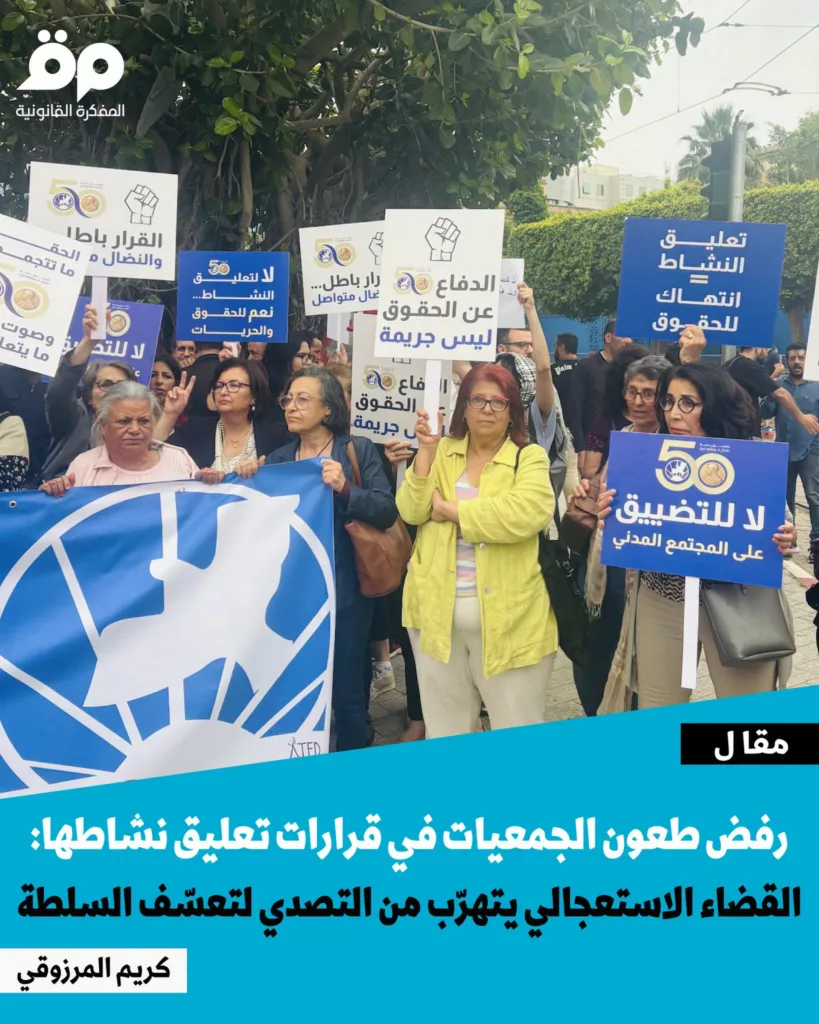
Freedom of association is faltering in Tunisia. What was a fundamental achievement of the democratic transition is now threatened by ever more fussy state control. Under the guise of transparency and good governance, the reforms proposed in the latest report by the Instance Supérieure de Contrôle Administratif et Financier (ISCAF) risk completing the gradual stifling of associations, particularly those defending human rights and fundamental freedoms.
The tightening of controls on foreign funding, the centralization of association data and the intrusion of banks into transaction monitoring form a formidable bureaucratic arsenal. These measures are not insignificant: they pave the way for arbitrary restrictions, political targeting and the financial paralysis of associations critical of the regime. The announced revision of Decree-Law no. 88 of 2011, which until then guaranteed relative autonomy to civil society, leaves little doubt as to the objective pursued: to exercise total control.
This drift is part of a general climate of repression in which legal instruments are misused for political ends. The use of Article 96 of the Penal Code, which criminalizes abuse of office, has become a political weapon under Kaïs Saïed. Intended to combat corruption, this article is now used to eliminate all opposition. Politicians, civil servants, economic players: all can be accused on the basis of a vague and subjective definition of "harm to the public interest". Justice, subject to executive power, becomes a tool for settling scores.
In this climate of growing repression, despair is gaining ground. A wave of immolations has shaken Tunisia since December 2024, recalling the tragic gesture of Mohamed Bouazizi in 2010. Ten cases in three months, in marginalized regions where poverty and unemployment continue to grow. These acts of distress reflect the failure of those in power to respond to the social and economic aspirations of the Tunisian people.
The judicial crisis is another facet. By denouncing the subservience of judges to the government and refusing to bow to the decisions of an instrumentalized judiciary, opposition politician Abir Moussi has highlighted the collapse of the rule of law. With no constitutional court and no separation of powers, Tunisia is becoming a state where political trials are the norm and the executive dictates its will to a judiciary reduced to a mere recording chamber.
Internationally, Tunisia's double standards are equally edifying. While the government boasts of its commitment to migrants' rights at the UN, it is stepping up repression of human rights defenders on the ground and exploiting the migration issue to obtain European funding. The case of Abdallah Saïd, arrested for his commitment to refugees, illustrates the hypocrisy of a government that wraps itself in humanitarian principles while blithely trampling them underfoot.
Finally, the recent law n°1-2025, amending the decree-law on the Fidaa establishment (Foundation for the Protection of Victims of Terrorist Attacks, the Military, Internal Security Forces and Customs), shows how the current regime privileges the security forces, who guarantee its continued existence, to the detriment of the victims of the revolution and the condemnation of past abuses. This hierarchy of rights reflects a gradual erasure of revolutionary memory in favor of a system in which the protection of power's allies takes precedence over any consideration of justice and fairness.
Faced with this accumulation of excesses, the question arises: what remains of the democratic aspirations raised by Tunisians in 2011? Surveillance and repression mechanisms are tightening, freedom is shrinking, and the voice of civil society is increasingly stifled. While Tunisia still retains the appearance of a democratic state, it is in reality engaged in a spiral where transparency becomes a pretext for control, justice an instrument of persecution, and governance a mask for repression.
The awakening of civil society and the mobilization of citizens will be crucial in preventing this drift from becoming irreversible. For if Tunisia's recent history teaches us one thing, it's that the people have already refused dictatorship. Time will tell whether they will once again make their voices heard.