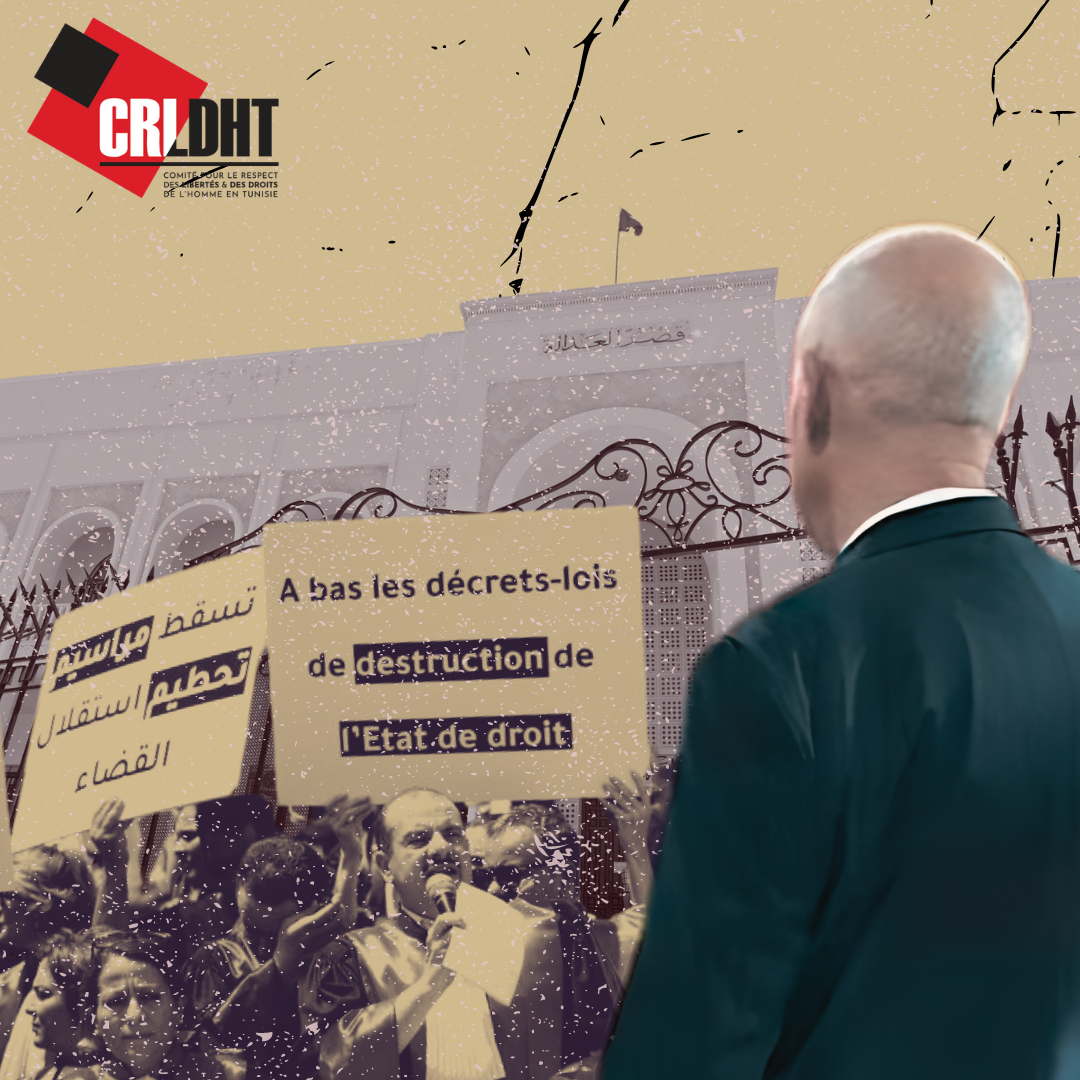
Two years have passed since the President of the Republic dismissed 57 judges and overruled the Administrative Court's ruling in favor of 49 of them, which acquitted them of the charges brought against them and refuted all the allegations made against them. This episode constitutes a flagrant violation of the Tunisian State's commitment to respect the decisions handed down by independent judicial bodies,
In view of the communiqués and declarations issued by the various magistrates' bodies, which attest to the arbitrary dismissals, dismissals, degradations and transfers, all measures designed to sow fear in their ranks,
Considering also the repeated arrests, the fabrication of false accusations, the heavy prison sentences handed down to civil society activists, journalists and politicians, and the arbitrary detention of political leaders beyond the 14 months authorized by law, imprisonment based on unfounded accusations,
It is clear that the intention of the executive branch is to undermine the independence of the judiciary and turn it into a tool at its disposal, an intention expressed by the President of the Republic on numerous occasions in his vengeful speeches. Whether before or after the dissolution of the elected Supreme Council of the Judiciary, or before or after the entry into force of the Constitution drafted by Kaïes Saied himself in 2022, the aim is to make the judiciary a mere function subject to the presidential executive.
The Committee for the Respect of Freedoms and Human Rights in Tunisia:
- Declares that the authorities bear full responsibility for the violation of the law and the infringement of the independence of the judiciary; demands that the decision of the Administrative Court concerning the reinstatement of the unjustly dismissed judges be respected;
- Condemns the fact that the Ministry of Justice continues to target and intimidate judges by various means, each more unacceptable than the last,
- Commends the resistance of the Association of Tunisian Magistrates (AMT) and its tireless defense of the independence of the judiciary and public freedoms, and reaffirms its support for the association's president, Mr. Anas Hmaidi, in the face of the harassment and incessant legal proceedings to which he is subjected (travel bans, etc.);
- Calls on Tunisian judges of all ranks to defend their structures and render their decisions impartially until the judiciary, as guarantor of justice and protector of rights and freedoms, regains its free will. It also reminds them of their responsibility in any judicial decision that does not respect the law or is biased.
- Finally, the CRLDHT calls on all justice-loving forces, in particular parties, organizations, associations and national and international personalities, to defend the independence of the judiciary, to support the judges who have been dismissed and to do everything in their power to put an end to arbitrariness. Fear and terror must not prevail, and Tunisia must not be transformed into a dictatorship that stifles all freedom-loving voices.