Violence, discursive structure and populist solutions
The summer and autumn of 2025 marked a turning point in Tunisia's protest dynamic. In just three months - July, August and September - 1,316 protest movements were recorded, almost double the number for the same period in 2023 and 2024.
September alone saw 653 mobilizations, a record since the beginning of the year.
These protests took many forms, mainly on the ground (82%): sit-ins, strikes, peaceful marches, road blockades, hunger strikes, and even rallies in front of the presidential palace. Social networks have become the other arena of protest, with videos, photos and statements denouncing the failure of the political and economic model imposed by Kaïs Saïed.
On the social front, mobilization remains largely mixed: 1,164 joint actions, 129 led by men and 23 by women.
The causes of national anger
The protest wave can be explained by a tangle of political, social and symbolic factors.
In September, several mobilizations coincided with the departure of the Maghreb and international Palestine solidarity flotilla, demanding the release of Tunisian activists arrested by the Israeli army. At the same time, the confrontation between the authorities and the trade union movement intensified: the UGTT organized a major national march on August 21, 2025, from Place Mohamed Ali to Avenue Habib Bourguiba.
These protests are taking place in a climate where Kaïs Saïed's regime is pursuing its policy of systematic repression of political opponents, journalists and human rights defenders. Decree 54, which has become one of the central instruments of this repression, has already brought down many voices, both visible and invisible.
But the root of Tunisia's malaise runs deeper.
The population is faced with a feeling of disillusionment and collective betrayal. The regime's economic and social policies have led to insecurity, mass unemployment, the collapse of public services and worsening water shortages. Small farmers, women and children are paying a heavy price for an environmental and social injustice that has become structural, the symbol of a populist ideology with no horizon.
Added to this is the closure of the last outlet: migration.
The harga, the ultimate escape route, has become a mirage in the face of tightened security measures imposed by Europe. This joint policy has asphyxiated local economies based on cross-border trade - on both the Libyan and Algerian sides. Even survival smuggling, once tolerated, is now criminalized.
Against this backdrop of social suffocation, all classes and regions of the country eventually converged on a new sequence of struggles, crystallized around a symbol: the mobilization of Gabès in October 2025.
Gabès: popular anger cracks populist rhetoric
A study conducted at the École nationale d'ingénieurs de Sfax revealed that phosphogypsum, a by-product of the chemical industry, contains toxic and radioactive substances. According to the European Commission (2018), the Tunisian chemical complex dumps 5 million tonnes of this waste into the Mediterranean every year, representing 40,000 m³ of toxic discharges per day.
Despite these damning data, the government has chosen denial.
By removing phosphogypsum from the list of hazardous waste, Kaïs Saïed has trampled on science, scorning environmental mobilizations and citizen alerts. This choice illustrates an extractivist and rentier logic: shameless exploitation of territories (Gabès, Gafsa, Redeyef...) for the benefit of companies linked to transnational interests, while local populations suffocate in pollution and misery.
The spark of revolt
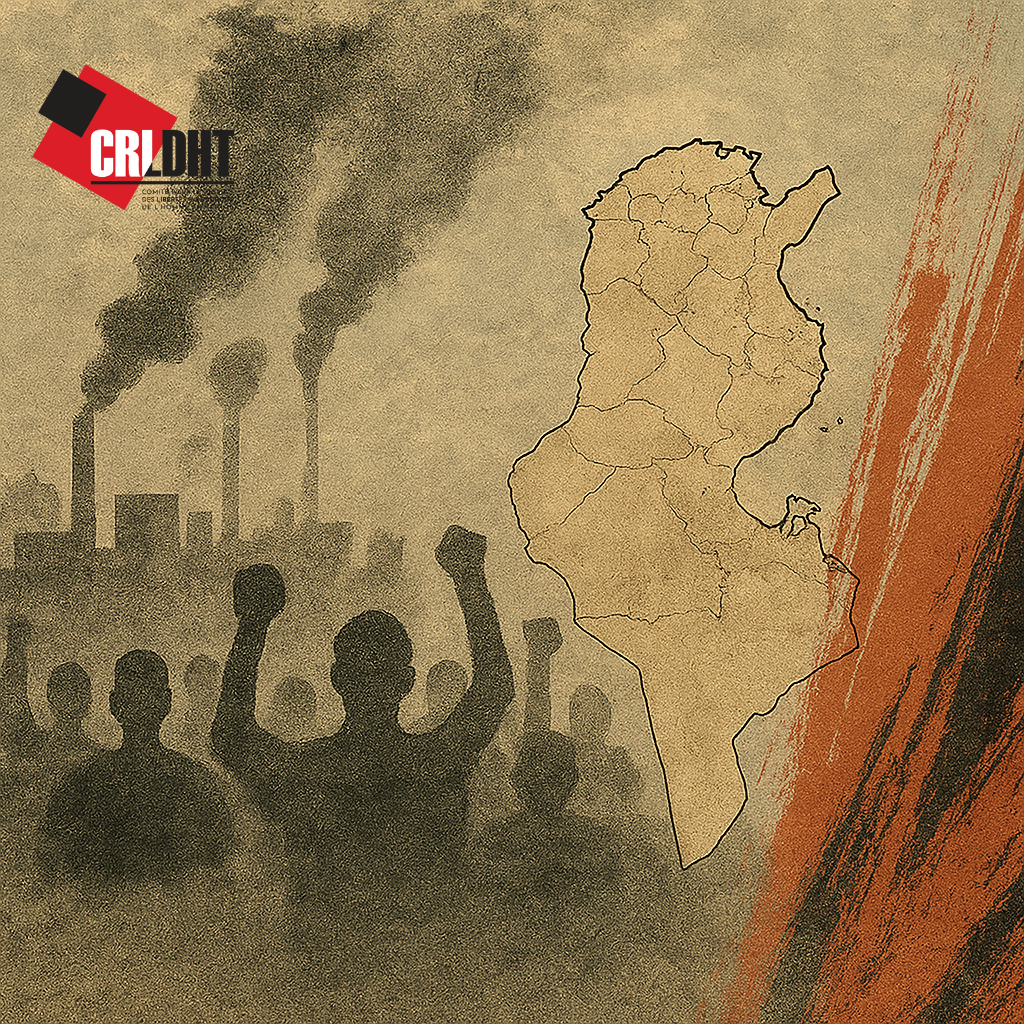
Everything came to a head in Gabès on October 10, 2025, when a gas leak from the chemical complex poisoned several pupils at the Chet Essalem secondary school. The incident, far from being unprecedented, acted as a detonator for accumulated anger.
On October 21, the city came to a standstill: an almost total general strike, backed by an intergenerational, union and associative mobilization.
The environmental movements, present since 2011, were able to transform this crisis into a founding moment of collective resistance.
The populist counter-offensive
Faced with this mobilization, the regime reacted with contempt and fear.
Aligned media and pro-Saied columnists described the movement as manipulated, foreign-funded and politicized.
National Guard spokesman Houssem Eddine Jebabli even went so far as to speak on television of "foreign interference" and the "involvement of minors seduced by external forces".
At the same time, police and judicial repression intensified, seeking to transform a citizens' mobilization into a mere "security incident".
Breaking through the wall of fear
But this time, the official story didn't hold up.
The mobilization of Gabès :
- Breaking the rhetoric of fear and conspiracy used to disqualify any challenge;
- Restored civic courage, breaking the silence imposed since July 25, 2021;
- Gathered all social forces around the regional UGTT, the pivot of the movement;
- An alternative discourse based on reason, justice and ecology;
- Received massive support from citizens and associations, both in Tunisia and abroad.
The day before the strike, Parliament held a special session on the Gabès issue, followed by a meeting between Kaïs Saïed and his head of government, Sara Zaafrani.
Once again, the President recycled the same populist lexicon:
"corrupt networks", "plotters", "instrumentalization of suffering".
No technical, political or ecological solution was mentioned.
A crack in the populist wall
By attacking the discourse of fear head-on, the mobilization in Gabès opened a breach in Kaïs Saïed's populist system.
It shows that Tunisian society is not resigned: despite repression, blockades and weariness, the protest cycle continues, more diffuse, more conscious, more deeply rooted.
From the streets of Gabès to the thirsty countryside, from closed factories to saturated schools, Tunisia is once again roaring - not for a savior, but to take back the confiscated word.