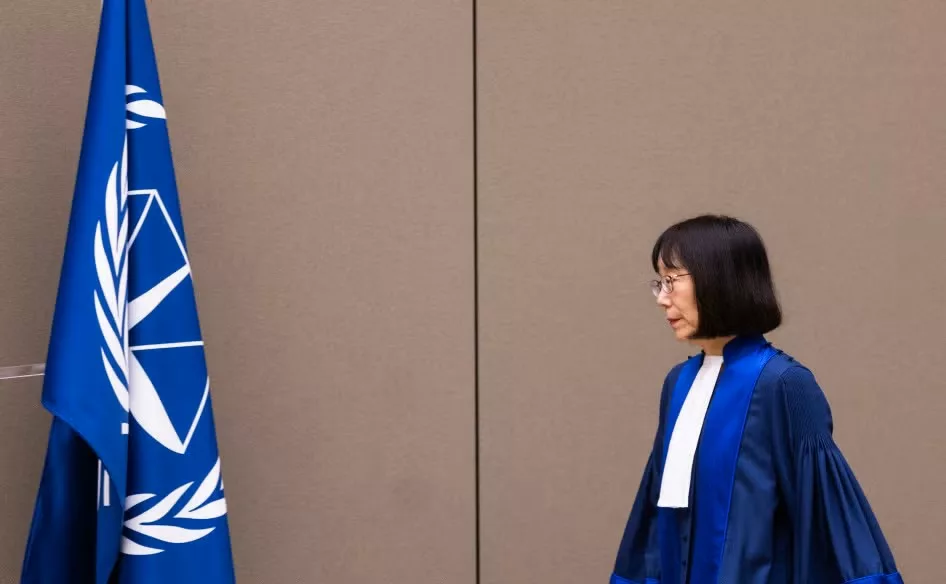
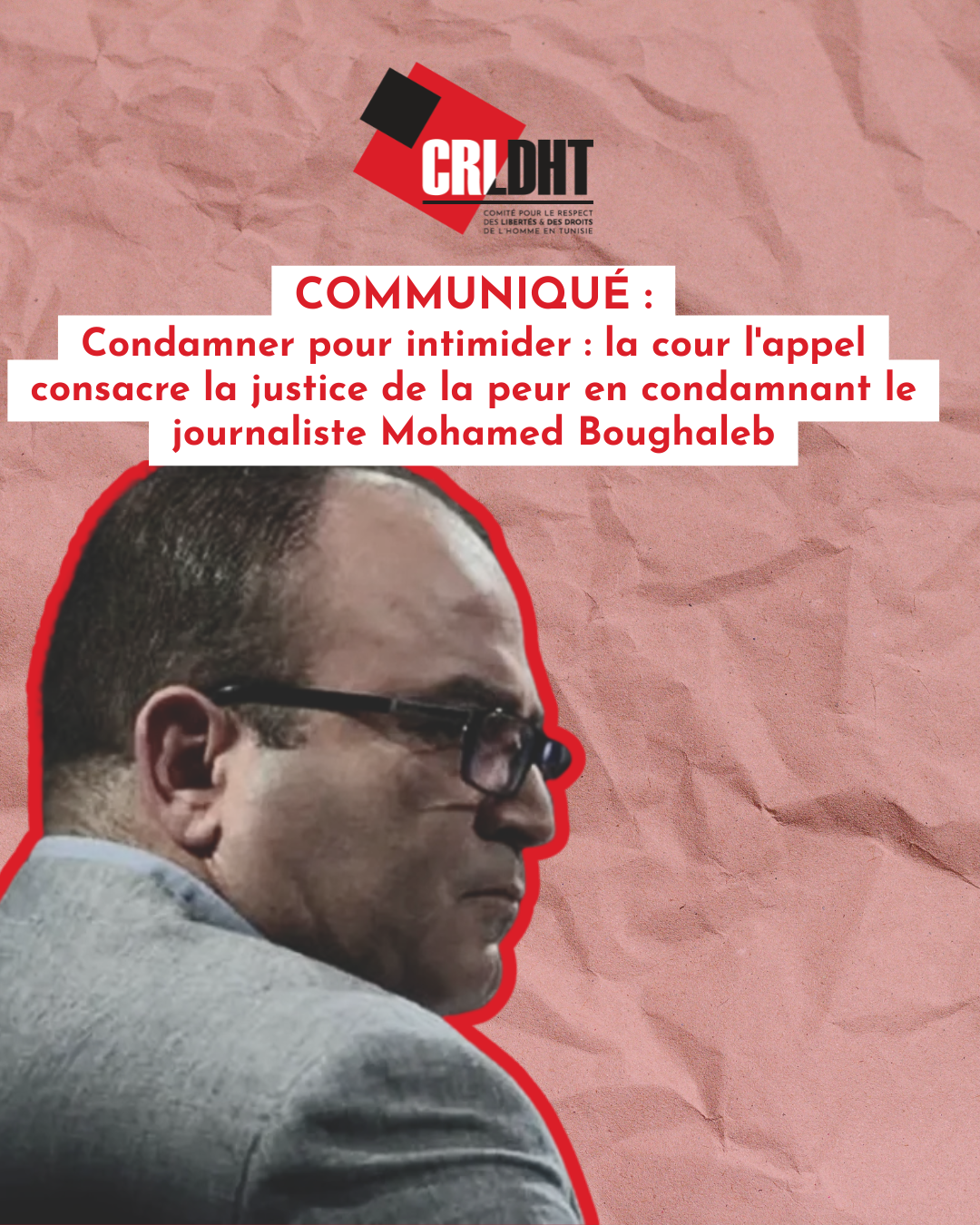
The decision handed down on Friday, January 2, 2026, by the criminal division of the Tunis Court of Appeals, confirmingMohamed Boughaleb'stwo-year prison sentence—albeit suspended—is aserious act, revealing the advanced state of decay of the Tunisian justice system and its assumed submission to the executive branch.
By confirming the principle of the conviction itself, the Court of Appeals endorses alogic of criminalizing journalistic speechand validates the political use of Decree-Law 54 as a tool for silencing critical voices. The suspended sentence does not change the nature of the decision: it is neither an acquittal nor a correction of a manifest injustice, but amessage of permanent threataddressed toMohamed Boughalleband, through him, to all journalists, intellectuals, and citizens who refuse to remain silent.
The case is based on a complaint filed by a university professor accusing the journalist of defamation and threats based on a post on social media. It is an old case, dating back to April 2023, investigated without serious digital expertise, without rigorous proof of the attribution of the comments, and in disregard of the most basic principles of criminal law and freedom of expression. Despite these major flaws, the courts persisted, stubbornly insisting on criminalizing what is, at worst, a matter of public debate and critical expression.
In July 2025,Mohamed Boughallebhad already been sentenced in the first instance to two years in prison. The Court of Appeals could have corrected a decision that was clearly disproportionate, legally fragile, and politically motivated. It chose not to do so. It preferredto uphold the sentence, while suspending its execution, thus keeping the journalist under the constant threat of incarceration at any moment.
This decision is part of an ongoing crackdown. Mohamed Boughallebhas already paid for his journalistic work with his freedom: sentenced in April 2024 to six months in prison in a case linked to the Ministry of Religious Affairs—a sentence increased to eight months on appeal—he served his entire sentence. He spent nearly 11 months in detention, in harsh conditions, which had a lasting effect on his physical and psychological health.
Since his conditional release on February 20, 2025, he has remained subject to severe restrictive measures: a ban on leaving the country, permanent judicial supervision, and mandatory court appearances. The Court of Appeals' decision does not put an end to this relentless persecution: itnormalizes and institutionalizes it.
The Tunisian justice system is no longer an arbiter here: it has become adisciplinary tool, tasked with reminding journalists that criticism comes at a price, that free speech can lead to prison, and that Decree-Law 54 remains a sword of Damocles ready to fall on anyone who refuses to toe the line.
This verdict is not an isolated decision. It is part of a broader crackdown on freedom of expression, marked by the prosecution of journalists, lawyers, opponents, and activists, and by the systematic use of repressive laws to stifle public debate. The confirmation ofMohamed Boughalleb'sconviction is asymbolic condemnation of press freedom in Tunisia.
History will remember that, even under the guise of a reprieve, this justice system chose fear over law, obedience over independence, and repression over freedom.
SupportingMohamed Boughalleb, Chadha Haj Mbarek, Sonia Dahmani, Borhen Bsaies, Mourad Zeghidi, and all the others means defending an essential collective right: the right to inform, criticize, think, and speak out.