
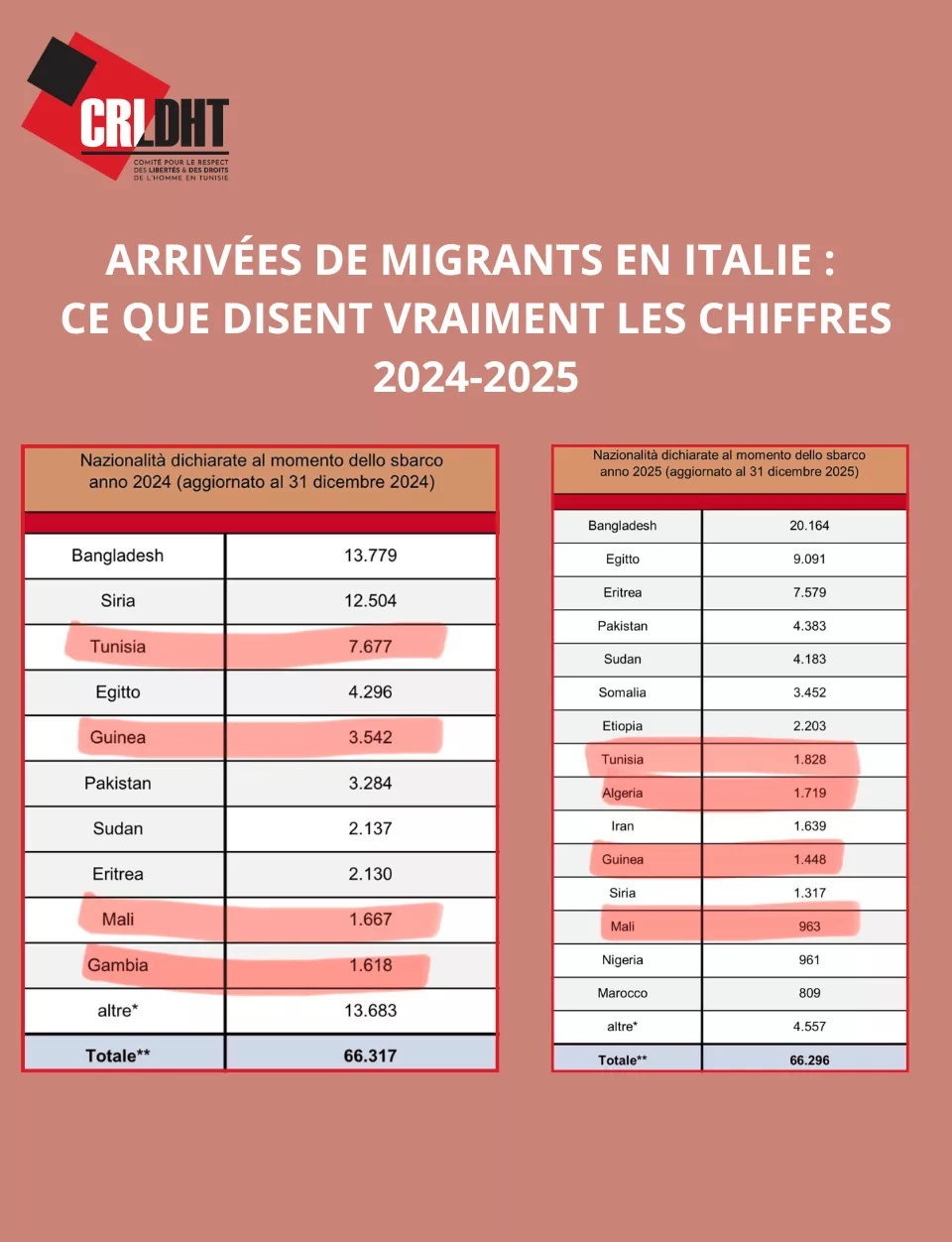
The tables published by the Italian authorities on the nationalities declared upon arrival in 2024 and 2025 offer valuable—and often misinterpreted—insight into migration dynamics in the central Mediterranean. Behind simplistic rhetoric and political manipulation, these data tell a more complex story, marked by forced displacement, route reconfiguration, and closure policies that shift flows without eliminating them.
Stability of the total, recomposition of origins
First observation: the total number of arrivals remains virtually unchanged from one year to the next.
- 2024: 66,317 people
- 2025: 66,296 people
This overall stability actually masks a profound reshaping of nationalities.
In 2024, arrivals are dominated by several clearly identified nationalities:
- Bangladesh: 13,779
- Syria: 12,504
- Tunisia: 7,677
- Egypt: 4,296
- Guinea: 3,542
- Pakistan: 3,284
- Mali: 1,667
- Gambia: 1,618
Tunisia thus appears to be one of the main countries of origin, a striking fact for a country long considered primarily as a transit territory. This data must be viewed in the context of the multidimensional crisis the country is currently experiencing: economic collapse, political repression, shrinking civic space, and a lack of prospects for young people.
In 2025, the hierarchy will change radically:
- Bangladesh: 20,164
- Egypt: 9,091
- Eritrea: 7,579
- Pakistan: 4,383
- Sudan: 4,183
- Somalia: 3,452
- Ethiopia: 2,203
- Tunisia: 1,828
- Algeria: 1,719
- Guinea: 1,448
- Mali: 963
The decline in arrivals from Tunisia is dramatic: from 7,677 to 1,828 people in one year. This drop cannot be interpreted as an improvement in the internal situation in Tunisia. Rather, it corresponds to a drastic tightening of control policies, enhanced security cooperation with Italy and the European Union, and increased outsourcing of migration management.
Outsourcing borders: shifting routes, not causes
These figures confirm a reality well known to human rights organizations: deterrence policies do not reduce migration; they shift routes and change profiles.
The decline in Tunisian arrivals in 2025 coincides with:
- an increase in interceptions at sea,
- increased pressure on departures,
- and bilateral agreements linking financial aid to migration control.
At the same time, the increase in arrivals from Bangladesh, the Horn of Africa, and Sudan reflects the worsening of conflicts, humanitarian crises, and authoritarian regimes elsewhere.
What the figures don't say – but reveal between the lines
These statistics don't tell the whole story:
- violence suffered en route,
- deaths in the Mediterranean,
- conditions of detention and deportation,
- nor violations of the right to asylum.
But they reveal a major political truth: Europe chooses with whom it negotiates control over mobility, even if it means turning a blind eye to human rights violations in partner countries.
The decline in Tunisian arrivals in 2025 illustrates the role assigned to Tunisia: that of Europe's advanced border guard. This role comes with funding, security cooperation, and a worrying silence on:
- political repression,
- the criminalization of civil society,
- and violence against sub-Saharan migrants on Tunisian soil.
Reducing the numbers does not mean protecting people or addressing the root causes of migration.
The data for 2024–2025 show one essential thing: the central Mediterranean remains a major migration route, regardless of the obstacles put in place. The question is therefore not only "how many arrive," but at what human and democratic cost these figures are achieved.
As long as migration policies are based on repression, externalization, and the bargaining of human rights, the statistics will continue to change... without an end to human tragedies.