The February and March issues of the Journal Officiel contain virtually no legislation; rather, they are ministerial decrees announcing the opening of posts or competitions, usually internal to the administration, as well as appointments. In short, all the day-to-day administrative management of the State.
In view of the quality and impact of the new texts - be they decree-laws, presidential decrees, or organic or ordinary laws issued by the Assembly of People's Representatives - one could say, without subjective exaggeration: no news, good news.
Presidential dismissals and the verticality of power
However, a number of presidential decrees published in the Journal officiel de la République tunisienne (Official Gazette of the Republic of Tunisia) have drawn our attention to the conception of the ministerial institution in this new regime, that of Kaïs Saïed post-coup d'état of July 25, 2021.
These are Presidential Decree no. 08/2025 of February 5, 2025 concerning the dismissal of the Minister of Finance, and Presidential Decree no. 164/2025 of March 20, 2025 concerning the dismissal of the Head of Government.
The origins of the ministerial function in Tunisia
The institution of the minister, or prime minister, goes back well before the establishment of the Republic, and even before the formation of the Tunisian state itself. The minister - or "wezir" - has been around since at least the Arab-Muslim conquest, although similar institutions can be found in the Carthaginian and Roman regimes, and even in the Amazigh kingdoms.
The diwenes, established since the Umayyad dynasty, are the ancestors of the ministries. During the reign of the Aghlabids in Tunisia, the organization of the administration underwent a major expansion during a prosperous period. Throughout Tunisia's history, successive monarchic regimes have known the function of minister, which generally designates a person from the court, appointed by the king or emir to assist him in a given field, or with more extensive prerogatives in the case of the "grand vizier".
It was a highly esteemed position, as is reflected in popular folklore - notably in the tales about Jaafar al-Barmaki, Haroun al-Rachid's minister, who had to be both cunning and loyal. The minister's reputation and room for maneuver depended on several factors: his tribal, religious or courtesan allegiances and alliances; the trust placed in him by the caliph or emir; and the latter's strength or weakness as the holder of central power.
The function of the vizier: between loyalty and beheading
The State, in its contemporary sense in Tunisia, established with the Husseinite kingdom, knew this high function attributed to the freedmen of the janissary army. The minister was then the bey's advisor - hence the popular expression: " Dabber ya wazir wela rassek ytir " (literally: "Offer good advice, O minister, or your head will be cut off"), which reveals the precariousness of this function, suspended from the temperament of the sovereign, the exclusive holder of state powers and perceived as Allah's khalif.
There is no shortage of examples of ministers who met a tragic end, including those whose work has been praised, such as Youssef Saheb Ettabaa or the reformer Khaireddine Pacha. Other ministers had sulphurous reputations and were known for their corruption, such as Chedly Khaznadar, Ben Ayed or Mustapha Ben Ismaïl.
It is the sovereign who has the final say on their appointment or the end of their career, a decision influenced of course by those he trusts, in a decision-making process as opaque as it is complicated and unstable.
The Republic and its Secretaries of State: continuity or change?
With the proclamation of the Republic in 1957 and the adoption of the 1959 Constitution, the ministerial function was maintained, but under the title of Secretary of State. This change in terminology in no way diminished the prerogatives of the ministers or secretaries of state who, depending on the portfolio entrusted to them, left their mark on their respective fields.
We well remember Behi Ladgham and Hédi Nouira as heads of government, and numerous ministers such as Mohamed Masmoudi, Ahmed Ben Salah, Mohamed Mzali, Tahar Belkhodja, Mohamed Sayah, Habib Chatti, and so many others who left their mark on Tunisian political life through their fields of competence. Often, they embodied a political orientation in their own right; and when Bourguiba decided to change course, they were dismissed.
In the Ben Ali era, ministers' scope for decision-making has narrowed considerably: anything strategic or political is, de facto, decided in Carthage. The minister, like the head of government, simply implements these decisions. As was already the case under the monarchy, the permanence of the office depends exclusively on the President of the Republic, and the minister becomes a fuse, sacrificed at the slightest crisis or failure.
The 2022 constitution: a return to absolute presidential executive power
The 2014 Constitution was revolutionary in that it enshrined the head of government as the true head of the executive, making the executive branch a two-headed institution. Unprecedented new rules were introduced concerning the appointment of the government, its control and even its dismissal by a motion of censure.
The coup d'état of July 25, 2021 aborted the experiment in democratic transition, reinstating the Presidency of the Republic as the centerpiece of the entire power architecture. The head of government, like the ministers, is now appointed by the President of the Republic (article 101 of the 2022 Constitution) and can be dismissed by his decision alone, without even having to justify it (article 102 of the 2022 Constitution).
Their status and prerogatives reduce them to mere executors of the President's strategies, policies and instructions, as Article 111 of the 2022 Constitution clearly states, echoing the sinister Presidential Decree 117/2021. Moreover, article 112 confirms this new - or rather old - submission of the government, specifying that it is accountable only to the President of the Republic.
The illusion of parliamentary control
As for the Assembly of People's Representatives (ARP), article 67 confers on it only a legislative function. However, article 115 allows the ARP and the National Council of Regions and Districts to pass a motion of censure:
"The motion of censure is admissible only if it is justified and signed by one-third of the members of the Assembly of People's Representatives and one-third of the members of the National Council of Regions and Districts. Voting may only take place forty-eight hours after the motion has been tabled.
But the conditions laid down are not just formal: the motion can only be tabled "if they find that the actions he is taking are not in line with the general policy of the State and the fundamental choices provided for by the Constitution". In other words, if they are not in line with the choices made by the President of the Republic, since it is he who sets the general policy and fundamental choices, in accordance with the 2022 Constitution.
The 48-hour deadline is, of course, designed to give the President of the Republic some leeway to exert pressure, in the theoretical event that a third of the two assemblies decide to table a motion of censure without his agreement or permission.
The motion of censure must be passed by two-thirds of the Assembly and the Council, but there is one last - and by no means least - condition to be met: acceptance by the President of the Republic of the government's resignation, as specified in article 115.
With this last condition , we're back to square one: it's the president who decides. Articles 114, 115 and even 116 are nothing more than window-dressing, an institutional trompe-l'œil designed to give the impression of the existence of a counter-power or a formal control mechanism.
Confiscated sovereignty
It goes without saying that, even in the event of a vote of no confidence by the two assemblies - which the President dominates - he can refuse to accept the government's resignation, and the government can also refuse to tender its resignation, without incurring any sanction or liability.
What is certain is that the people are no longer sovereign and have no influence on the appointment or dismissal of the government. The successive, unjustified dismissals are a further manifestation of the violation of every Tunisian's right to participate in the public affairs of his or her country, guaranteed both constitutionally and conventionally.
The Tunisian citizen - or rather, from now on, the subject of the President of the Republic - no longer even has the right to be informed. Meanwhile, Kaïs Saïed looks set to consolidate his record as the president who has appointed the greatest number of heads of government in the contemporary history of the Tunisian Republic, proof that the same conditions inevitably produce the same effects.
Governance without direction or vision, orchestrated instability
In the absence of presidential policies and strategies, no head of government, and no government, can fulfill its mission of "assistance" within the meaning of article 87 of the Constitution of 2022. No one can assist a president devoid of strategic vision and public policy initiatives, even though he has a monopoly on defining fundamental choices and the means of implementing them.
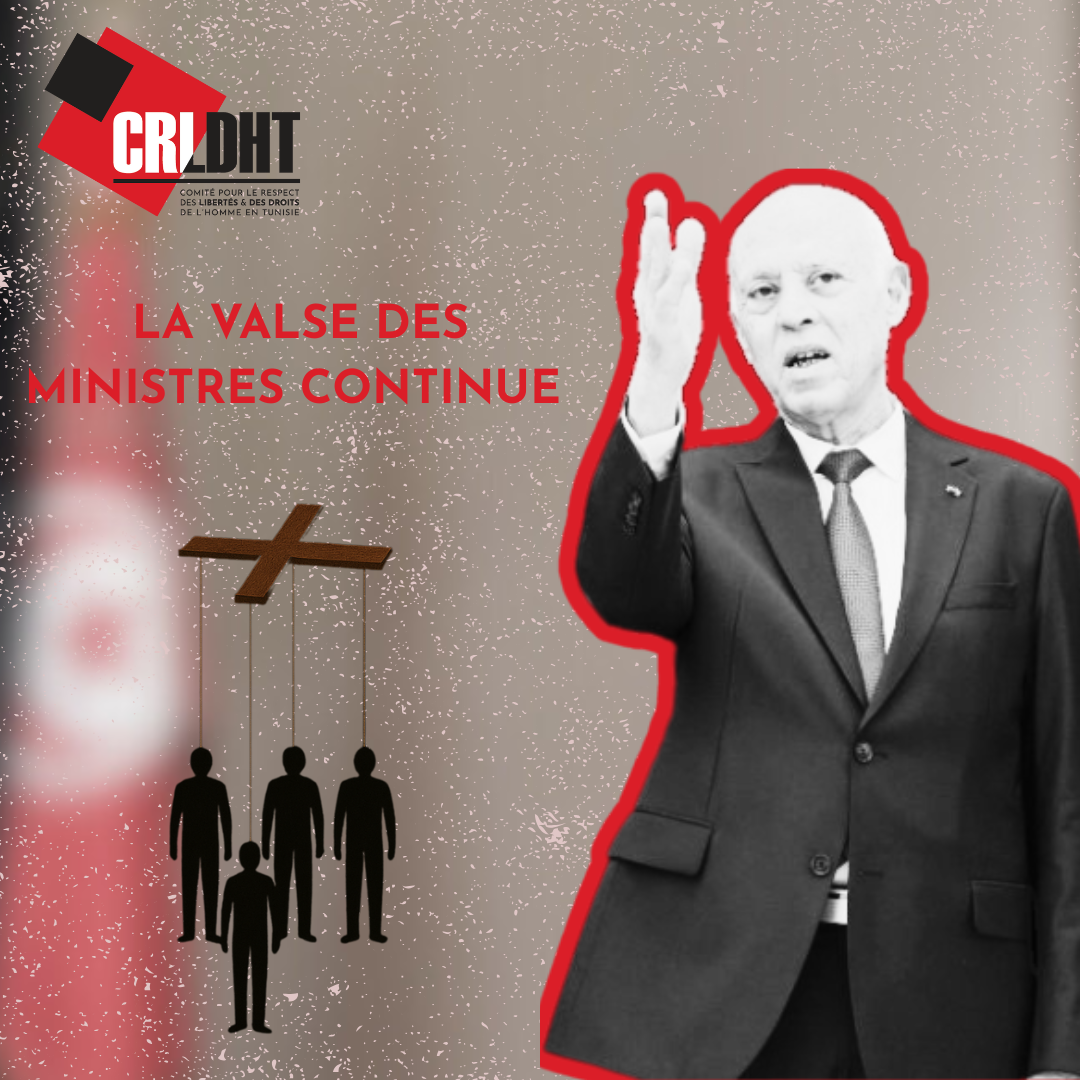
In the meantime, the nightly ball of dismissals and appointments shows no signs of coming to an end. In fact, Kaïs Saïed has even unilaterally decided to modify the text of the ministerial oath, without even promulgating an edict to this end.
The paradox is that Kaïs Saïed based his coup d'état on the popular will to break with governmental instability, as well as on the promise to restore the prestige of the State - a prestige he himself scorned by staging the dismissals in a humiliating and disrespectful manner.
Institutionalized humiliation as a method of government
This staging goes beyond the person of the dismissed officials: it aims to humiliate all the regime's officials and collaborators, who find themselves in turn sacrificed on the altar of presidential failures, dismissed, forbidden to travel, pending possible criminal prosecution for plotting against State security - if not for corruption, Kaïs Saïed's two all-purpose arguments.