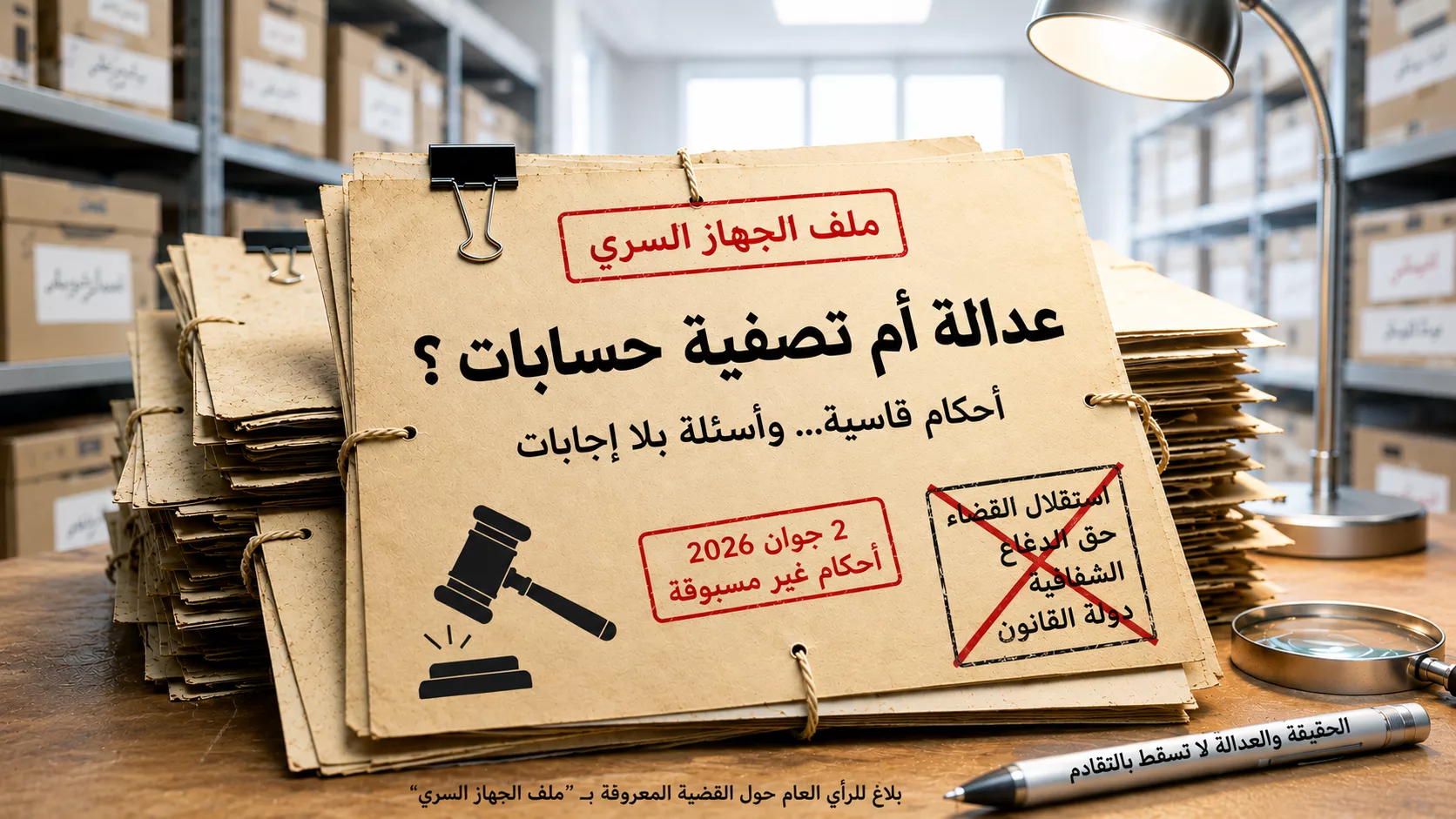
On June 2, 2026, the criminal division specializing in terrorism cases at the Tunis Court of First Instance handed down its verdict in the so-called “secret apparatus” case, a matter that had dominated political and media discourse in Tunisia for more than a decade.
The sentences handed down are among the harshest ever recorded in the country’s modern history. Mustapha Khedher was sentenced to life imprisonment plus an additional 96 years. Ridha Barouni, Taher Boubahri, Kamel Aïfi, and seven other defendants were sentenced to life imprisonment plus an additional 76 years. Fathi Beldi received a life sentence plus an additional 50 years, Abdelaziz Daghsni a life sentence plus an additional 37 years, Kamel Bedoui a life sentence plus an additional 32 years, and Samir Hannachi a life sentence plus an additional 30 years.
Rached Ghannouchi, the long-time leader of the Ennahda movement and former speaker of parliament, was sentenced to life imprisonment plus an additional 30 years. Ali Larayedh was sentenced to 42 years in prison, Kaïs Bakkar to 48 years, Belhassen Nakkach to 46 years, and Ali Ferchichi to 34 years. All those convicted will also be placed under administrative supervision for five years following the completion of their sentences.
SERIOUS CHARGES, BUT NO LEGAL LINK HAS BEEN ESTABLISHED BETWEEN THEM AND THE MURDERS OF CHOKRI BELAÏD AND MOHAMED BRAHMI
It is also worth recalling the nature of the charges on which this trial was based.
Contrary to a widely held public perception, those convicted in the “secret apparatus” case were not tried for murdering Chokri Belaïd or Mohamed Brahmi, nor for directly ordering those murders.
The charges focused primarily on the alleged existence of a clandestine parallel organization, intelligence and information-gathering activities conducted outside the state’s legal framework, the possession and misuse of confidential documents, as well as various offenses classified as terrorist acts or as threats to national security.
These criminal charges, however serious they may be, are legally distinct from charges of murder, complicity in murder, or ordering a political assassination.
However, after more than a decade of legal proceedings, commissions of inquiry, judicial investigations, and trials, no court ruling has established that those convicted in the “secret apparatus” case planned, ordered, or carried out the assassinations of Chokri Belaïd and Mohamed Brahmi.
This fact is all the more significant given that the murders of Belaïd and Brahmi were the subject of separate legal proceedings, which led to the conviction of several members of jihadist groups involved in the planning and execution of the crimes.
Thus, despite repeated attempts to link the “secret apparatus” case to the political assassinations of 2013 in the public debate, the court rulings issued to date have not established the existence of a direct criminal link between the individuals convicted in this case and the perpetrators or masterminds of the assassinations.
The question therefore remains: how did a case that was presented for over a decade as the key to solving the most notorious political assassinations in modern Tunisia result in exceptionally harsh sentences without any legal proof of the alleged link between this supposed organization and these crimes?
THE REOPENING OF A POLITICAL CASE AFTER JULY 25, 2021
Beyond the exceptionally harsh nature of these sentences, this trial raises numerous questions about how it was conducted, its political context, and the very nature of the charges brought.
The case stems from allegations made several years ago regarding the alleged existence of a parallel intelligence and security structure operating on behalf of Ennahda. However, the initial investigations and legal proceedings did not conclusively establish the existence of such an organization or implicate the key political leaders who are now under scrutiny.
This case, in which for many years it had not been possible to establish the evidence necessary to bring charges against the key political figures who have now been convicted, reached a decisive turning point after July 25, 2021. Its reactivation occurred against the backdrop of a profound reconfiguration of Tunisia’s institutional and judicial landscape, marked by an unprecedented concentration of power and growing challenges to the guarantees of judicial independence.
The judges who initially handled the case and did not accept the prosecution’s most extreme arguments were gradually removed or recused, while other, more compliant judges were appointed to continue the investigation. There is clearly a political will to secure exemplary convictions against the leading figures of Ennahda.
The reopening of the “secret apparatus” case took place during the tenure of Justice Minister Leïla Jaffel, amid an unprecedented overhaul of the judicial system. It was under her leadership that several cases targeting political opponents saw a dramatic acceleration, following years in which investigations had failed to establish the responsibilities that are now being attributed.
The “secret apparatus” case does not involve only political figures. Among those prosecuted or convicted are also former security officials, which adds another dimension to the case. This trial is also part of the profound restructuring that the security and intelligence agencies have undergone since July 25, 2021. It therefore appears not only as a political case targeting the opposition, but also as a reflection of internal rivalries and score-settling within the security institutions,
A TRIAL MARRED BY SERIOUS VIOLATIONS OF THE PRINCIPLES OF A FAIR TRIAL
The conditions under which the trial was held also fueled controversy. Repeated requests to ensure greater public access to the hearings and media coverage that would allow the public to follow the proceedings in their entirety were denied. The hearings took place in an environment that defense attorneys denounced as incompatible with international standards for a fair trial.
The prosecution’s case was built on flimsy, sometimes contradictory testimony from individuals who were themselves facing charges in other cases. Presented as key evidence, these accounts helped fuel a sweeping prosecution case without the production of the material evidence essential to establishing the most serious allegations raised throughout the trial.
For years, part of the public debate has portrayed the alleged existence of this device as the key to explaining the assassinations that deeply shook Tunisia in 2013. However, the legal proceedings surrounding these assassinations followed their own course and resulted in convictions of members of jihadist groups involved in the planning, logistical support, and execution of the crimes.
The verdicts handed down in these cases did not establish Ennahda’s responsibility as a political organization, nor did they demonstrate that the assassinations were ordered or carried out by the alleged “secret apparatus.” Despite years of investigation and the extensive resources mobilized, this central accusation, widely circulated in the public sphere, was not upheld by the court rulings regarding the assassinations of Chokri Belaïd and Mohamed Brahmi.
This reality raises a fundamental question: how can we explain that the case that led to the harshest sentences in Tunisia’s recent political history failed to legally establish the link that many had been presenting for over a decade as its main basis?
SPECIAL COURTS IN THE SERVICE OF POLITICAL REPRESSION
The verdict of June 2, 2026, is not merely a judicial decision; it marks a profound turning point in Tunisia’s political and institutional history. Given the unprecedented severity of the sentences handed down, the conditions under which the trial took place, and the many unresolved issues that continue to surround this case, this judgment appears to be the culmination of a long process of criminalizing the political opposition. Far beyond the fate of those convicted, it confirms a troubling drift of the judicial system toward a logic of exception where the interests of the state tend to supplant the fundamental guarantees of a fair trial. This verdict will stand as a precedent with far-reaching consequences for civil liberties, judicial independence, political pluralism, and the rule of law. It ushers in a period in which every citizen must now question their own protection against arbitrary action, as the safeguards meant to preserve rights, freedoms, and the independence of the judiciary now appear to be weakened.
The CRLDHT strongly condemns what appears to be a mere sham of a trial, marked by serious violations of the fundamental principles of due process. The lack of transparency in the proceedings, the refusal to allow genuine public access to the hearings, the restrictions imposed on the defense, the consistent evidence suggesting the manipulation of the judiciary and a profound undermining of the independence of the judges called upon to rule in this case, and the absence of direct evidence supporting the most serious charges have deeply undermined the credibility of these proceedings.
The CRLDHT believes that a justice system worthy of the name cannot be satisfied with mere assumptions, political constructs, or accusatory narratives developed over the years without being corroborated by indisputable material evidence. The exceptional severity of the sentences handed down stands in stark contrast to the many unresolved issues that continue to surround this case and reinforces doubts about the true impartiality of the proceedings.
The CRLDHT expresses its deep concern over the increasing use of the judicial system as a tool for resolving political conflicts. Such an abuse undermines not only the rights of those being prosecuted, but also public confidence in the judicial system and in the very foundations of the rule of law.
In the absence of the minimum guarantees of a fair, public, adversarial, and independent trial, this verdict risks being remembered in the national consciousness as one of the darkest episodes in Tunisia’s judicial history, marking the shift from a justice system that protects civil liberties to a system of exceptional justice mobilized against political opponents.
Paris, June 6, 2026