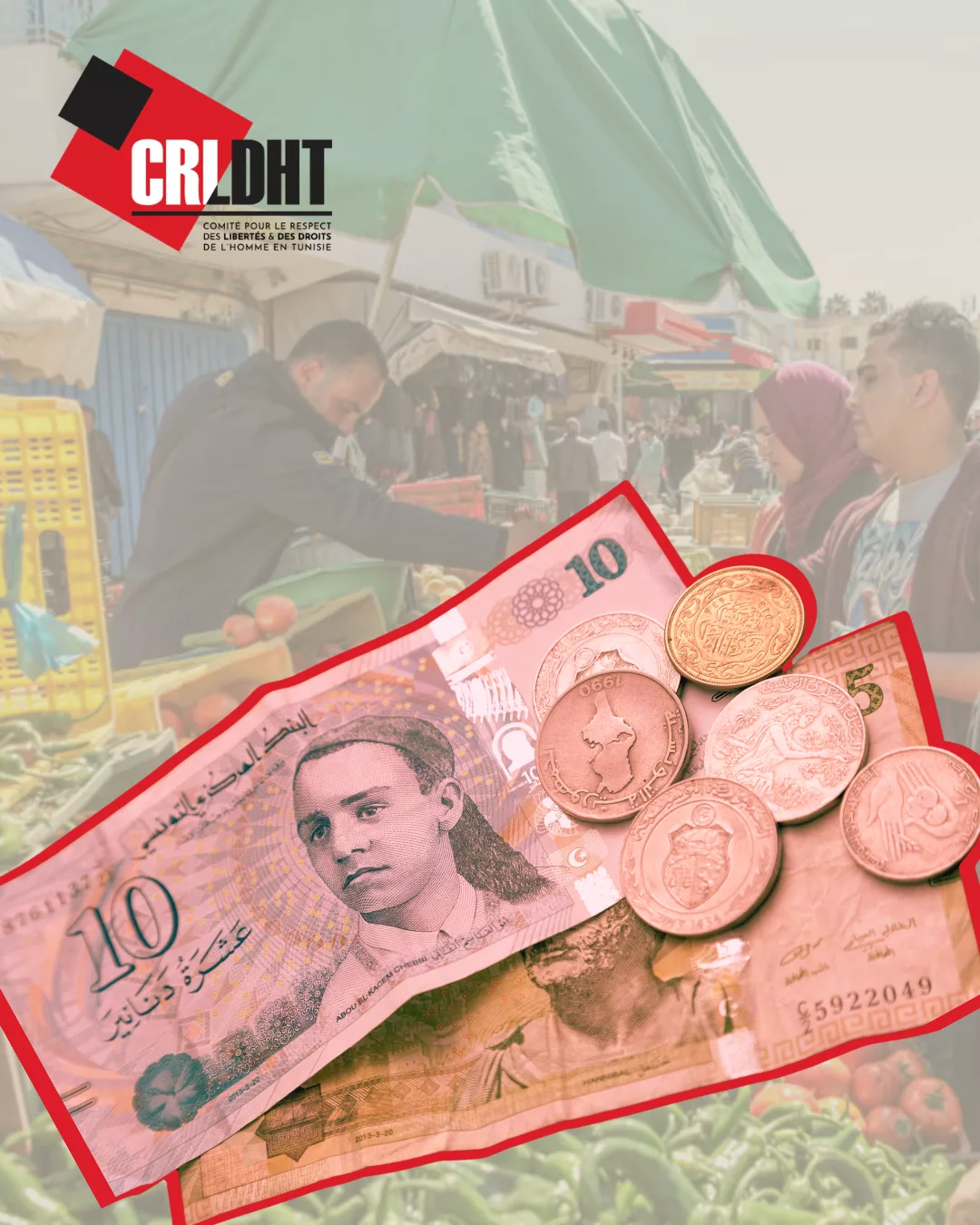
The debate over the minimum wage in Tunisia goes beyond simply setting a legal minimum wage. It raises a deeper question: the actual ability of workers to live with dignity amid sustained price increases and stagnant incomes.
Data published by the Al Qatiba website (https://www.facebook.com/share/p/1DkC2r8dou/?mibextid=wwXIfr) show that in 2025, the minimum wage in Tunisia will be approximately 528 dinars per month for a 48-hour workweek. This corresponds to approximately 155 to 160 euros per month at the current exchange rate.
However, recent increases in minimum wages have lagged significantly behind the rise in the cost of living. Between 2021 and 2025, increases in the minimum wage totaled approximately 22.9%, while cumulative inflation exceeded 33% over the same period. In other words, minimum wages have risen more slowly than prices, meaning that workers’ real purchasing power has declined.
Analyses published by Al Qatiba confirm this assessment. The website points out that the successive increases in the minimum wage—7% in 2024 and 7.5% in 2025—remain insufficient to offset the erosion of purchasing power accumulated during years of high inflation. A study cited by the website indicates that an employee who earned 1,500 dinars in 2022 and 1,650 dinars in 2025 would still have lost approximately 13% of their real purchasing power.
The relative low level of Tunisia’s minimum wage becomes even more apparent when compared to similar countries in the region. Converted to euros, the monthly minimum wages are approximately as follows:
| Country | Minimum wage | Approximate equivalent |
| 🇯🇴 Jordan | 290 Jordanian dinars | Approx. €375–380 |
| 🇲🇦 Morocco | 3,100 dirhams | approx . €285–290 |
| 🇩🇿 Algeria | 24,000 Algerian dinars | approx . €165–170 |
| 🇹🇳 Tunisia | 528 Tunisian dinars | approx . €155–160 |
As a result, Tunisia’s minimum wage ranks among the lowest in the region. It is roughly half that of Morocco’s and less than a quarter of Jordan’s, while it stands slightly below Algeria’s minimum wage, depending on exchange rate fluctuations.
The visuals published by Al Qatiba also highlight another key point: in Tunisia, the minimum wage is not merely a wage floor. It also serves as a benchmark for a significant portion of economic and social rights, including:
certain social security mechanisms,
calculations related to pensions and retirement benefits,
access to certain public programs such as public housing, subsidized loans, or certain types of health insurance.
In other words, when the minimum wage remains too low, it is not only workers’ direct income that is affected: the entire social safety net is dragged down as a result.
Finally, recent studies indicate that the average wage in Tunisia’s private sector is around 665 dinars, while the cost of living for a family of four in major cities is estimated at at least 3,000 dinars per month to cover basic needs. This growing gap between income and expenses explains the mounting social pressure, the weakening of the middle class, and the proliferation of strategies for economic survival.
Thus, the issue of the minimum wage goes far beyond that of a mere economic indicator. Today, it serves as a barometer of Tunisia’s social crisis:
gradual loss of purchasing power,
sustained pressure on low wages,
erosion of social protections,
and the growing difficulty for a significant portion of the population to maintain a decent standard of living.
In this context, the debate over raising the minimum wage does not concern only a few hundred thousand workers earning the legal minimum. It actually affects a broad range of low-wage earners—nearly half of all employees in the formal sector—whose wages remain directly or indirectly tied to this threshold.