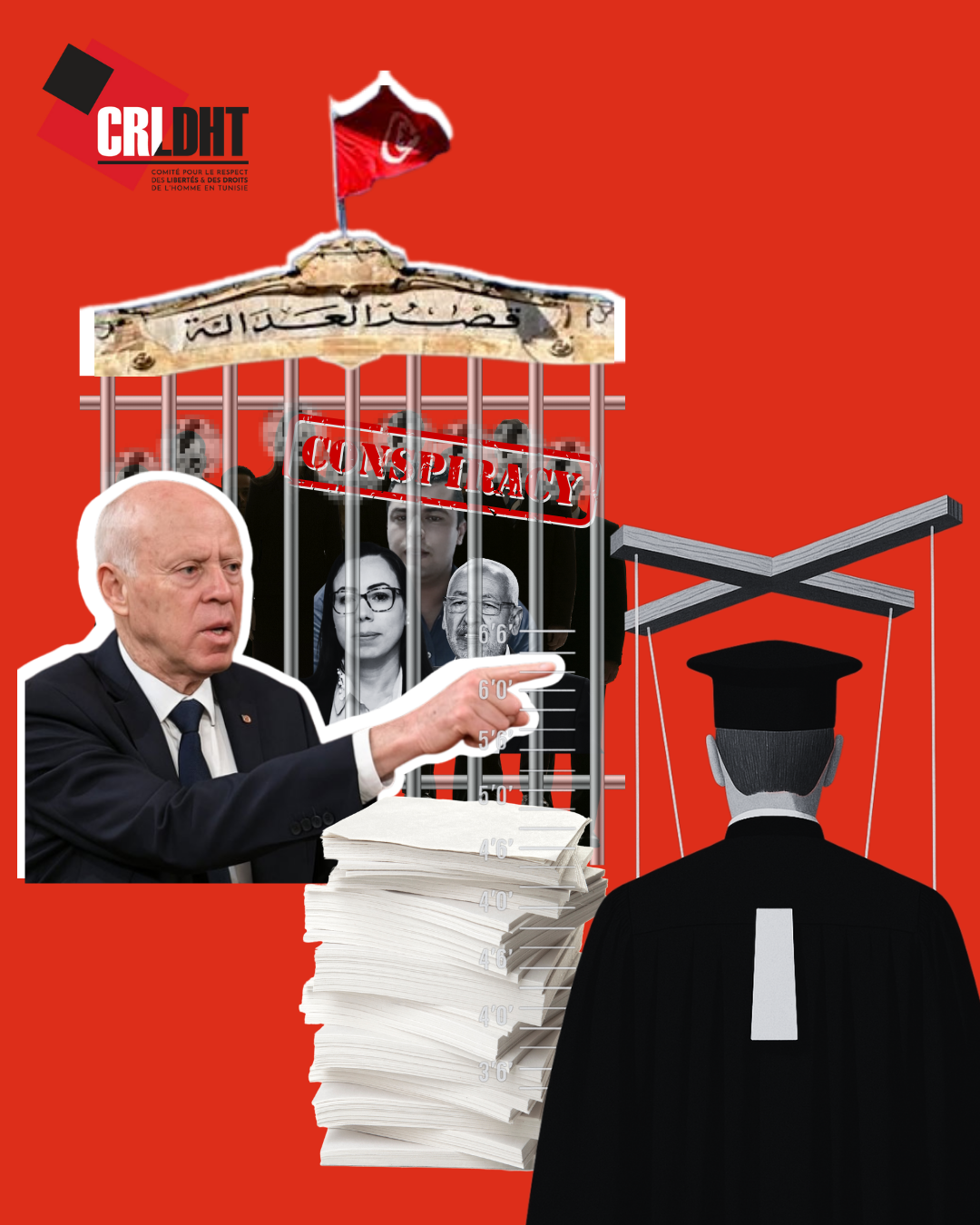
In an increasingly heavy-handed and authoritarian atmosphere, Tunisia has reached a new milestone in the instrumentalization of justice for political ends. On July 8, 2025, the criminal division of the anti-terrorism section of the Tunis Court of First Instance handed down its verdict in the case known as "Conspiracy against State Security 2". The sentences are heavy, the procedures contested and the political motivations obvious.
Massive convictions against a backdrop of lack of evidence
Among the main convicts was Rached Ghannouchi, former president of the dissolved parliament and historic leader of the Ennahdha movement, who was sentenced to 14 years in prison. Detained since April 17, 2023, he has refused to appear before a court he describes as "judicial theater", denouncing an unfair and political trial. This new conviction comes on top of several sentences already handed down against him, including 22 years in prison in the so-called "Instalingo" case and 1? years for remarks described as "incitement to hatred" in what the press dubbed the "tağūt" affair. At over 84 years of age, Rached Ghannouchi's health is seriously deteriorating in detention, without access to the necessary medical care, in conditions incompatible with his age and medical situation.
Six other defendants, present at a distance from their places of incarceration, were sentenced to 12 years' imprisonment each: Habib Ellouze (former Ennahdha deputy), Rayen Hamzaoui (mayor of the municipality of Ezzahra, former Nidaa Tounes), Mehrez Zouari (former head of special services at the Ministry of the Interior), Abdelkarim Labidi (former head of security at Carthage airport), Kamel Bedoui (former army officer) and Fethi Beldi (former Ministry of the Interior official).
But it was the sentences in absentia that marked a spectacular turning point: 35 years in prison with immediate execution against thirteen figures, including Nadia Akacha (former head of the presidential cabinet), Chahrazed Akacha (journalist), Mouadh Ghannouchi (son of Rached Ghannouchi) , Lotfi Zitoun (former minister, former member of Ennahdha) , Maher Zid ( former deputy), Rafik Bouchlaka (former Ennahdha minister), Kamel Guizani (former ambassador, former head of national security) and others. A heterogeneous list, bringing together Islamists, technocrats, those close to the President and former allies turned dissidents.
Serious accusations ... but without any tangible basis
The indictment is based on particularly heavy charges: conspiracy against state security, terrorist conspiracy, recruitment for violent acts, attempted overthrow of the constitutional order, among others.
But the whole case rests exclusively on the statements of two anonymous witnesses, nicknamed "X" and "Chekib", whose testimonies are contradictory, partially retracted and not corroborated by material evidence.
No phone taps, no seized plans, no weapons, no evidence of money laundering or logistical coordination were presented. Worse still, some defendants were prosecuted simply because their telephone number appeared in a co-accused's directory.
Systematic violation of fair trial standards
Many voices, including defence lawyers, denounce an unfair trial:
- Hearings held remotely, with no possibility of direct confrontation.
- Denial of the right to a public trial.
- Impossibility for lawyers to plead fully.
- Use of anonymous witnesses not questioned by the defense, in violation of article 14.3.e of the International Covenant on Civil and Political Rights (ICCPR) and article 7 of the African Charter on Human and Peoples' Rights.
These practices seriously compromise judicial independence. The Tunisian judiciary, brought to heel by successive purges since July 25, 2021, now acts as an extension of the executive.
A tool for widespread political repression
The Complot 2 case is not an isolated one. It is part of a long series of prosecutions against opponents and critical figures such as :
- Ali Larayedh: 34 years in prison.
- Khayem Turki: 48 years old.
- Kamel Letaief: 66 years old.
- Noureddine Bhiri: 43 years old
The Kaies Saied system fabricates a logic of collective guilt, extending suspicion to anyone who had a political role between 2011 and 2019. A strategy of criminalizing the democratic past, aimed at legitimizing the authoritarian present.
A climate of repression and despair
This affair sheds light on a well-oiled strategy: broadening the spectrum of repression to disorientate, fragment and intimidate the opposition. Even within its own ranks: the inclusion of Nadia Akacha, despite being the architect of Kaïs Saïed's rise, shows that no-one is immune. The message is clear: loyalty does not protect against banishment.
Reactions were numerous:
- Rached Ghannouchi's defense denounced a judgment handed down without a regular hearing or the opportunity to plead.
- The Salvation Front coalition calls it a "judicial masquerade".
- Several international NGOs and independent jurists are concerned about the normalization of exceptional trials and the collapse of fundamental guarantees in Tunisia.
The "plot 2" trial marks a new stage in the drift of Tunisian power. This is not a fight against terrorism, but a political trial of exclusion, aimed at erasing a decade of pluralism and closing once and for all the democratic parenthesis opened in 2011.
International silence in the face of this normalization of repression can only reinforce the impunity of a power that makes fear, suspicion and arbitrariness the pillars of its governance.
Those who thought they were burying ideas with condemnations may well see resistance reborn once again in other forms.
In view of the seriousness of the violations observed in the so-called "Plot against State Security 2" case, the Committee for the Respect of Freedoms and Human Rights in Tunisia (CRLDHT) calls on :
- Annul judgments handed down in disregard of fundamental guarantees, in particular the right to a fair trial, the right to be heard and the right to defend oneself.
- Immediate release of all people detained for their political opinions or commitments, with priority given to those exposed to health risks due to their age or condition.
- Put an end to the use of anti-terrorism laws, which have been misused to repress opponents, intimidate civil society and neutralize public debate.
- Strengthen solidarity networks with detainees' families, targeted lawyers and harassed civil organizations, in order to preserve a civil space now threatened with collapse.