
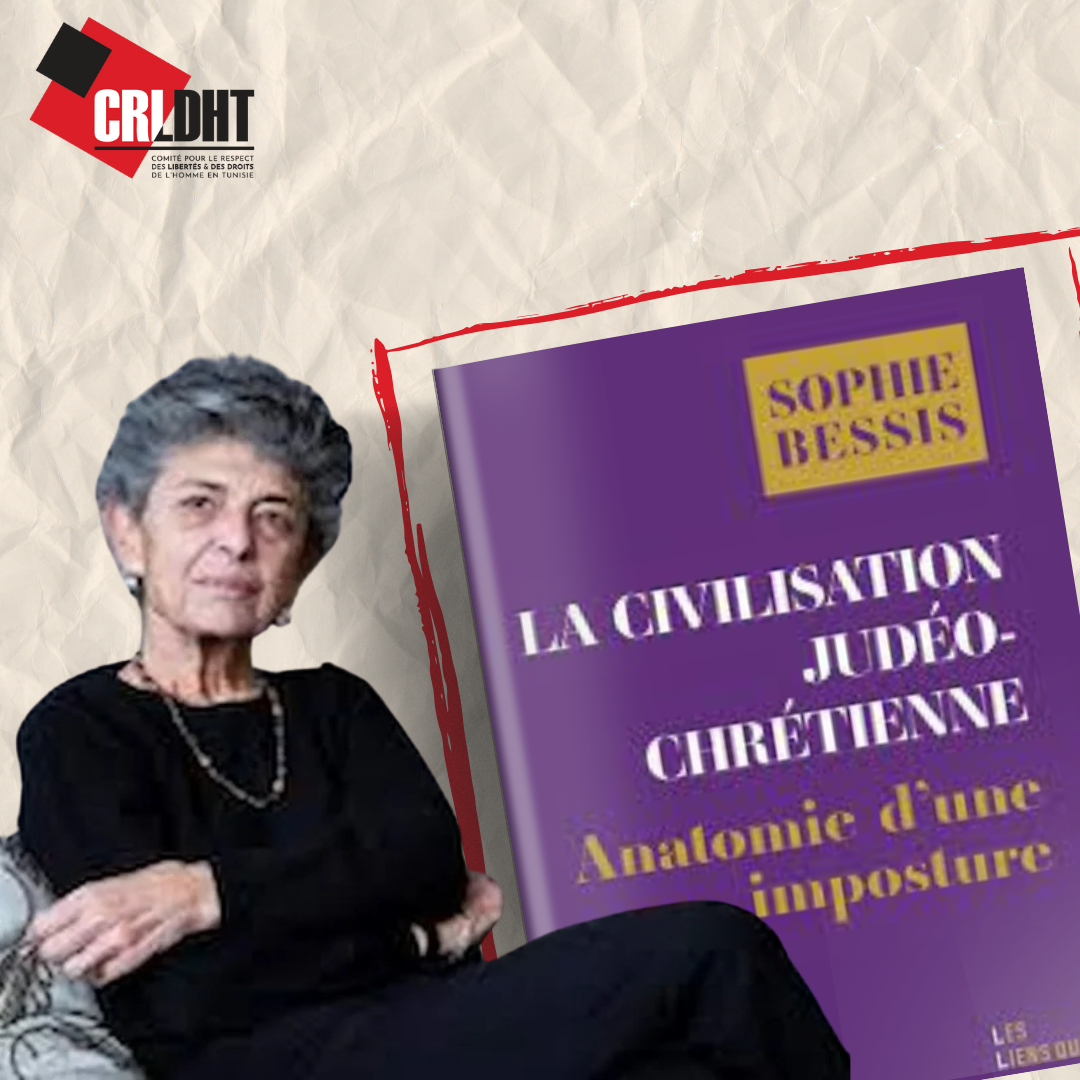
The publication of Sophie Bessis's La Civilisation judéo-chrétienne : anatomie d'une imposture (Judeo-Christian civilization: anatomy of a sham ) triggered an astonishing media frenzy. For an essay of barely 100 pages, written by an intellectual of long standing but little courted by mainstream platforms, the press coverage - from Blast to Le Monde, via podcasts, TV debates and cultural programs - seems disproportionate. Why such a sudden infatuation with a little pamphlet that, moreover, merely reveals what so many others had already sensed: that "Judeo-Christian civilization" is not a historical reality, but an ideological figment?
This excitement is due first and foremost to the force of the intellectual gesture. By deconstructing the expression, S.Bessis does not merely criticize it. She takes it apart, revealing its political, identity and geopolitical underpinnings. What presents itself as a consensual cultural label turns out to be a machine of exclusion: a performative tool that erases the Muslim contribution to European history, rewrites Judeo-Christian relations and erects Israel as an outpost of the West.
But this paradoxical media success also reveals a nervousness. For S.Bessis not only points to the extreme right's use of the term, she also sheds light on the soft consensus that has grown up around it. She shows that the left, the classical right and the liberal center have also seized upon it, under the guise of universal values or the defense of democracy. The expression functions as a comfortable fiction, allowing the West to symbolically redeem itself from the Shoah while stigmatizing Islam, designated as the enemy of civilized humanity.
In this respect, the book is a gentle bomb: it points to the heart of current Western political discourse, its founding lies, its consoling myths. And this is undoubtedly the key to its enthusiastic reception: it celebrates not so much the analysis as the relief it brings. Finally, someone says what many no longer dare to name: that behind the apparent Judeo-Christian reconciliation lies a historical repression, a symbolic manipulation, a tool of cultural warfare.
What the author brings to light is a great replacement... semantic. The shift, in the 1980s, from a European narrative based on secularism, the Enlightenment and the Greco-Roman heritage to a neo-identitarian narrative in which Europe is defined by its "Judeo-Christian roots" marks an ideological shift: religion is reinvesting the public sphere, but in an ideologized, instrumental, post-political form. And in this narrative, Islam is no longer simply the other: it is the antithesis.
This falsification is doubly dangerous. It places European Jews in a position of symbolic assignment to Israel, as if their Jewishness necessarily bound them to a state that claims to represent them all. And it freezes Muslims in a status of radical, suspicious and violent otherness. In this configuration, coexistence becomes suspect, plurality unthinkable and solidarity impossible.
The impact of S.Bessis's book lies less in its novelty than in its clarity. It does what few recent essays have dared to do: name, historicize and deconstruct. It yields neither to easy polemics nor to soft neutrality. He refuses the logic of erasure - whether of Eastern Judaism, Judeo-Arab relations, or the contributions of Islam to European history. And it is perhaps here, in this stubborn refusal to simplify, that the key to its impact lies: it lays bare a discourse that has become hegemonic, without ever yielding to the ease of indignation or the comfort of silence.
So it's not just a "little book" that has made an impact. It's a radical challenge to a language that has become natural, but is in no way natural. In this sense, the media frenzy is also a recognition of a truth that has been kept quiet for too long, of a necessary discomfort and a precious lucidity.
Sophie Bessis, La civilisation judéo-chrétienne , Anatomie d'une imposture, Editions Les liens qui libèrent (LLL) ; February 2025 : site : www.lesliensquiliberent.fr