Rania Berro and Hamza Meddeb, "Navigating uncertainty" (Arab Reform Initiative, April 2025)
A breath of democracy quickly overtaken by authoritarianism
Fourteen years after the January 2011 revolution, Tunisia, long considered the democratic exception in the Arab world, is experiencing a severe setback in fundamental freedoms. Civil society, which was one of the pillars of the democratic transition, is now seeing its scope for action drastically reduced. The report by Rania Berro and Hamza Meddeb for the Arab Reform Initiative(2025-04-FRENCH-Navigating-Uncertainty-Civil-Societys-Struggles-and-Challenges-in-Post-2011-Tunisia.pdf ) provides a detailed analysis of this trajectory of hope, resistance and disillusionment. It sheds light on the profound changes taking place in Tunisia's associative fabric, its major contributions but also its vulnerabilities, against a backdrop of resurgent authoritarianism.
Post-2011: a decade of civic effervescence
The overthrow of the Ben Ali regime ushered in an unprecedented cycle of liberalization. Decree-Law 88 of 2011 marks a historic breakthrough: it guarantees the freedom to create associations by simple declaration, enshrines the right to access information, authorizes foreign funding and broadens the scope of action of NGOs to include long-prohibited areas such as human rights, governance or transitional justice.
As a result, the number of associations has exploded, rising from 9,000 in 2010 to almost 25,000 by 2023. Among them, a minority - around 300 to 400 - stand out for their commitment to democratic and social struggles. Organizations such as Al-Bawsala, I-Watch, FTDES and Mourakiboun have established themselves as counter-powers, promoting transparency, accountability and the defense of fundamental rights. The role of the Quartet (UGTT, UTICA, ONAT, LTDH) in resolving the 2013 political crisis, crowned with the Nobel Peace Prize in 2015, embodies the pinnacle of this recognized and legitimate civil society.
A vital force ... fractured and weakened
But this dynamic is accompanied by structural imbalances. The report identifies eight major limitations that weaken the capacity of CSOs to resist authoritarian restoration:
- Double-edged professionalization: While it has led to an increase in expertise, it has also fuelled mistrust, reinforcing the image of "foreign-funded technocrats" out of touch with grassroots realities.
- An imbalance between procedural and substantive democracy: by focusing on legislative reform rather than social or economic change, CSOs neglected the demands for social justice, territorial equality and economic reform - which were the real drivers of the 2011 uprising.
- A growing gap between established CSOs and informal activism: mutual distrust, generational divides, tensions between professionalized structures and horizontal movements (such as EnaZeda, Manich Msamah or Falgatna) undermine the cohesion of the civic field.
- A persistent divide between secular and Islamist currents: the inability to overcome ideological polarization has prevented the formation of common fronts in the face of democratic setbacks, to the point of justifying, for some, Kaïs Saïed's coup de force in 2021.
- The ambivalent role of the UGTT: sometimes a driving force, sometimes a brake, the union has given priority to defending the interests of its civil service affiliates, to the detriment of solidarity with marginalized classes and autonomous social movements.
- The porosity between activism and political ambition: associations have served as electoral springboards, blurring the line between disinterested commitment and power strategy, and fuelling public distrust.
- Dependence on international donors: the project-based funding model has often led CSOs to follow donor priorities (counter-extremism, entrepreneurship, migration) rather than articulate their actions with local needs.
- The absence of major institutional reforms: the non-installation of a Constitutional Court and the abortive reform of the judiciary and police have permanently undermined the rule of law, paving the way for an all-powerful executive.
An authoritarian turn confirmed
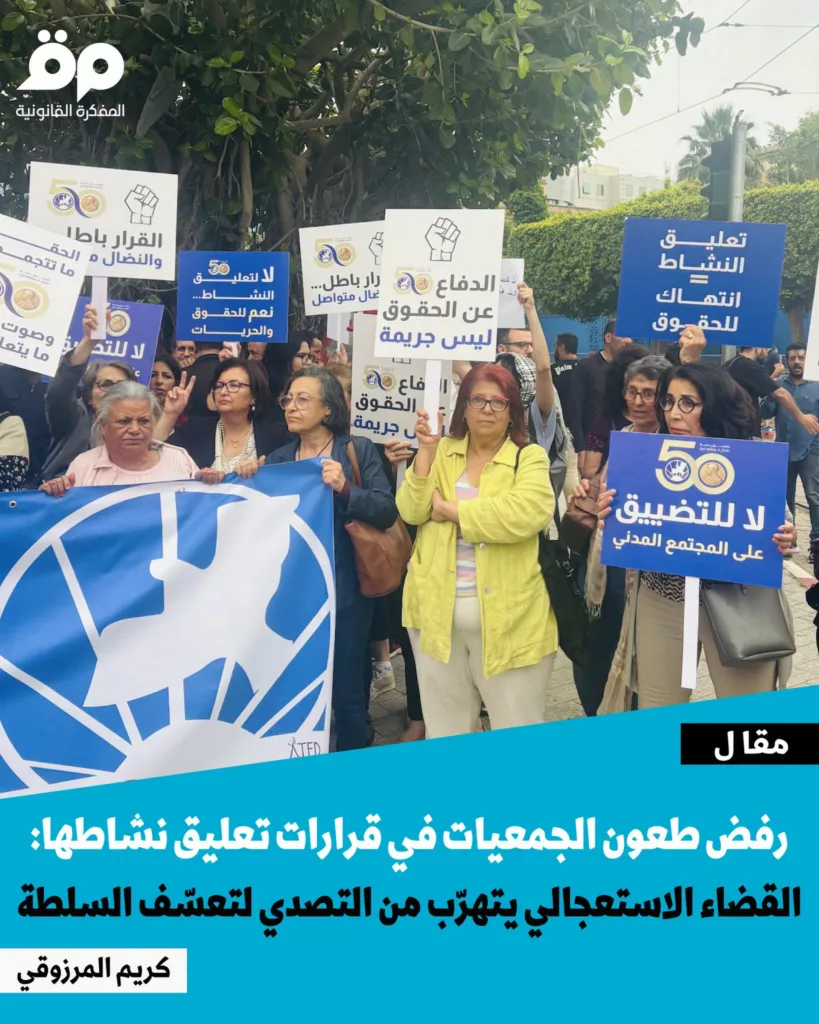
Since 2019, signals of a shrinking civic space have been multiplying. The post-attack security climate, the 2015 anti-terrorism law, accusations of money laundering and treason against NGOs, and attacks on human rights defenders have weakened CSOs. Decree-Law 54 of 2022 on cybercrime reinforced the criminalization of critical opinions.
With the concentration of power in the hands of President Saïed, the dissolution of Parliament, the dismantling of the independent judiciary and the stigmatization of NGOs as "agents of foreigners", Tunisian civil society is now faced with an assertive regime of repression.
Reconfiguring resistance: tomorrow's challenge
In the face of this drift, the report calls for a quantum leap. It calls for a civil society that fully assumes its political role, reconnects with popular aspirations, rebuilds broad, autonomous coalitions, and places social justice at the heart of its struggles. The challenge is no longer simply to preserve civic space, but to reconstitute it.
In a Tunisia where checks and balances are disappearing, civil society remains one of the last bastions of democratic vigilance. But to make an impact, it must overcome its divisions, free itself from the injunctions of technocratic neutrality, and reconnect with the driving forces behind the revolution: youth, marginalized territories, women and precarious workers. This is the price that will have to be paid if a new democratic hope is to take shape.