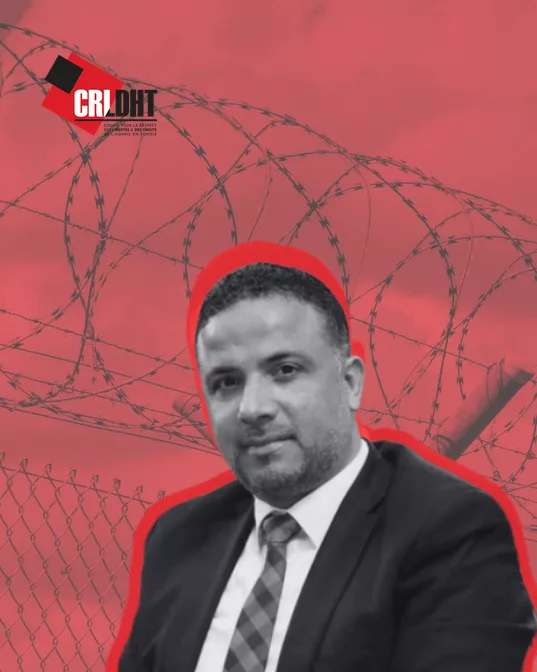
The Algerian authorities took the unexpected decision to hand Seifeddine Makhlouf over to the Tunisian authorities by land on the afternoon of Sunday, January 18, 2026.
Maître Seifeddine Makhlouf, lawyer, former member of parliament, and president of the Al Karama party, has been convicted several times by the judicial and military courts for the same acts, in violation of constitutional and conventional principles of criminal law, in the so-called airport case. He was also prosecuted in a case known as the "corridor" case, where an exchange with a member of the military prosecutor's office served as the basis for serious terrorism charges. The military court went so far as to violate the independence of the bar by prohibiting Mr. Makhlouf from practicing his profession as an additional penalty.
Mr. Makhlouf was arrested in Algeria after leaving Tunisia illegally. He was sentenced to three months in prison by an Algerian court, a sentence he served, and was then placed in a shelter run by the Office of the United Nations High Commissioner for Refugees, where requests for admission to several countries were refused, notably by Qatar and Turkey, despite the fact that he had always been politically close to the regimes in those countries.
In recent days, Mr. Makhlouf was preparing to leave Algeria for the United Kingdom, where his application for family reunification had been processed and approved, when suddenly the Algerian authorities abruptly changed their minds and handed him over to the regime of Kaïs Saïed.
This extradition appears all the more problematic given that it took place without any effective judicial guarantees and in clear contradiction with Algeria's legal commitments. Indeed, the Tunisian-Algerian Mutual Assistance Convention of December 15, 2021, ratified by Algeria by Presidential Decree 26-66 of February 4, 2025, stipulates in Article 4 that extradition requests must be refused if extradition constitutes a violation of international human rights principles, in particular those set out in the International Covenant on Civil and Political Rights (paragraph 1(d)), or if the crimes are considered political or related to political crimes (paragraph 1(e)). Extradition may also be refused if there are grounds for believing that the trial or sentence is based on the political opinion of the person concerned (paragraph 2(a)).
The CRLDHT :
- Denounce these despicable maneuvers by the Algerian authorities, since the extradition was outside the legal framework.
- Deplores the absence of any judicial remedy against the extrajudicial decision to extradite, which deprives the person surrendered of all the guarantees offered by the Convention, the Constitution, and Algerian law.
- Expresses outrage and condemns the attitudes of the Qatari and Turkish authorities in response to the humanitarian request made on behalf of Mr. Makhlouf.
- Calls for the immediate provisional release of Mr. Seifeddine Makhlouf and for his rights to a fair trial to be respected.