- The facts and content of the case at first instance
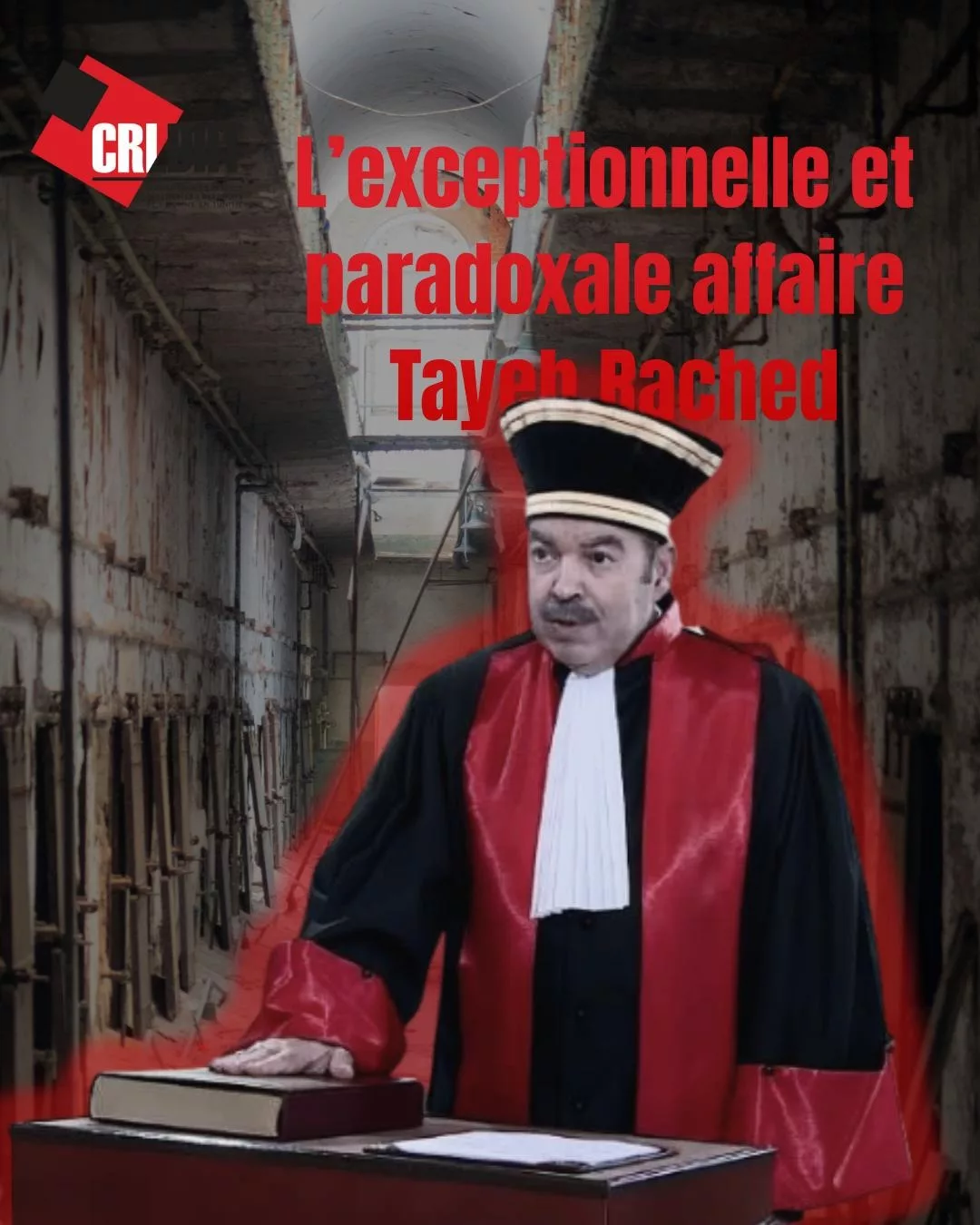
Tayeb Rached, former omnipotent First President of the Tunisian Court of Cassation (2019) and former Advocate General at the Tunis Court of Appeal, has been the main protagonist of a highly publicized and closely followed conflict since 2020. He was convicted on October 27, 2025 by the Tunis Court of First Instance on several charges, including corruption.
When the Conseil supérieur de la magistrature examined a disciplinary file concerning two magistrates, it discovered that they were merely executors - "small fish". It then decided to order a disciplinary and a judicial investigation to unmask the perpetrators of a well-honed network of judicial corruption.
This was the starting point of what became known as the "affair of cassations without referrals".
The First President of the highest judicial court, Tayeb Rached, was suspected of having intervened - already when he was Advocate General - on behalf of businessmen in a criminal case with high economic stakes. He was alleged to have influenced the proceedings so that the case would be closed in cassation without referral, in return for the payment of large sums of money, thus causing considerable damage to the State.
These facts were only the tree that hid the forest: the interested party allegedly orchestrated a procedural mechanism reminiscent of the "corridor" of Ben Ali's time, by setting up a chamber of cassation with an illegal composition (the two judges disciplinarily sentenced at the start of the case were part of it), which handed down rulings "at the request" of Tayeb Rached.
Investigations revealed other facts and actions liable to heavy criminal penalties.
- Chronology of key events
- June 23, 2019: the Inspectorate General of the Ministry of Justice is seized of a case involving procedural breaches in several cases of cassation without referral.
- November 2019: the Inspectorate General submits an initial preliminary report confirming the existence of serious overruns and irregularities.
- November 2019: the case is officially referred to the Public Prosecutor's Office for judicial investigation.
- September 2020: opening of an investigation file and request to lift the immunity of the First President of the Court of Cassation, Tayeb Rached.
- November 2020: effective lifting of immunity by the Supreme Judicial Council.
- December 2020: Tayeb Rached's membership of the Supreme Judicial Council is frozen.
This sequence of acts marks the shift of the case from the disciplinary to the criminal arena, paving the way for in-depth investigations and legal proceedings culminating in the judgment of October 27, 2025.
- Decision of October 27, 2025
The defendants were convicted, according to their respective roles, of corruption and illicit enrichment, forgery of public documents, abuse of office, money laundering and use of falsified documents.
Abderrazak Bahouri and Marouane Tellili were convicted of forgery of a public document, passive corruption, criminal conspiracy for unlawful enrichment and bribery mediation.
The prison sentences were heavy: Tayeb Rached was sentenced to around 30 years' imprisonment.
Complementary penalties were also handed down: substantial fines, confiscation of accounts and land titles, and joint and several payment of a record amount of over 935 million dinars to the State as compensation, with immediate execution.
- The judicial and institutional context: justice under presidential tutelage
Although the evidence published and publicized against Tayeb Rached and the other defendants is overwhelming, this should not obscure the fact - or rather the truth - that they did not receive a fair trial.
However obvious guilt may be, it cannot deprive the accused of their fundamental rights. A fair trial, although enshrined in the Constitution of Kaïs Saïed, has become impossible in the current context.
Since July 25, 2021, the Tunisian judiciary has become the methodical target of the President, who has arrogated all powers to himself through supraconstitutional decree n°117/2021, and then through a Constitution he himself drafted.
In February 2022, Legislative Decree no. 11/2022 dissolved the elected Supreme Judicial Council, replacing it with a provisional council whose members are appointed by the President. The organic law governing the Council was repealed.
In June 2022, Decree-Law no. 35/2022 further strengthened presidential power: the President can now dismiss any magistrate without any prior disciplinary or adversarial procedure. The dismissed magistrate is automatically prosecuted, with no possibility of appeal before trial.
On the same night, 57 magistrates were dismissed. The suspended sentences handed down by the administrative court, as well as the provisional ruling of the African Court of Human Rights ordering the suspension of these dismissals, were not respected.
The President's public denigration and recurrent threats against magistrates have created a climate of terror. To better control them, he failed to appoint new members to the Conseil supérieur de la magistrature, which now lacks a quorum.
Transfers and promotions are now made by simple memos from the Minister of Justice, depending on the docility of those concerned.
Under these conditions, the independence of the judiciary is irremediably compromised. Every accused person becomes, from the outset, a victim of a violation of his or her fundamental rights.
Kaïs Saïed's "war against corruption" is thus transformed into a factory of victims: the real culprits become the victims of an illegitimate justice system, which will compromise any future restoration of the rule of law.
- History and progress of the case
The Tayeb Rached affair would probably not have come to light had it not been for the vigilance of the elected Supreme Judicial Council, which uncovered a veritable iceberg of corruption.
However, the Council, and in particular the Supreme Judicial Council, was not unanimous on this highly divisive issue.
Despite compelling evidence, Tayeb Rached was not suspended from his duties as First President of the Court of Cassation until August 20, 2021, which further weakened the Council.
Its President, Youssef Bouzekher, and a few members nevertheless held firm to ensure that serious investigations were carried out.
The decisive role played by the Public Prosecutor at the Tunis Court of First Instance, whose investigation revealed damning facts against Tayeb Rached, should also be highlighted.
This affair was unprecedented in more ways than one. It was the first time in Tunisia's history :
- That a sitting First President of the Court of Cassation is being prosecuted for corruption (three criminal prosecutions);
- That a First President of the Court of Cassation should have his immunity lifted;
- That he be suspended as a member of the Conseil supérieur de la magistrature while continuing to preside over the Cour de cassation;
- That he should continue to practice while his immunity is lifted and his suspension pronounced;
- That a criminal and disciplinary case involving magistrates at this level should be so highly publicized;
- That a First President of the Court of Cassation should appear on a television program to plead his innocence on a channel owned by an alleged beneficiary of corruption;
- That an issue divides the elected Board of Governors so much, with some decisions being made by a single vote.
The publication of the indictment and the documents in the file (title deeds, purchase contracts at derisory prices) gave the case a new dimension.
V. Critical analysis: contradictions and excesses
Tayeb Rached's defense tactics also amplified the affair. He documented anomalies and infractions committed by his colleagues, which he himself covered up, in order to blackmail them in the event of disagreement. He imposed a generalized omerta.
His defense consisted in politicizing the case: he accused Bachir El Akremi of terrorism and collusion with Ennahdha, rallied political and media support, and turned the case into a media duel between Rached and Akremi.
Magistrates who had denounced the preferential treatment given to Rached were in turn targeted, as was Hamadi Rahmani, author of statutes and petitions calling for the suspension of the First President.
Ironically, on October 30, 2025, Rahmani appeared before the correctional chamber of the Tunis court, accused of defamation following a complaint by Tayeb Rached.
Dismissed by the Kaïs Saïed regime, he is now under judicial attack for having defended the independence of the judiciary.
Another contradiction is the fate reserved for Bechir Akremi, Public Prosecutor of the Tunis Court, whose conviction of Rached actually confirms his integrity.
Persecuted, tortured and arbitrarily detained, Akremi was one of the first to reveal the offences attributed to Rached.
Kaïs Saïed's judiciary has no qualms about convicting Tayeb Rached of corruption, while prosecuting Hamadi Rahmani for denouncing the same corruption.
This is a form of justice that denies the adversarial process and enshrines contradiction.
- Recommendations and lessons learned
- Guaranteeing the independence of the judiciary
- Restore an elected, autonomous High Council of the Judiciary with constitutional guarantees.
- Repeal decree-laws n°11/2022 and n°35/2022, which place the judiciary under the direct authority of the President.
- Ensuring the right to a fair trial
- Reinstate fundamental procedural guarantees (adversarial process, publicity, right to defense).
- Put an end to exceptional justice and to judgments handed down under political influence.
- Protecting magistrates and whistleblowers
- Rehabilitate and compensate arbitrarily dismissed judges.
- Protect judges, lawyers and prosecutors who denounce corruption or defend the rule of law.
- Restoring the credibility of the judicial system
- Publish the Tayeb Rached judgments and related decisions in full to restore public confidence.
- Establish an independent commission to audit the decisions of the Cour de cassation since 2018.
- Preventing the "victim factory
- Recognize that the fight against corruption can only be credible within a framework of the rule of law.
- Reject the use of justice to settle political scores.
Conclusion
God forbid that Kaïs Saïed's "justice" should be fair.
The Tayeb Rached affair, in all its complexity, reveals both the depth of corruption and the bankruptcy of a judiciary under political tutelage.
This is a historic turning point that should serve as a warning and the basis for a democratic overhaul of Tunisian justice.