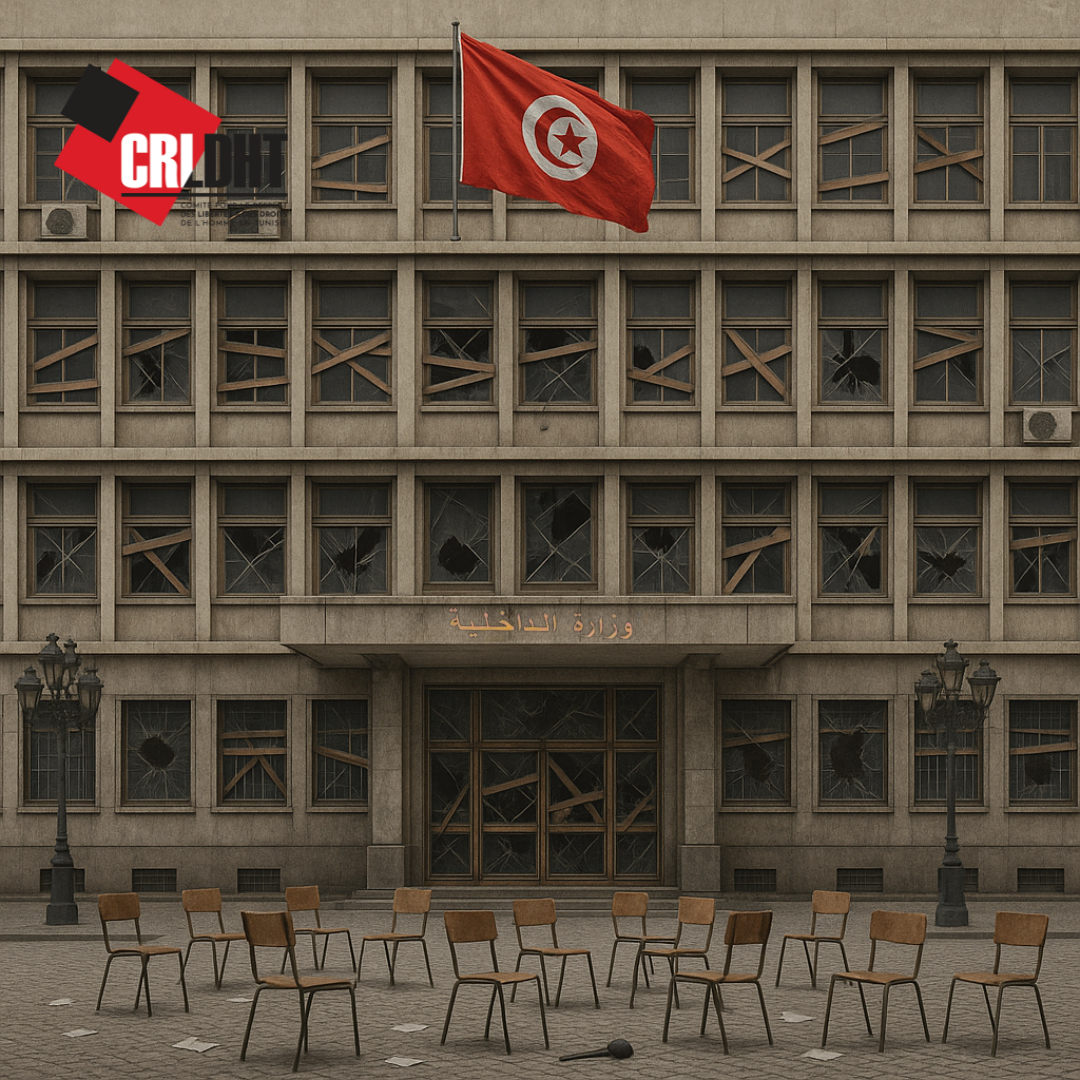
At a time when Tunisia is experiencing a profound regression in democracy, the promulgation of organic law no. 4/2025 has given a semblance of legitimacy to institutions devoid of content. The local, regional and district councils set up under the aegis of Kaïs Saïed are less a step towards participatory democracy than a further illustration of the regime's authoritarian verticality.
A reform designed to neutralize checks and balances
After a delay of more than two years, organic law no. 4/2025 of March 12, 2025 has finally been promulgated and published in the Official Journal of the Republic of Tunisia. It is a creation of President Kaïs Saïed, the fruit of his own Constitution adopted in 2022, designed to put into practice his vague theory of "building from below". A project presented as emancipatory, but which in reality aims to wipe out intermediary bodies, notably political parties. The individual-centric voting system and the narrow territorial division of constituencies have the mechanical effect of preventing any collective dynamic. The result: a weakened Assembly of People's Representatives, local and regional councils, and a National Council of Regions and Districts, unable to oppose presidential authority.
Institutions pulled out of the presidential hat
Like the Constitution of 2022, these institutions have not been the subject of any public debate, either academic or institutional. Their composition, missions and operating rules have never been clarified. The basic text reserves a section for the National Council of Regions and Districts, with a few elements on its composition and the draft texts to be submitted to it, but no legal framework is given for local, regional or district councils. The situation is totally improvised.
Absurd elections for indefinite councils
With legal anarchy becoming the norm, elections were organized for these undefined councils. The Independent High Authority for Elections (ISIE) even attempted to assign roles to these bodies, before withdrawing for lack of a legal basis. Citizens ran for office, defending their programs, without knowing what their duties would be, or even to which council they would belong, since some representatives are chosen by lot. Voters, for their part, voted blindly. The abstention rate reached world records. In some constituencies, no candidates were put forward - a rational decision, after all.
Elected officials reduced to presidential campaign agents
Once elected, the members of these councils did not stand out for their independence. Their friction with the delegates and governors fuelled the social networks. Above all, they mobilized during the presidential election to collect sponsorships for Kaïs Saïed, assuming the role of relays for a power that claims to abolish relays.
A façade of legal independence
It was not until 2025 that the organic law conferred legal status on these councils. Article 1 recognizes them as public bodies with administrative and financial independence. But this recognition comes at a time when elected municipal councils have been dissolved without renewal, and the end of municipal elections has been announced. The popular base is now in the hands of the appointed administration.
Unclear powers and a text with no effective scope
In terms of content, the organic law remains a model of ambiguity. The second paragraph of article 1 states that the councils must work towards "global and equitable economic and social integration" and debate draft plans. A vague formulation, with no means or mechanisms specified. Article 5 refers to a future organic law on budgets. Another phantom text.
A fictitious budget autonomy
The independence proclaimed in article 1 is largely contradicted by article 2, which introduces a logic of "accompaniment" of the administration, i.e. of tutelage. Article 9 reveals the real intention of the legislator: instead of transferring the assets of the former regional councils to the new ones, these are handed over to the State, via the Governor.
Permissions, allowances and decrees: logistical details
Article 6 of the law stipulates that council members may ask their employer for permission to attend meetings and training courses, subject to three days' notice. They may not be penalized for absence in this case, nor penalized in their careers.
Directors' fees, instability and dependency at the Ministry of the Interior
On April 4, 2025, two decrees supplemented the law:
- Decree n°177, which organizes the work of the councils in seven succinct articles. It imposes a rotating secretariat, a sign of the structural instability of these bodies.
- Decree n°178, which sets attendance allowances: 200 dinars per session (capped at 800 dinars per month), 300 dinars for disabled people (capped at 1,200 dinars).
These allowances are reminiscent of directors' fees in public limited companies. They are financed by the Ministry of the Interior, even though the law speaks of financial autonomy. What's worse, this expenditure is not even included in the 2025 budget, but comes into effect immediately!
Populist engineering out of touch with reality
This short but incoherent organic law only serves to give credence to the regime's populist rhetoric. In practice, these councils have no tools, no clear mandate and no popular legitimacy. The parallel with the Economic and Social Council of the Ben Ali era is tempting, except that the latter sometimes included competent profiles. Here, however, the level of expertise is glaringly inadequate.
The organs of institutional absurdity
With no effective mission and no solid legal framework, these councils are not part of any branch of government. They have no legislative, executive or even truly consultative powers. Deprived of experts, resources and a listening ear, they are nothing more than spectacular symbols of the absurdity of a regime that uses institutional forms to mask its democratic vacuum.