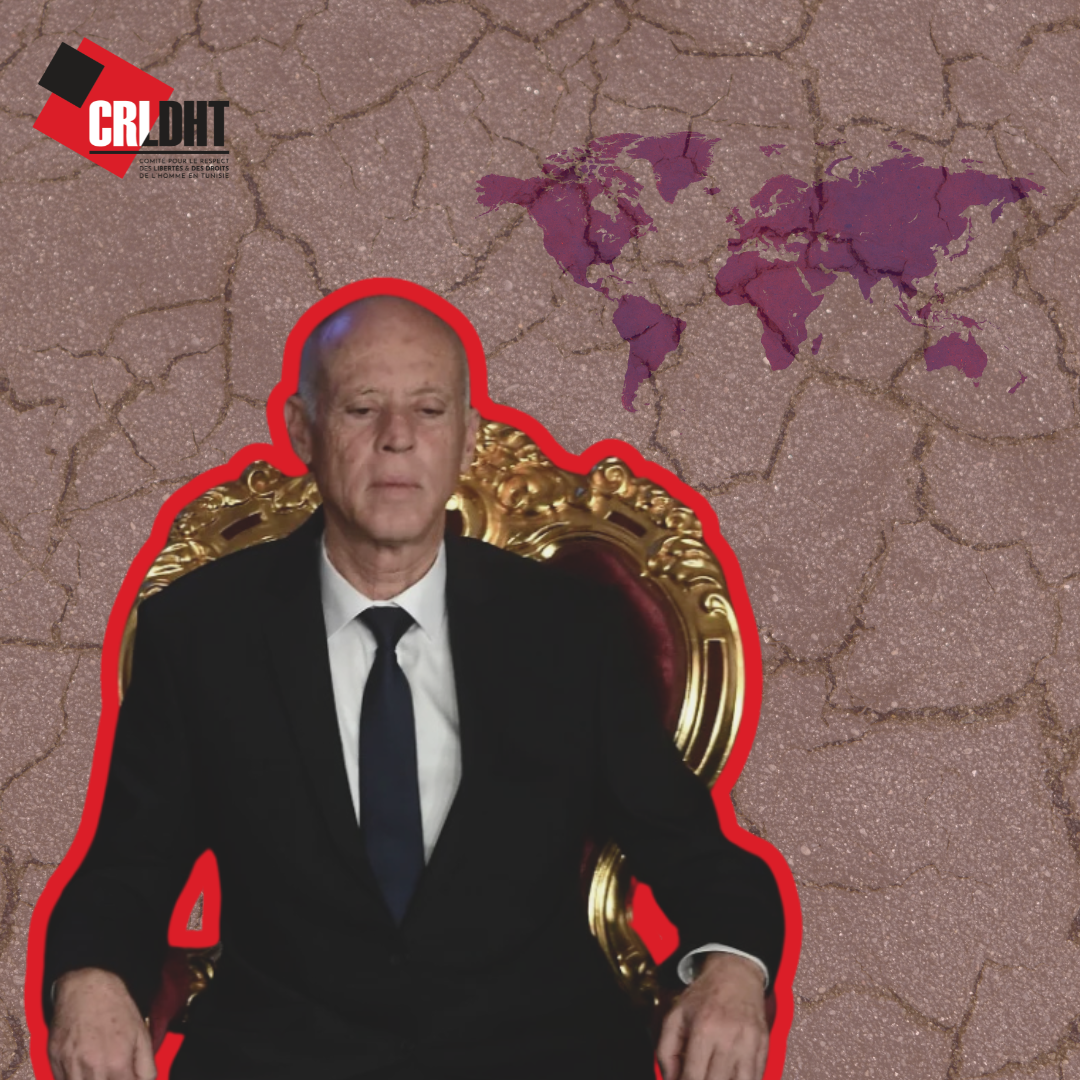
The recent sequence of events in Tunisia - from the withdrawal of the declaration recognizing the jurisdiction of the African Court of Human Rights, to the holding of the National Security Council and President Saïed's speech on that occasion, to the dismissal of Prime Minister Kamel El Madouri and the appointment of a new head of government at a late hour and without explanation - must not mask a glaring reality: this regime, and in particular President Kaïs Saïed its keystone, has locked itself into a diplomatic solitude unprecedented in Tunisia's history since independence.
Independence Day on March 20, 2025 highlighted the serious diplomatic situation in which Tunisia finds itself. Throughout the history of the Tunisian Republic, this celebration has always been an occasion for the President of the Republic to receive calls, letters or telegrams of protocolary congratulations recalling fraternal and friendly relations with heads of state and government with ties to Tunisia, shared values, or even positions on this or that issue. With Kaïs Saïed now at the helm, this routine exercise in protocol is a thing of the past.
In diplomacy, exchanges on the occasion of national holidays are a significant barometer of the level of relations a state maintains with its partners. Their absence cannot be reduced to a simple omission or a harmless oversight: in diplomacy, silence always has a meaning. Of course, tradition dictates that the closest countries, anxious to preserve their bilateral ties, are the first to respect and perpetuate these protocol practices. However, Kaïs Saïed's brutal exercise of power, particularly in his capacity as Tunisia's first diplomatic representative, has ruled out any prospect of consolidating - or even simply maintaining - fraternal and friendly relations with the country's international environment.
To date, only one telephone call from Algerian President Abdelmadjid Tebboune has been officially recorded on March 20, 2025, according to the Tunisian Presidency's Facebook page. Another call, on March 21, 2025, was also made to President Emmanuel Macron, according to the same source.
The evidence is unequivocal: the major capitals are missing in action. For the first time in the history of Tunisian-Moroccan relations, the Moroccan sovereign refrained from sending a message or making an appeal on the occasion of March 20. This weighty silence can be explained by Kaïs Saïed's openly partisan stance on the Western Sahara issue - an unprecedented stance that dealt a severe blow not only to bilateral relations with Rabat, but also to the Greater Maghreb project as a whole.
Nor did any of the various political authorities in Libya, another Maghreb neighbor, make the slightest diplomatic gesture. None of its leaders bothered to address the palace of Carthage.
Abdel Fattah al-Sissi's Egypt, which Kaïs Saïed seems to have taken as a model following his visit to Cairo - some even pointing to the direct involvement of Egyptian services in the coup d'état of July 25, 2021 -, also remained silent on the occasion of Tunisia's national holiday.
As for the Gulf monarchies, they seem to have completely ignored Kaïs Saïed and this national holiday. It has to be said that they never really envisaged a relationship of equals, despite the fact that Kaïs Saïed embodies, in many respects, the counter-revolution they actively supported in the region. His ambiguous relationship with Iran has only served to reinforce this distance from all conservative regimes.
The Arab League, whose last summit Kaïs Saïed ignored, aligning himself with the position of President Tebboune, did not address a few customary words of protocol. Kaïs Saïed's Tunisia is far from being audible or influential in the Arab League, unlike in the Bourguiba era, when Tunis hosted its headquarters and Chadli El Klibi was its Secretary General. Even under Ben Ali, Tunisia did not project the image of a poor relation.
On the African side, the diplomatic record is hardly any better. It is heavily tainted by the xenophobic and racist remarks made by President Kaïs Saïed in 2023, when he took up the conspiracy theory of the "great replacement" by directly targeting migrants from sub-Saharan Africa.
Kaïs Saïed's alleged pan-Africanism goes little further than a few perfunctory declarations. He has no strategic - or even tactical - vision for the African continent. The persistent silence of many African leaders with regard to Tunisia can also be explained by President Saïed's conspicuous absence from the last African Union summit, at a time when major issues were being discussed, notably migration and cooperation with countries of origin.
This voluntary disengagement reflects a purely utilitarian approach: Kaïs Saïed prefers to use the migration issue in his negotiations with the European Union, to the detriment of any South-South dialogue with African partners.
Relations between the European Union and Kaïs Saïed are an obvious paradox. On the one hand, on the basis of a memorandum, the EU continues to rely on its cooperation to curb irregular emigration - whether this concerns Tunisians or migrants from sub-Saharan Africa. On the other hand, Kaïs Saïed remains a politically toxic and increasingly unattractive partner. Even Giorgia Melloni, President of the Italian Council and privileged interlocutor of the Tunisian President in recent months, didn't say a word to him on the occasion of March 20.
This ambivalent relationship resembles a diplomatic "je t'aime moi non plus". One thing is certain: Kaïs Saïed finds himself in clear international isolation. And there's no need to mention the United States, whose attitude oscillates between apparent disinterest and indirect support for his coup.
In the final analysis, President Saïed received only one official message: that of his Algerian counterpart, Abdelmadjid Tebboune, with whom he enjoys an unbalanced relationship bordering on vassalization. The Tunisian regime, in the throes of losing both its internal legitimacy and its international credibility, now seems largely dependent on Algerian support for its survival.
The Algerian presidency also made it clear that its call was to offer its condolences following the death of one of Kaïs Saïed's relatives - a detail that was completely omitted from the Tunisian communiqué. This type of omission is not insignificant: the Tunisian presidency has already distinguished itself by regularly disseminating information that differs from that reported by the Head of State's foreign interlocutors. These are not translation errors, but deliberate manipulations for propaganda purposes.
In this regard, the Élysée Palace has not issued any statement confirming the alleged conversation of March 21, 2025, nor provided the slightest clarification of its content.
Under the reign of Kaïs Saïed, Tunisian diplomacy is becoming increasingly bogged down, with serious and systematic violations of human rights and the rule of law. Repeated warnings from UN institutions and Tunisian civil society alike bear witness to a generalized regression that affects all areas of public life.
The damage inflicted on Tunisia's foreign relations goes far beyond the image of an isolated or infrequent president. This diplomatic damage has a lasting impact on the country's essential interests, in the short, medium and long term.