
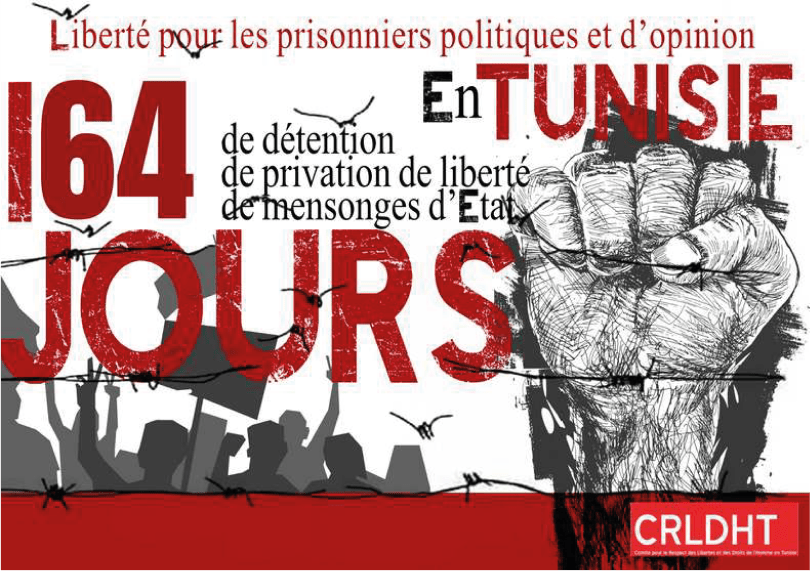
On July 13, 2023, a demonstration was organized in front of the Tunis Court of Appeal to call for the independence of a justice system that Kaïes Saïed uses to neutralize his opponents and critics, and to demand the release of political prisoners imprisoned for the past five months. On the same day, Chaïma Issa, an activist with the Salvation Front and the first political prisoner after the revolution, and Lazhar Akremi, a courageous critic of K. Saïed's authoritarian decisions, were released. However, their release was accompanied by a ban on travel and public appearances, presumably to prevent them from testifying to the false nature of the "plot against State security" dossier.
On her release from prison, Chaïma Issa issued a statement, a veritable urgent appeal to the Tunisian people, and in particular to its lifeblood. She calls for:
- the rejection of hatred and the primal desire for vengeance, of the propagation of division and division, in other words, of everything that underpins the populist presidential discourse that K. Saïed is trying to entrench in Tunisian society in order to maintain his power.
- to the unity of civil and political forces in order to obtain the release of political prisoners who have done nothing but oppose K. Saïed's anti-democratic measures and demand the restoration of the democratic path interrupted since July 25, 2021.
It considers that K. Saïed has not only deviated from the democratic course and aggravated the political crisis, but has also accentuated the acute economic and social crisis which today threatens the population on a daily basis due to inflation on an unprecedented scale and shortages of raw materials which are paralyzing many economic sectors.
Chaïma Issa also spoke of the moral crisis the country is going through, referring to the shameful attitude of the authorities towards African immigrants, the official position having nothing to envy to the rhetoric of the extreme right when it evokes the "plot to modify the demographic composition of Tunisia and attempt to change its Arab-Islamic identity".
Violating immigrants, attacking their property, pushing them back into the desert without food or shelter are nothing short of crimes against humanity.
In recounting her prison experience, she also spoke of the injustices suffered by women in ordinary prisons, whether in terms of harsh and sometimes unjust sentences, or mistreatment and lack of respect for their dignity and rights.
Finally, she expressed her gratitude and appreciation to the Defense Committee for "rescuing her from the prison monster" and defending her before and during her arrest.
The CRLDHT supports the activist Chaïma's position on the need to mobilize all forces to free all political prisoners. In turn, it expresses its deep gratitude to the Committee for the Defense of Political Prisoners, which has demonstrated their innocence and revealed the vacuity of the prosecution file, its strange contradictions and the many transgressions that accompanied their arrest and imprisonment, all courageous and honorable positions that history will remember.
Internationalization of the issue of arbitrarily detained political leaders
Four organizations (the National Committee for the Defense of Freedoms and Democracy, Avocats sansfrontières, EuroMed Droits and the Attahrir Institute for Middle East Policy) have filed a joint complaint with the United Nations Working Group on Arbitrary Detention. The complaint is lodged on behalf of eight political prisoners arbitrarily detained for an alleged "plot against state security". They are Khayem Turki, Chaïma Issa, Abdelhamid Jelassi, Issam Chebbi and Ghazi
Chaouachi, Ridha Belhaj, Jaouhar Ben Mbarek and Lazhar Akremi.
As a reminder, the charges brought against these political figures are serious: "membership of a terrorist organization, plotting against state security and attempting to overthrow the government", all crimes punishable by death.
As a reminder, the charges brought against these political figures are serious: "membership of a terrorist organization, plotting against state security and attempting to overthrow the government", all crimes punishable by death.
The Comité de défense des personnalités politiques (Committee for the Defense of Political Figures) issued a press release confirming the emptiness of the files and the absence of evidence, arguing that the incarceration of these people was the result of the investigating judges' submission to the dictates of the supervisory authority.
Statement by the National Administrative Commission of the Tunisian General Labor Union: rejecting the policy of wage seizure/withholding, gagged voices and agreements "concocted in dark rooms".
The National Administrative Commission of the Tunisian General Labor Union (UGTT) on July 15, 2023, dealt with a number of issues, including primary education, the infamous Decree 54 (of September 2022), the authorities' refusal to engage in dialogue, price rises, the deterioration in purchasing power, the immigration issue and the approach adopted for dealing with the European Union.
It expressed its support for the primary education branch and condemned the withholding of teachers' salaries as "illegal and immoral practices aimed at starving teachers, men and women alike". It decided to keep the session of the Administrative Commission open in order to monitor events and decide on appropriate forms of struggle. It called for the withdrawal of Decree 54, issued "with the aim of silencing voices" and restricting freedoms.
Noting the government's persistence in closing all doors to dialogue with the aim of "undermining the credibility of negotiations and violating rights, including trade union rights", she called for meetings to be held with the government to implement the agreements reached, taking into account inflation indicators, the fall in the Dinar and rising prices.
In addition, the Administrative Commission warned that the immigration issue cannot be resolved under pressure and blackmail from Western countries, nor by agreements concluded behind closed doors without disclosing their content to the public. She expressed her refusal to see Tunisia play the role of police to protect Europe's borders, and called for respect for human rights and international treaties to protect African immigrants, and to oppose all racist practices against them.
Rencontre des peuples pour la dignité des immigrés:
"In Africa, no development without mobility! In Europe, no respite without development in Africa! "
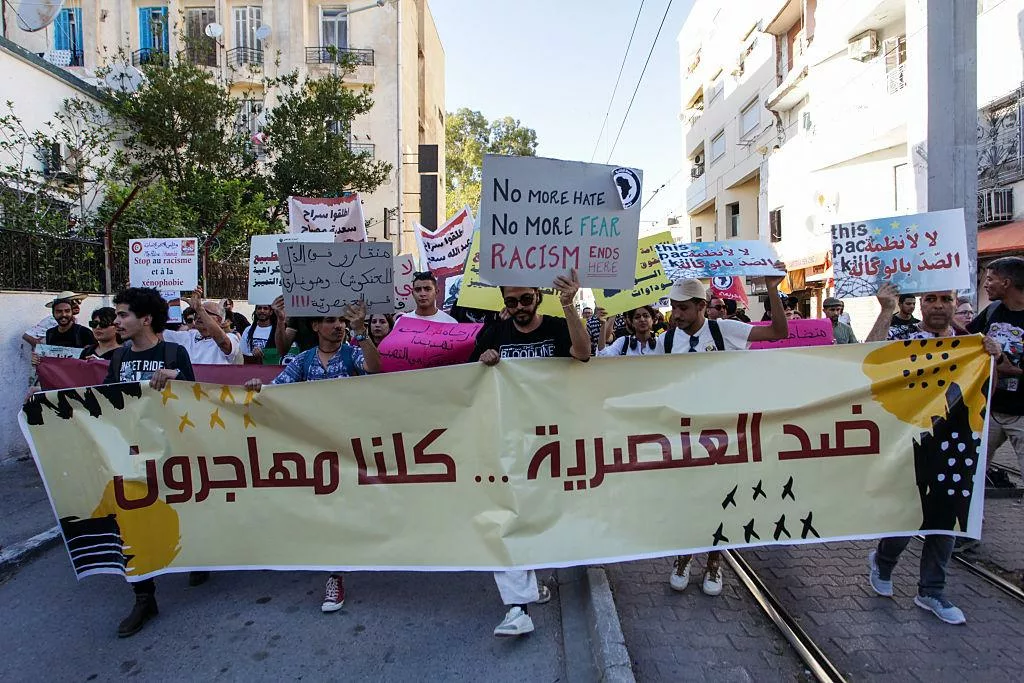
In response to the scandalous memorandum of understanding between Tunisia and the European Union, and in anticipation of the meeting of political leaders in Rome on July 23, 2023, whose aim is to further aggravate the repression of immigrants and refugees, and to perpetuate the logic of neo-liberalism that turns the countries of the southern Mediterranean into mere guardians of European countries, On Thursday July 20, 2023, civil society organizations, youth groups and social movements from Tunisia, the Maghreb, Africa and Europe organized a counter-summit in Tunis under the title "People's meeting in solidarity with immigrants, against European immigration policies".
In their final declaration, the participating organizations expressed their condemnation of the governmental meeting taking place in Rome, and considered that the memorandum of understanding signed between the European Union and Tunisia responds to the needs of European governments to export their borders and prevent migrants deemed undesirable from reaching Europe, where mistreatment is multiplying to the point of criminalizing even humanitarian rescue operations at sea.
The final declaration also considered that the document signed with Tunisia is in line with the theses of the European far right, which spread fear of immigrants and fuel hatred towards them, while justifying Kaïes Saïed's racist discourse on the "invasion of immigrant hordes" in Tunisia.
In place of a vague, biased and unbalanced memorandum, a call has been made for a "responsible participatory dialogue" on migration that includes all active forces in order to promote alternative and sustainable solutions that protect the rights of migrants and asylum seekers.
When immigrants are dumped in the desert without food, water or shelter in the middle of the summer heat
Libyan border guard units have released videos showing African migrants of various nationalities being rescued by them after the Tunisian authorities relegated them to a desert area on the border with Tunisia. The migrants claimed that the Tunisian authorities had confiscated their passports and mistreated them.
In addition, according to testimonies provided by "Agence France-Presse", dozens of immigrants were taken to a desert area on the border with Libya, "without food, water or even shelter." AFP photographed them trying to find shelter from the heat, which, according to the agency, is "over forty degrees"!
For its part, the Tunisian Red Crescent, which managed to visit the border areas between Tunisia and Libya, and Tunisia and Algeria, its president declared that hundreds of migrants had been forcibly expelled by the Tunisian authorities and "abandoned to their fate".
UN experts: Tunisian authorities must halt mass expulsions of migrants and stop attacks on them
On Tuesday, July 18, 2023, UN experts issued a statement expressing their concern at the discriminatory treatment of migrants from sub-Saharan Africa and urging the Tunisian authorities to halt the mass expulsions targeting them and protect their rights in accordance with international law.
The statement reminds the Tunisian authorities that collective expulsions are prohibited under international law, and stresses that the mistreatment of migrants and asylum seekers on the grounds of their skin color violates all international laws prohibiting racial discrimination. The UN experts also call on the Tunisian government to take immediate steps to put an end to hate speech and manifestations of racism in the country, protect African migrants from violence, investigate reported acts of violence and consider reparations to victims following a fair trial.
The Council of Europe Commissioner for Human Rights: the lack of clear human rights guarantees in the memorandum of understanding.
Commenting on the memorandum of understanding between the European Union (EU) and Tunisia, the Commissioner for Human Rights of the Strasbourg-based Council of Europe (an organization of 47 countries) called on Council member states to ensure that any agreement on migration includes human rights guarantees so as not to violate the rights of migrants and refugees. His comments follow on from the Memorandum of Understanding signed by the EU with Tunisia, adding that recent violations against immigrants and asylum seekers in Tunisia make respect for such guarantees an urgent issue. The Human Rights Commissioner also called on EU countries to clearly indicate the impact of each agreement on the human rights situation, as "in the absence of clear and tangible guarantees in the framework of cooperation on migration, the tendency of European countries to sacrifice human rights in order to export their responsibilities is worsening".
Kaouthar Ben Hania's "B'nat Olfa": a look back at the revolution, its contradictory narratives and the rise of Islamist extremism
After the revolution, Olfa (her first name) saw no harm in her daughters wearing the niqab, even seeing it as a way of "protecting" them from the rise of extremist Islamist currents. However, she later experienced very difficult times when two of her daughters fell into this extremism and joined hotbeds of tension.
This is the main theme of the film by Tunisian director Kaouthar Ben Hania, presented in official competition at the Cannes Film Festival last May, after years of absence from the festival.
The film, a blend of fiction and fact, representation and documentation, is inspired by the 2016 account of a mother named Olfa Al-Hamrouni, who publicly declared on a private Tunisian channel that two of her daughters, Rahma and Ghouffrane, victims of jihadist extremism, had left the country clandestinely in 2014 for Libya, where they were arrested, imprisoned and tried for carrying weapons in the ranks of the Islamic State.
This is Kaouthar Ben Hania's fifth feature-length film, and she says she wanted to highlight the way in which violence is transmitted within the family, and show how the male domination that oppresses women is often maintained by the mothers themselves. The film also highlights the indifference and inaction of the Tunisian authorities at the time.
Interviewed by several French media ( Le Monde , Télérama...), the Franco-Tunisian director illustrates the extent to which freedom of expression and creation have enabled a new generation of Tunisian filmmakers to flourish since 2011. Today, these freedoms are threatened by a cruel lack of resources and an increasingly stifling climate.
Of our Republic
The Tunisian Republic has faced many dangers since its proclamation on July 25, 1957. The convulsions it experienced immediately after independence almost destroyed it. Once the beylicate had been abolished, Bourguibian presidentialism gradually transformed the country into a republican monarchy, modern but lacking in freedoms. Ben Ali's authoritarian regime then turned it into a police republic. In 2011, the revolution gave it a new lease of life. It is now referred to as the "second republic", a republic that has shown itself capable of resisting the blows of terrorism and the disastrous attempts to transform it into a caliphate*.
But today, hit full force on July 25, 2021 by a constitutional coup that betrayed its spirit and rehabilitated the most caricatured forms of personal power and arbitrariness, it has never been so threatened. Since the referendum of July 25, 2022, it has been held hostage by a populist
hate speech from the highest echelons of the State. Article One of the country's successive constitutions since 1957 has been abolished. Article One, which defined Tunisia as "a free, independent and sovereign state, with Islam as its religion, Arabic as its language and the republic as its regime",
, was a point of consensus. The same goes for article two, which until then had described Tunisia as a "civil state, founded on citizenship, the will of the people and the rule of law". Gone, too, is the reference to human rights, equality between men and women, and freedom of conscience, all contributions linked to the modernization of the Republic in 2014. In place of these two articles, Article 5 of the 2022 Constitution now refers to "the Islamic nation" and obliges the State, and the State alone, to work towards "the realization of the vocations of authentic Islam, which are to preserve life, honor, property, religion and freedom". In fact, the new Fundamental Law amounts to nothing less than a deviation
from the republican ideal.
To this so-called "war of liberation" that President Kaïes Saïed claims to be waging against "the enemies of the people", we must oppose the hope that has not disappeared from the expectations of the population. Witness the numerous collective protest actions carried out since the coup de force of July 25, 2021, driven in particular by the aspiration of bangs of the youth and women to preserve essential gains such as freedoms of expression, association and demonstration, and to fight for dignity and against inequalities whether economic, social, territorial, cultural, gender or racialized. For us, these are the pillars of the Republic that we must continue to defend, so that these principles once again become the foundation of Tunisians' shared identity. This means not only reconnecting with the social and democratic foundations of the republican ideal, but also restoring constitutional legality and banishing from our imaginations those populist chimeras that do nothing but doom the country to darkness.
* Refer to the collective work: Que Vive la République!Tunisia 1957-2017, Editions Alif, 2018