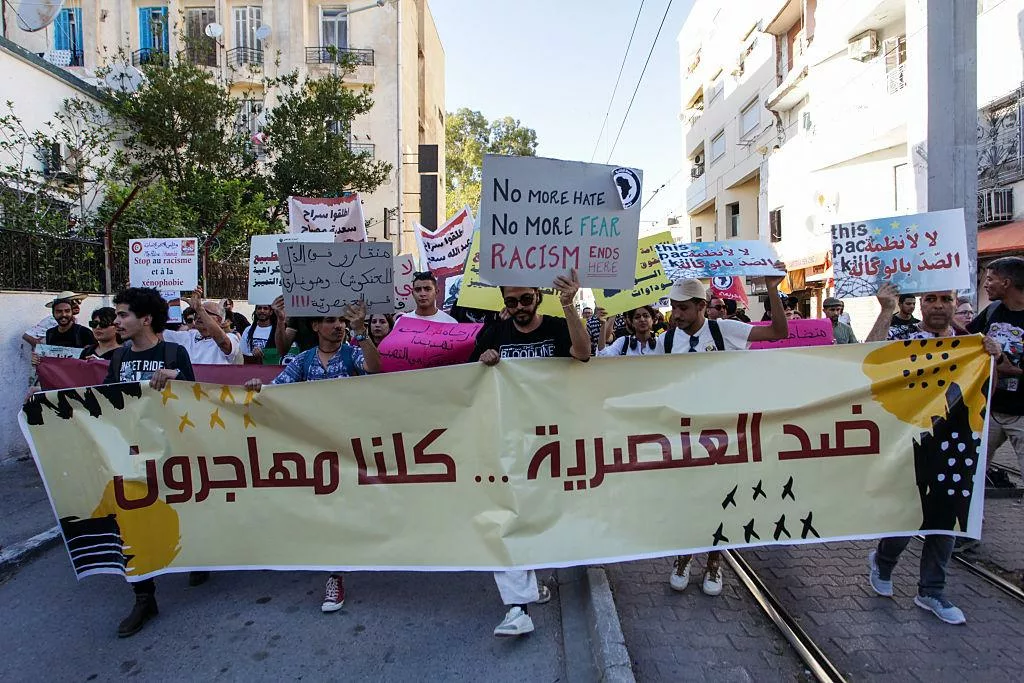

The absurdity of Kaïs Saïed's justice seems to know no bounds. After the wave of prosecutions and imprisonments of civil society activists who were in their humanist role of helping migrants and acting in compliance with the relevant standards - as was the case with Saadia Mosbeh, president of the anti-racist association M'nemty, and other members of the association, Cherifa Riahi and other members of Tunisie Terre d'Asile, Imen Ouerdani, president, and the vice-president of the municipality of Sousse, Mustapha Jammali, Abdelkrim Hkimi and others from the Tunisian Refugee Council, Abdallah Saïd from the Association des enfants de la lune, as well as many others whose families have chosen not to communicate their incarcerations for fear of worsening their judicial situation - this month of November 2025 saw the appearance of a new case, or episode, in this judicial paranoia: for the correctional chamber of the financial division of the Tunis court of first instance, crime is a gift.
The facts date back to 2016, when a first check received from the Indian Central Bank in the amount of 14,958 US dollars was paid into a Tunisian bank account without being reported to the Central Bank or given import permission. The prize was awarded by the Indian government to Me Rached Ghannouchi, leader of the Ennahdha party, for his role in promoting peace. Awarded for the first time to an Arab and Muslim personality, the Nahdhaoui leader is said to have donated the amount to the Tunisian Red Crescent Association, as well as another cheque issued by an American bank to the value of 1,250 US dollars.
It is true that the formalities of notification and import permission, as set out in article 42 of decree 608/1977, were not respected, notwithstanding Mr. Ghannouchi's noble cause or motivations, nor his selflessness. However, his right to a fair trial should not be overlooked, and in particular the need to comply with the criminal procedures in force, such as the three-year statute of limitations laid down in article 22 of the Foreign Exchange and Foreign Trade Code.
The excessive sentence of two years, despite the good faith of the person concerned - who stated that he had not been informed by his bank of the obligatory formality, which is proven in the file - as well as the modest amount and the allocation of the money to a noble cause, make the sentence disproportionate. The reasons for this are extrajudicial, as jurisprudence generally does not opt for such a lengthy custodial sentence in cases involving larger sums and more serious offences, but rather fines. This excessive judgment is curiously reminiscent of the sentence imposed on Imed Trabelsi after the revolution: ten years' imprisonment for a cannabis consumption offence for which the penalty is commonly known - one year's imprisonment and a fine of one thousand dinars.
The CRLDHT
- Condemns these procedural violations and the instrumentalization of justice.
- Considers that the disproportionality of the sentence betrays a political settlement of scores with Rached Ghannouchi.
- Expresses its solidarity with Rached Ghannouchi, who is on hunger strike in solidarity with Jaouhar Ben Mbarek, as are Ridha Belhaj, Abdelhamid Jlassi and Issam Chebbi.
- Reiterates its call to all Tunisians to contribute to the popular resurrection of our Tunisian revolution.