A sham trial, an illegal judgment and confirmation of a justice system entirely UNDER THE COUPLE OF THE EXECUTIVE.
45, 35, 33, 25, 20, 18, 17, 14 13, 12, 10, 3 and 2 years' imprisonment for political, civil and media figures, totalling 824 years' imprisonment.
November 27, 2025 will go down as one of the darkest dates in Tunisian judicial history.
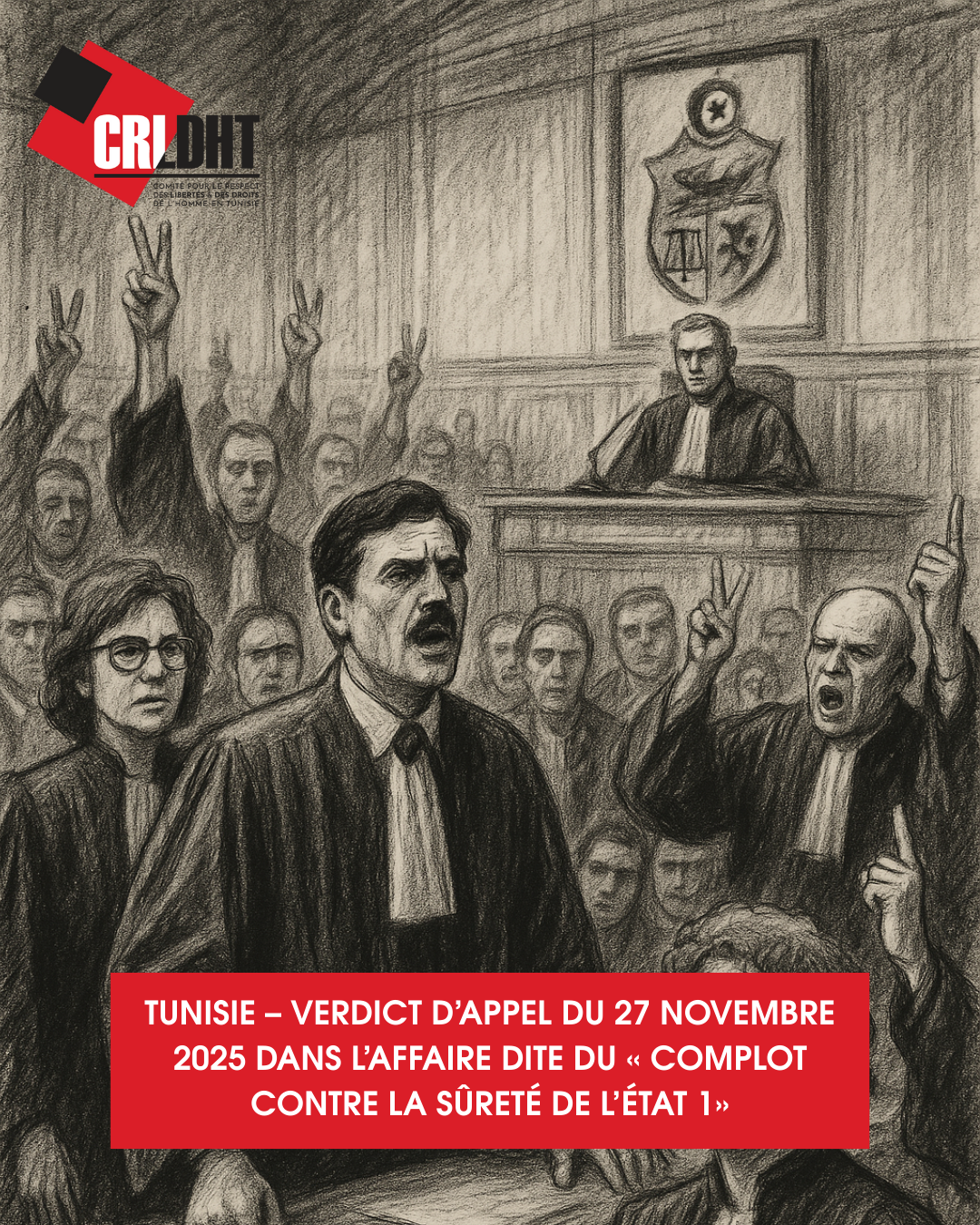
At the end of a revolting, absurd, iniquitous procedure, marked by the most serious violations of constitutional and international guarantees, the Tunis Court of Appeal handed down sentences ranging from 2 to 45 years in prison against journalists, lawyers, political opponents, human rights defenders, senior civil servants and ordinary citizens.
This verdict, read in the absence of the detainees, without debate, without pleadings, without confrontation, without examination of the evidence, confirms that Tunisian justice has ceased to function as an independent power: it is now an instrument of political control.
I- A flawed procedure from start to finish: a verdict without a trial
- Since the beginning of the trial, the courts have imposed - in violation of the law - compulsory videoconferencing for detainees despite :
- The absence of a reasoned decision,
- The defendants' explicit refusal,
- Lack of safety necessity,
- Repeated requests from lawyers,
- The crucial issue of confrontation in an allegedly "terrorist" trial.
On November 27, no prisoners were brought into the courtroom. Only three defendants were connected remotely.
- The case of Jaouhar Ben Mbarek illustrates a clear desire to remove him from the judicial scene. While he was hospitalized and on hunger strike for over thirty days, the prison administration transmitted a document claiming that he had "refused to attend" the hearing. His lawyers denounced this blatant falsification, all the more shocking as a complaint of torture had been lodged in his name a few days earlier.
- A request for recusal from the presidency of the chamber was lodged, but no action was taken. The official judge merely stated that "the competent authority had rejected all requests", without providing any decision or justification.
- The court refused to grant the defense access to the essential elements of the case file: correspondence from the prisons, the so-called "Algerian services report" used as incriminating evidence, and notifications from the Public Prosecutor's Office.
These successive blockages constitute a clear and cumulative violation of the minimum guarantees of a fair trial.
- The prison letters - all identical - stated that the defendants "refuse to attend". The defense demonstrated that these documents were false, as some inmates had explicitly asked to be present.
- Access for journalists was strictly limited, while only a few representatives of foreign embassies were able to attend the hearing.
Refusing to support a judicial farce, the lawyers decided not to plead until their clients were brought before the court.
In a sign of solidarity and protest, Ayachi Hammami and Chayma Issa - summoned in a state of freedom - also refused to be heard by an investigating chamber that offers no guarantee of real justice.
The hearing was held under the slogans that resounded in the room: "Freedoms! Freedom! Down with investigative justice!
II- Appeal sentences: a punitive architecture designed to terrorize
The convictions confirm that justice has ceased to be an independent power. It has become a punitive administration at the service of the executive.
Here is a complete list of the sentences handed down:
- 45 years in prison: Kamel Letaief (arbitrarily detained)
- 35 years: Khayem Turki- + TD 100,000 and asset freeze (arbitrarily detained)
-33 years' imprisonment: Ali El-Hlioui - Hamza Meddeb - Monji Dhaouadi - Kamel Guizani - Ridha Driss - Mustapha Kamel Nabli - Kaouther Daâssi - Mohamed Abderraouf Khalfallah - Abdelmajid Ezzar - Tasnim Khriji - Nadia Akacha - Rafik Chaâbouni - Najla Letaïef - Bochra Belhaj Hmida - Bernard-Henri Lévy. All considered fugitives (legally impossible sentences under Tunisian law - demonstrating judicial fabrication).
- 25 years in prison: Karim Guellati (at large),
- 20 years in prison: Jaouhar Ben Mbarek - Ghazi Chaouachi - Issam Chebbi - Ridha Belhaj - Noureddine Bhiri - All in arbitrary detention. Chaima Issa (free) ; + freezing of assets + 50 000 DT)
-13 years in prison: Mohamed Bedoui (free) , Kamel Bedoui (arbitrarily detained)
-10 years in prison: Sahbi Attig - Said Ferjani - (arbitrarily detained)
-Reduced sentences: Abdelhamid Jelassi (in arbitrary detention): 10 years; Ayachi Hammami: 5 years (released); Ahmed Nejib Chebbi: 12 years (released); Ridha Charfeddine (in arbitrary detention): 2 years + 3 months administrative supervision.
- aggravated sentences: Chokri Bahria: 14 years (at liberty); Mohamed Hamdi: 17 years+20,000D(at liberty).
- Acquittals : Noureddine Boutar; Lazhar Akremi; Hattab Slama
III- A complete collapse of the Tunisian justice system
1 Violation of the Tunisian Constitution
- Right to liberty and dignity: articles 22,25,26
- Right to equality before the law article 23
- Right to a fair trial articles 33,124
- Right to a legal sentence article 34
- Right of defence article 33
- Right to freedom of expression article 37
- Right to participate in the government of one's country article 39
- Right to freedom of association and to belong to a political party article 40
- Right to freedom of assembly article 42
- The obligation of the judiciary to protect human rights article 55
- Independence of the judiciary article 117
- Guarantees of independence in the professional career of judges articles 120,121.122
- Right to double jurisdiction article123
- Right to a public trial article 124
2. Violation of international conventions
- International Covenant on Civil and Political Rights articles 9, 14, 19, 22
- Convention against Torture articles 1,2,4,5
- African Charter on Human Rights articles 1,2,3,4,5,6,7,10,11,13,26
3 Violation of decree 11/2022 on the provisional higher council
- Articles:14,15,17: Appointment and promotion of judges
4. violation of anti-terrorism law organic law n°26/2015
- Articles 40 and 143: Anti-terrorism judges and their appointment
- Article 42: The representative of the public prosecutor's office at the anti-terrorism court of appeal
- Articles 46, 47 and 50: for testimonials
- Article 73: for remote witnessing and hearing
- Articles 75, 76,77: for the concealment of witness identification and its removal
5 Total violation of the Code of Criminal Procedure
- Article 13bis: right to counsel
- Article 141bis: exceptional videoconferencing, not automatic
- Article 85: Preventive detention
- Article 134,135,136: summoning the accused
- Article 143: Direction of debates
- Article 144,145,146,148: Trial proceedings
- Article 151: Basing of decisions on evidence in the file and oral and adversarial discussions
- Articles158,159,160: summoning witnesses
- Article 164: Deliberation
- Article 168: Reasons for judgments
- Article175: Default judgment
None of these procedural obligations were respected, not to mention the monumental blunders at the bottom.
6. Direct interference by the executive: the President of the Republic had publicly asked the judiciary not to acquit the accused, claiming that "whoever exonerates them is their accomplice", and he hammered home that "we must not wait for the courts to qualify the detainees as terrorists". The verdict confirms that the judiciary has complied with political instructions, given that the President of the Republic has arrogated to himself the prerogative to dismiss any magistrate without any prior disciplinary procedure, respect for the adversarial process or the right of defence. What's more, a judge who has been dismissed is criminally prosecuted and cannot contest his dismissal.
IV- Tunisia's slide into INTEGRAL authoritarianism
November 27 trial:
- Confirms the disappearance of the rule of law,
- Criminalizes the opposition,
- Instrumentalizes justice as a tool of repressive governance,
- Turning Tunisia into a fully-fledged police state.
This is less a judgment than an administrative act of war against dissent, designed to neutralize any political alternative and terrorize civil society. Objectives solemnly proclaimed by Kaïs Saïed himself as part of his chimerical "war of liberation".
The CRLDHT requests
- Immediate annulment of the verdict for absolute nullity.
- The release of all political prisoners
- Activation of international mechanisms: UN Working Group on Arbitrary Detention, Special Rapporteur on the Independence of Judges, African Commission on Human Rights.
- A moratorium on all judicial, security and anti-terrorist cooperation with Tunisia
- Large-scale national and international mobilization
This verdict is not an act of justice: it's a death sentence on judicial independence,
a political document, a collective punishment and a declaration of war on freedom.
History will record that, on November 27, 2025, Tunisian justice ceased to exist as an autonomous power.
The struggle continues for the release of all detainees, the restoration of law and the defense of human dignity.
Paris, November 29, 2025