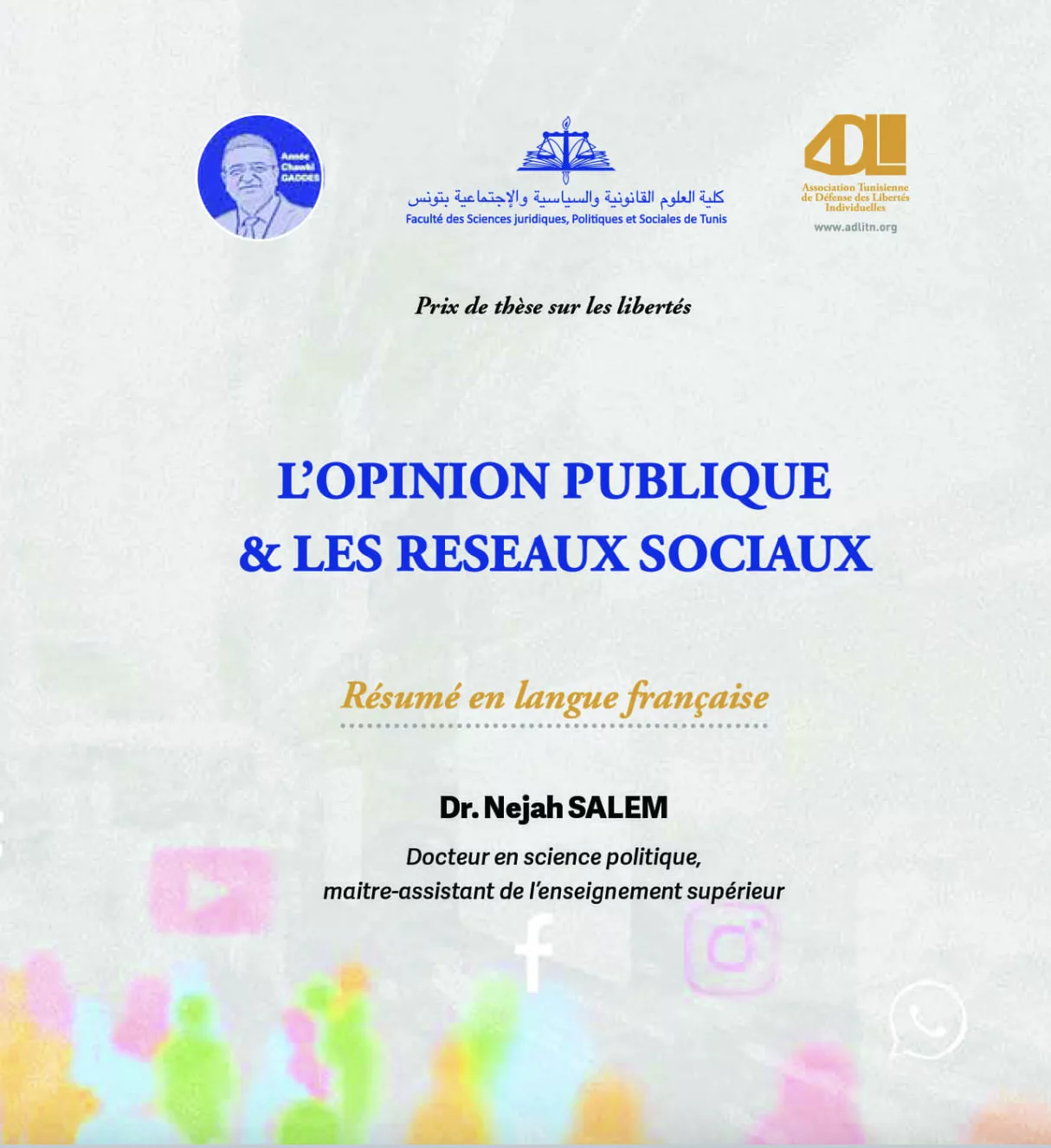
We continue to talk about social media as if they were merely spaces for expression, places for debate, sometimes excessive but fundamentally neutral. This interpretation is not only naive, it is now dangerous. A recent, rigorous and disturbing academic study forces us to face reality: social media has become a political battleground, where opinion is manufactured, consent is manipulated, and the very conditions of freedom of choice are being profoundly redefined.
In Public Opinion and Social Media, based on an award-winning thesis in political science (in Arabic), Najeh Salem debunks two illusions that still too often shape our relationship with digital technology. The first is the belief that "public opinion" is always visible, stable, and measurable. The second is based on the idea that digital technology automatically liberates societies simply by increasing the number of channels of expression.
However, the author reminds us that public opinion is anything but a homogeneous bloc. It is unstable, fragmented, and subject to power struggles. Following in the critical footsteps of Pierre Bourdieu, Najeh Salem shows that polls, indicators, and "barometers" are never neutral. They can become powerful political tools, capable of producing a fictitious majority, imposing certain themes, and fabricating media "evidence." What appears to be an objective snapshot of society is often a staged consensus.
But the most decisive contribution of this work lies elsewhere. It lies in the uncovering of a central mechanism of contemporary domination: the "soft guidance" of citizens' choices (التوجيهالناعم). You are not forbidden to think. You are guided. You are saturated. You are locked into information bubbles. Through artificial trends, "buzz," emotional narratives, and opaque algorithms, the illusion is created that "everyone thinks the same way." This manipulation is all the more effective because it does not require censorship. It produces confusion, exhaustion, and, ultimately, resignation.
In Tunisia, this interpretation is particularly enlightening—and deeply disturbing. Since the turning point of July 25, 2021, the country has undergone a transformation in its mode of government marked by the concentration of power, the weakening of countervailing powers, and increasingly security-focused management of public space. The arguments developed by Najeh Salem help us understand how, without completely shutting down the internet, a regime can nevertheless control public opinion.
Those in power no longer have an interest in simply silencing dissent. They have an interest in producing a narrative: the "people" against the "traitors," "sovereignty" against "interference," "order" against "chaos." Social media then becomes the central arena where the appearance of this narrative is constructed, through coordinated campaigns, blacklisting, moral disqualification, and permanent polarization. The criminalization of expression works in tandem with the digital space: digital technology is used to identify, expose, and stigmatize; the law is used to punish, deter, and set an example.
This raises a brutal and unavoidable question: is political choice still free when the information environment is biased? The problem for democracy is no longer just fraud at the ballot box. It is fraud upstream, in the very formation of opinion.
The conclusion is clear. Defending human rights today means defending the freedom to choose, to inform oneself, and to debate. It means fighting against propaganda, against manufactured "trends," against the criminalization of opinion, and against the transformation of digital technology into a machine for controlling minds. As such, Najeh Salem's work is not only a major academic contribution: it is an indispensable critical tool for all those who refuse to see democracy dissolve into algorithmic illusion.
Reference: Najeh Salem, Public Opinion and Social Media, excerpts from doctoral thesis in political science, Tunisian Association for the Defense of Individual Freedoms (ADLI), Tunis, 2025. الرأي العام ومواقع التواصل الاجتماعي – ADLI | Tunisia