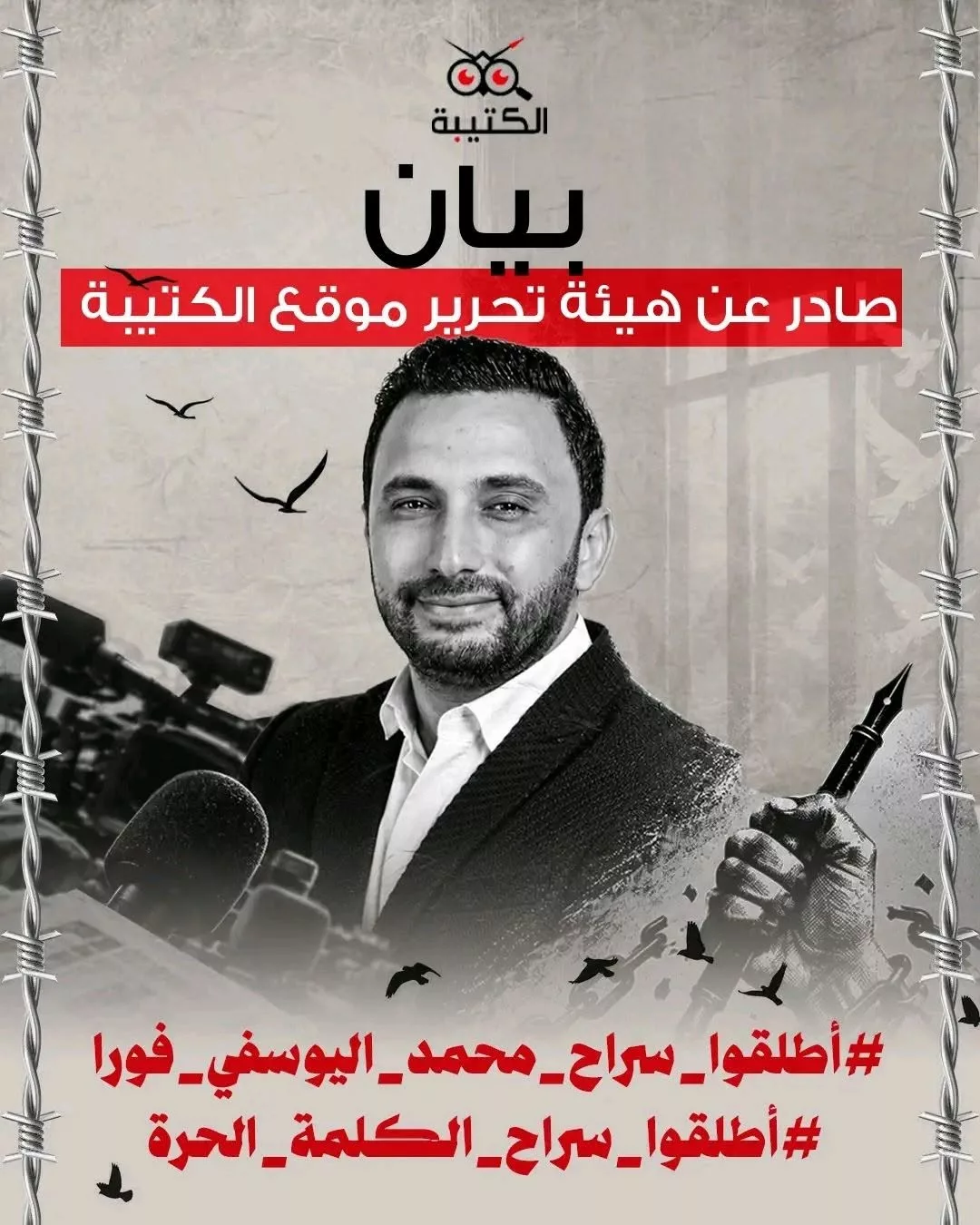
Journalist Mohamed Youssefi, editor-in-chief of the investigative news outlet Al Qatiba, has been detained since September 4, 2026. His arrest, police custody, and subsequent imprisonment are not merely part of a routine legal process. They are part of a policy of pressure, discrediting, and intimidation targeting independent journalists in Tunisia.
A sudden arrest, just as he was about to speak about water
On Friday, September 4, Mohamed Youssefi was on his way to the Express FM studios to appear on a program about the water crisis in Tunisia. He was not allowed to enter. He was arrested outside the radio station and taken to the unit investigating complex financial crimes.
The scene is deeply symbolic: a journalist known for his investigative reporting and critical views is prevented from speaking out on a matter of major public interest and is then taken into police custody.
The investigation was reportedly triggered by posts and comments circulating on Facebook regarding alleged suspicious enrichment. In other words, rumors and accusations spread online served as the starting point for an extremely serious proceeding targeting a journalist who has been practicing his profession independently for years.
Such an approach violates the most basic principles of necessity, proportionality, and the presumption of innocence. One cannot deprive a citizen—and certainly not a journalist—of their liberty on the basis of smear campaigns, without serious, verifiable evidence that has been discussed in a adversarial process.
Detention Continued Despite Emergency Surgery
On the night of September 4–5, Mohamed Youssefi suffered a serious medical emergency that required him to be taken to the hospital and undergo emergency surgery for appendicitis. Nevertheless, on September 7, his police custody was extended by forty-eight hours.
On September 8, after his health had deteriorated further and his hearing had to be adjourned, an arrest warrant was issued against him. His defense team and the National Union of Tunisian Journalists condemned the circumstances under which this decision was made, as well as the difficulties encountered in providing him with the necessary medication and medical care.
Prison can never be an extension of legal proceedings conducted with disregard for a prisoner’s health. In the case of Mohamed Youssefi, this seems all the more unjustifiable given that there is no evidence to suggest he could not have appeared in court as a free man, under judicial supervision if necessary.
Pretrial detention must be the exception. It must not become a form of punishment in advance, nor a means of breaking a journalist morally, physically, and professionally.
The Sham Trial Over “Foreign Funding”
The allegations specifically refer to financial flows that allegedly passed through an organization linked to the media outlet Al Qatiba. It is important to put things in perspective here.
In Tunisia, foreign funding of an association is not, in and of itself, a violation of the law. Decree-Law No. 88 of 2011 guarantees freedom of association and authorizes associations to receive funding, subject to the prohibitions expressly provided for by law, as well as reporting, traceability, and transparency requirements.
An association must, of course, account for its resources, comply with its administrative and financial obligations, and may be subject to audits. If there is a serious suspicion of irregularities, it must be thoroughly investigated, based on the evidence, through an inquiry that respects the right to a fair hearing. However, the mere fact of receiving legal, declared external funding intended to support an association’s or journalistic activity cannot automatically be equated with money laundering, illicit enrichment, or a threat to public safety.
That is precisely where the danger lies. By consistently portraying all external funding as suspect, the government paves the way for the criminalization of civil society, independent media, research, culture, and all initiatives that are not under its control.
The fight against corruption must not become a convenient excuse for imprisoning journalists who investigate, criticize, and demand accountability.
Broad and dignified solidarity
Mohamed Youssefi’s arrest sparked a major outcry. The National Union of Tunisian Journalists, journalistsfrom Al Qatiba, lawyers, Tunisian and international human rights organizations, labor activists, and the Tunisian Human Rights League expressed their solidarity and demanded his release.
On September 13, faculty members at the Institute of Journalism and Information Sciences published a remarkable petition. They emphasized that freedom of the press is not a corporate privilege, but a prerequisite for society’s right to be informed, to engage in debate, and to hold those in power accountable.
Their appeal rightly emphasizes that the practice of journalism—including the publication of analyses, investigations, interviews, and critiques related to public affairs—must never, in and of itself, be grounds for prosecution or imprisonment.
From his prison cell, Mohamed Youssefi thanked those who had rallied in his support. He maintained his innocence and highlighted the price he had paid for his independence: his critical stances on rights and freedoms, justice, health care, transportation, water, and electricity. He also reaffirmed a fundamental conviction: “The press is a power, not a function.”
This sentence sums up what is at stake. A press reduced to merely parroting official directives, fearing prosecution, or remaining silent in the face of abuses is no longer a free press. It can no longer fulfill its mission to society.
Free Mohamed Youssefi
The Mohamed Youssefi case concerns the right of all journalists to practice their profession without fear. It concerns the right of all Tunisians—men and women alike—to free, pluralistic, and independent news.
The authorities must:
- Immediately release Mohamed Youssefi and allow him to defend himself while remaining free;
- ensure comprehensive and effective medical care;
- respect the rights of the defense and the presumption of innocence;
- put an end to campaigns of defamation, incitement, and stigmatization against journalists;
- Stop misusing criminal and financial proceedings to intimidate independent media.
Freedom for Mohamed Youssefi.
Freedom for all journalists who are detained or prosecuted because of their work.