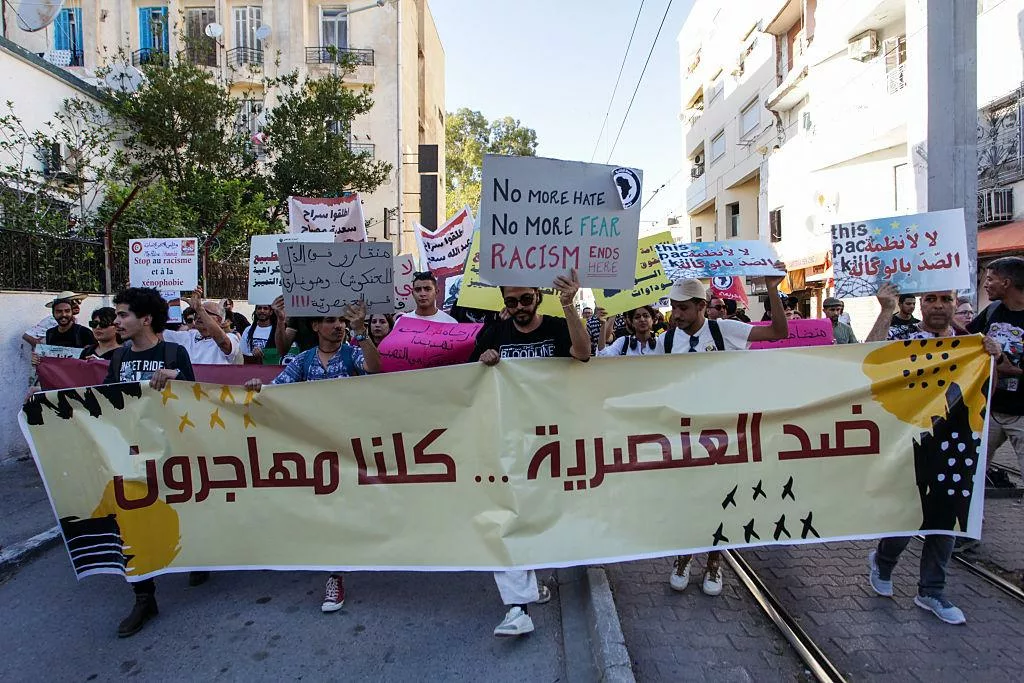
Joint press release signed by the CRLDHT
In view of : the widespread violations of the fundamental rights of migrants, asylum seekers and refugees in Tunisia, particularly those who are black; the absence of an asylum system in Tunisia; the Tunisian government's repression of civil society, the independence of the judiciary and the media ; and the impossibility of determining nationalities or assessing the protection needs of migrants and asylum seekers at sea in a fair and individual manner, it is clear that Tunisia is not a safe place to disembark people intercepted or rescued at sea. The current cooperation between the European Union (EU), several EU member states and Tunisia on controlling migratory movements, which relies in particular on the possibility of disembarking in Tunisia people rescued or intercepted at sea - following the example of previous cooperation with Libya - contributes to human rights violations.
European policies aimed at outsourcing border management in Tunisia support security forces that commit serious violations. They also hinder people's rights to leave any country and seek asylum, keeping refugees and migrants in countries where their fundamental rights are at risk. Disembarkation in Tunisia may also put people at risk and cause them serious harm, and expose refugees and migrants to a high risk of collective expulsion to Libya and Algeria, which is likely to violate the principle of "non-refoulement". The creation, on June 19, 2024, of the Tunisian Search and Rescue Region (RRS), requested and supported by the European Commission, risks becoming a new tool for violating people's rights rather than a legitimate fulfillment of the responsibility to protect safety at sea. Like its cooperation with Libya, the engagement of the EU and its member states with Tunisia could have the effect of normalizing serious violations perpetrated against people seeking protection, and compromising the integrity of the international search and rescue system by distorting it for migration control purposes.
As humanitarian and human rights organizations, we call on the EU and its member states to end their cooperation on migration control with the Tunisian authorities, who are responsible for serious human rights violations at sea and in Tunisia. Search and rescue NGOs and commercial vessels must not be asked to disembark anyone in Tunisia.
Widespread and repeated human rights violations
The findings of Tunisian and international organizations, as well as United Nations bodies, over the past two years, indicate that Tunisia cannot be considered a "safe haven" as defined by the International Convention on Maritime Search and Rescue (SAR Convention) 1979, the Maritime Safety Committee (MSC) and United Nations bodies, for people intercepted or rescued at sea, particularly black people.
Although a party to the 1951 United Nations Convention Relating to the Status of Refugees, Tunisia has no national asylum system or asylum laws. On Tunisian territory, irregular entry, stay or departure is an offence. After interceptions at sea or arbitrary arrests on Tunisian territory, the Tunisian authorities have repeatedly abandoned refugees, asylum seekers and migrants in the Tunisian desert or in isolated border regions with Libya and Algeria. These practices may constitute illegal collective expulsions, show total disregard for the right to life of refugees and migrants, and are likely to flout the principle of "non-refoulement". Those expelled risk serious human rights violations in Libya, and subsequent expulsions from Algeria to Niger. According to articles citing information provided by the United Nations, Tunisian security forces in particular have arrested people supposedly in an irregular migrant situation on the mainland, and handed them over directly to the Libyan authorities, who have then inflicted arbitrary detention, forced labor, extortion, torture and other ill-treatment, and even unlawful killings.
According to testimonies from refugees, migrants and asylum seekers gathered by Amnesty International, Human Rights Watch, the World Organization Against Torture and Alarm Phone, Tunisian maritime authorities have committed abuses and endangered lives during boat interceptions - including high-speed maneuvers threatening to capsize boats, resorting to physical violence, using tear gas from a short distance and colliding with boats - followed by a failure to systematically ensure individualized assessments of protection needs on disembarkation. The Tunisian authorities have also subjected refugees, asylum-seekers and migrants to torture and other forms of ill-treatment in the context of disembarkations, detentions or collective expulsions.
At the same time, several international and local organizations, human rights defenders and lawyers have reported an alarming deterioration in civil liberties and fundamental rights in Tunisia, affecting both the migrant population and Tunisian citizens. Since 2021, the country has experienced a significant regression in the field of human rights, characterized by a dismantling of the institutional safeguards designed to protect them, an erosion of judicial independence and a repression of freedom of expression, association and peaceful assembly. The disembarkation in Tunisia of Tunisian nationals intercepted or rescued at sea, which could include people fleeing persecution, torture or other serious harm and intending to seek asylum abroad, could effectively deprive people in need of international protection of the right to seek asylum.
The European Union's complicity in human rights abuses
Despite documented human rights violations by the Tunisian authorities, the EU and its member states have stepped up their support for Kaïs Saïed's government. Through the Memorandum of Understanding signed in July 2023, the EU has promised Tunisia a billion euros, including 105 million euros earmarked for border and migration management, in exchange for measures to prevent sea departures to Europe, particularly involving people in need of protection. With the establishment of a Tunisian search and rescue region, the Tunisian government has fulfilled a long-standing EU priority. While this represents an official step towards fulfilling Tunisia's responsibility to protect life at sea, the reality is that European Emergency Response Coordination Centers (ERCCs) will now refer boats in distress within the Tunisian search and rescue region to the Tunisian ERCC, reinforcing a progressive disengagement of EU actors in favor of actors with a poor human rights record.
By supporting an increased role for the Tunisian coastguard (National Guard) - without human rights benchmarks or a monitoring system in place, nor arrangements to ensure that those rescued are landed in a place of safety, which cannot be Tunisia - the EU is contributing to a risk of further serious human rights violations at sea and in Tunisia against refugees, migrants and those threatened with persecution in the country.
Humanitarian space for search and rescue non-governmental organizations (NGOs) will also be further reduced, if European RACs ask these NGOs to liaise with the newly created Tunisian maritime RAC for disembarkation, which they may refuse to do in order to respect the principle of "non-refoulement". UNHCR, the UN refugee agency, has noted that the processing of claims for international protection on board ships at sea is generally not appropriate. Under international maritime law, states have primary responsibility for coordinating rescue operations within their search and rescue zone, and for organizing disembarkation in a place of safety, which may be another state.
European support for human rights violations must stop
These developments follow the pattern seen in Libya since 2016. In addition to material, technical and political support, the EU and Italy backed the creation of a Libyan Search and Rescue Region and Maritime CCR, leading to a transfer of responsibility for search and rescue to the Libyan coastguard and an increase in refoulements and disembarkations in Libya, all the while knowing that this would expose refugees and migrants to a serious risk of horrific and murderous violations in Libya. The Italian government and EU institutions have not only continued this cooperation, but have also sought to extend it to other countries, notably Tunisia.
We therefore urge the EU and its member states to :
- Call on the Tunisian authorities to put an end to human rights violations against refugees, asylum seekers and migrants, with particular urgency in the case of illegal and potentially lethal collective expulsions.
- Call on the Tunisian authorities to put an end to the repression of civil society.
- Ensure that search and rescue NGOs and commercial vessels are not instructed to disembark people they rescue at sea in Tunisia, given the risks of human rights violations there, and given that fair individual assessments of these risks cannot be made at sea. Tunisia cannot be considered a safe place for people rescued at sea under applicable international law.
Withdraw financial and technical support for Tunisian authorities responsible for serious human rights violations in border and migration control.
Signatures : Afrique-Europe Interact, Alarme Phone Sahara (APS), All Included Amsterdam, Amnesty International, Associazione per gli Studi Giuridici sull'Immigrazione (ASGI), Association Calam, Association for Justice, Equality and Peace, Association Lina Ben Mhenni, Association Marocaine d'aide des Migrants en Situation Vulnérable (AMSV), Association pour la promotion du droit à la différence (ADD), Association Sentiers-Massarib, Association tunisienne de défense des libertés individuelles, Aswat Nissa, Avocats Sans Frontières (ASF), Baobab Expérience, Campagna LasciateCIEntrare - MaipiuCIE, Carovane Migranti, CCFD-Terre Solidaire, Chkoun? Collective, Comité de Sauvegarde de la LADDH, Comité pour le respect des libertés et des droits de l'Homme en Tunisie (CRLDHT), CompassCollective, Damj - l'Association Tunisienne pour la justice et l'égalité, Dance Beyond Borders, Emergency, Fédération des Tunisiens pour une Citoyenneté des deux Rives (FTCR), International Federation for Human Rights (FIDH), Forum Tunsien pour les Droits Economiques et Sociaux (FTDES), Fundacion Solidaire, Human Rights Watch, Intersection pour les droits et les libertés, iuventa-crew, L'association Tunisienne pour les Droits et les Libertés (ADL), La Cimade, LDH (Ligue des droits de l'Homme), Maldusa, Médecins Sans Frontières, Mediterranea Saving Humans, Melting Pot Europa, migration-control.info project, Migreurop, Missing Voices (REER), Mission Lifeline International e.V., PRO ASYL Bundesweite Arbeitsgemeinschaft für Flüchtlinge e.V., r42-SailAndRescue, Reclaim the Sea, Refugees in Libya - APS, Refugees Platform In Egypt (RPE), Resqship, Salvamento Maritimo Humanitario -SMH, Sarah Seenotrettung gUG, Sea-Eye e.V., Sea-Watch e.V., Search and Rescue Malta Network, Seebrücke, SOS Humanity e.V., SOS Mditerranée, Statewatch, Union des diplômés-chômeurs (UDC), United4Rescue - Gemeinsam retten e.V., Univ. of Southern California Gould School of Law Immigration Clinic, Watch the med Alarm Phone
October 3, 2024