Once again, an entire section of Tunisia's youth has risen up to demand basic rights, and once again, the state has cracked down. Following in the footsteps of teacher-researchers, magistrates and journalists, it's now the young medical generation's turn to be crushed by institutional contempt, delaying tactics and empty patriotic rhetoric. Yesterday, July 1, a new strike led by the Tunisian Organization of Young Doctors (OTJM) took place, in an increasingly deleterious social climate and in the face of a government which, rather than listen, prefers to divide, divert and threaten.
Chronology of an ignored movement
For several months now, young doctors have been sounding the alarm. These professionals in training, who work up to 120 hours a week for derisory remuneration, are warning of the precariousness of their condition. Without stable housing, relocated from one region to another every six months, forced to pay their own way through scientific conferences, they denounce a situation that has become untenable.
Faced with silence from the Ministry of Health, OTJM began a series of strikes and mobilizations: on April 21, then May 2, with rallies and calls for dialogue on each occasion. To no avail. From June 10 to 15, young doctors stepped up the pressure with a five-day strike, accompanied by a fifth campaign to boycott the selection process for medical training centers. Once again, the government turned a deaf ear. Worse still, in response to this fifth wave of boycotts, the authorities fragmented the operation into 40 different locations, a tactic designed to divide the movement and disorganize the ranks.
The State's response: tongue-in-cheek and threats
How did the state react? Officially, the authorities' response was as disembodied as it was ineffective. With communiqués on social networks, the Ministry of Health invited the young doctors to "return to their posts", invoking a dubious legality, preferring to violate the hierarchy of norms rather than open a dialogue. Cold declarations attempted to present the granting of social coverage - a fundamental right - as a government victory. A posture that underlines the extent to which those in charge have sought to give an illusion of progress, without ever building a coherent strategy for getting out of the crisis.
On June 30, a meeting was finally organized between the OTJM and a delegation led by the Minister of Social Affairs, Mustapha Ferjani, mandated by the Head of Government. Expectations of genuine dialogue quickly collapsed. The Minister readily admits that he only consulted the young doctors' demands "a few minutes before the meeting". Worse still, OTJM members report having been threatened with legal action if the movement continued - a parallel even being drawn with the sanctions targeting the Association des Magistrats Tunisiens. "I didn't threaten, I acted", declares the Minister, in a phrase that reveals the brutality of his approach to social protest.
And what does the president say?
Against this explosive backdrop, President Kaïs Saïed received the Minister of Health on July 1. His speech, true to his lyrical, moralizing style, dodged concrete demands and became locked in nationalist rhetoric. He recalled "the greatness of the Tunisian medical school", praised the presence of Tunisian doctors abroad and evoked, in a surreal flight of fancy, the historic role of medical figures in the anti-colonial struggle such as Habib Thameur and Ahmed Ben Milad.
Without ever explicitly naming the strikers or their demands, he claims to want to "rebuild public health", while emphasizing that "Tunisia lends its skills to the world" - a barely concealed way of legitimizing the brain drain. The Head of State promises a "new legal architecture" to protect healthcare workers, without announcing any timetable, concrete measures or planned dialogue with the strikers.
A muted repression, an organized escape
Beyond the rhetoric, the government's line is becoming clearer: the State does not negotiate, it divides. It does not respond to demands, it displaces or dilutes them. It doesn't protect its young carers, it drives them into exile. The words of the Minister of Social Affairs, acknowledging that the emigration of young doctors is "economically beneficial", sound like an admission: rather than investing in a robust healthcare system, Tunisia prefers to outsource its healthcare future.
The State goes even further: it now assumes a logic of replacement. In a recent statement, the Minister of Health asserted that the flight of Tunisian doctors was not a threat to the State, but an opportunity to earn foreign currency. He even bluntly mentioned the possibility of bringing in doctors from China or Hungary to fill the gaps. Such a stance reveals a utilitarian and profoundly dehumanizing vision of public policy, where the departure of highly qualified citizens becomes an accounting gain, and their replacement a logistical operation with no regard for the quality of care, the identity of the medical profession or social justice.
Meanwhile, public hospitals are emptying out. The shortage of doctors is getting worse. Patients in inland regions, the first victims of staff shortages, are left to fend for themselves. And young doctors, whose attachment to their country runs as deep as their anger, are exhausted shouting into the void.
Conclusion: towards a point of no return?
The institutional contempt shown towards young doctors is not simply a sectoral crisis. It embodies a deaf, authoritarian mode of governance, where threat replaces dialogue, and where flight is encouraged more than anchoring. The danger is twofold: the impoverishment of our healthcare system and the discouragement of an entire generation, which is not asking for favors or privileges, but simply respect for its dignity.
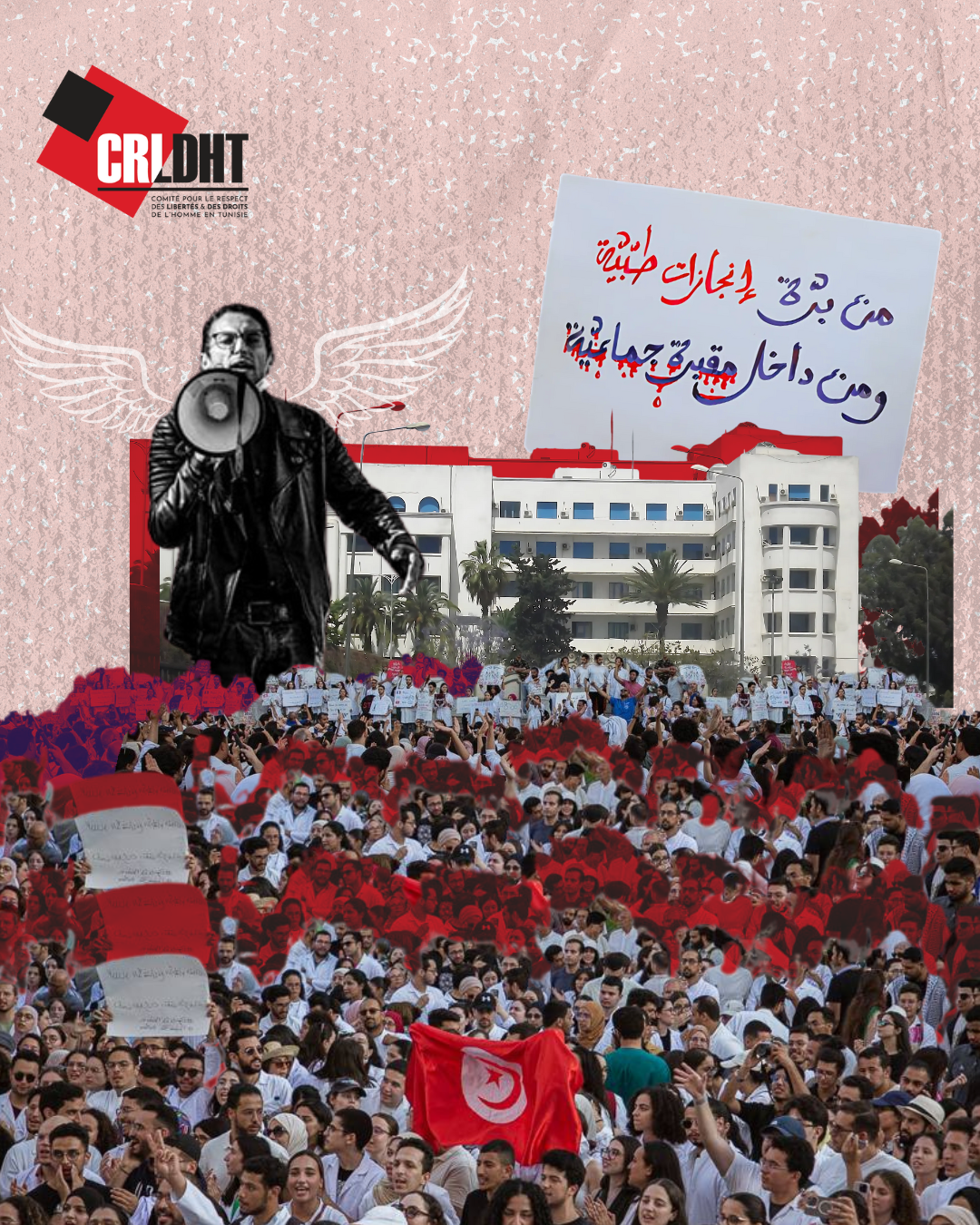
On July 1, a large number of people gathered in front of the municipal theater in Tunis. Students, activists and ordinary citizens came to say that this is not just a cause for young doctors. It's the cause of an entire society that refuses to see its children humiliated, its hospitals deserted, and its future sacrificed on the altar of contempt.
We express our full solidarity with the movement of young Tunisian doctors, fighting not only for their professional rights but also to safeguard a public health system in peril. Their struggle goes far beyond hospital walls: it embodies the dignity of a youth trained with excellence, shamelessly exploited and scorned by authorities deaf to social suffering. In the face of insidious repression, thinly veiled threats and a state cynicism that turns exile into a health policy, we salute their courage, perseverance and commitment to justice. Refusing silence, demanding a dignified future, denouncing the logic of abandonment and division: this is an act of resistance that engages us all. Their voices carry those of thousands of other young people who are marginalized, insecure and invisible. That's why their cause is our cause too.