
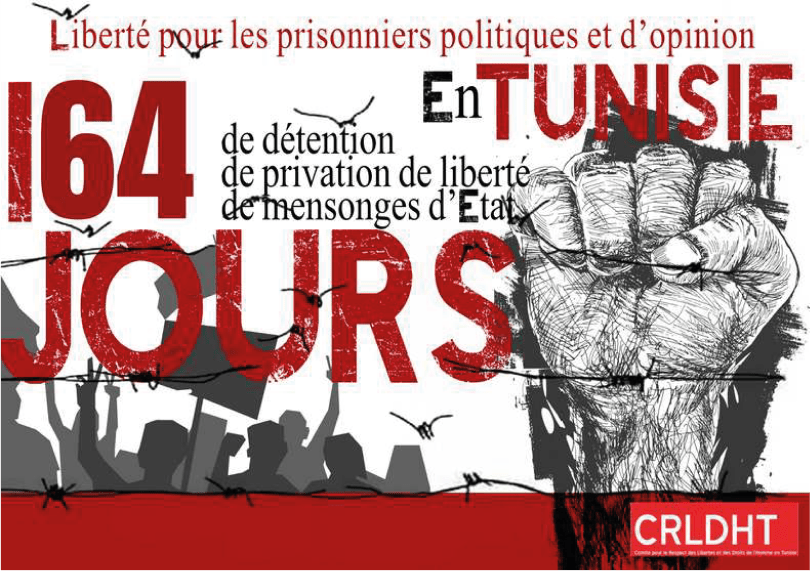
CRLDHT Newsletter July 25, 2023
The Tunisian Republic has faced many dangers since its proclamation on July 25, 1957. The convulsions it experienced immediately after independence almost destroyed it.
Once the beylicate had been abolished, Bourguibian presidentialism gradually transformed it into a republican monarchy, modern but lacking in freedoms. Ben Ali's authoritarian regime then turned it into a police republic. In 2011, the revolution gave it a new lease of life.
It's called the "second republic", a republic that proves itself capable of resisting the blows of terrorism and the disastrous attempts to transform it into a caliphate*.
But today, hit full force on July 25, 2021 by a constitutional coup that betrayed its spirit and rehabilitated the most caricatural forms of personal power and arbitrariness, it has never been so threatened.
Since the referendum of July 25, 2022, the country has been taken hostage by a hateful populist discourse at the highest level of government. Article One of the country's successive constitutions since 1957 has been abolished.
The same one which, defining Tunisia as "a free, independent and sovereign state, with Islam as its religion, Arabic as its language and the republic as its regime", was the consensus.
The same applies to article two, which until then had described it as a "civil state, founded on citizenship, the will of the people and the rule of law".
Gone, too, are the references to human rights, equality between men and women, and freedom of conscience - all contributions to the modernization of the Republic in 2014.
In place of these two articles, Article 5 of the 2022 Constitution now refers to "the Islamic nation" and obliges the State, and the State alone, to work towards "the realization of the vocations of authentic Islam, which are to preserve life, honor, property, religion and freedom".
In fact, the new Fundamental Law amounts to nothing less than a deviation from the republican ideal.
To this so-called "war of liberation" that President Kaïes Saïed claims to be waging against "the enemies of the people", we must oppose the hope that has not disappeared from the expectations of the population.
This is borne out by the numerous collective protest actions carried out since the coup de force of July 25, 2021, driven in particular by the aspiration of bangs of youth and women to preserve essential gains such as freedoms of expression, association and demonstration, and to fight for dignity and against inequalities whether economic, social, territorial, cultural, gender or racialized.
For us, these are the pillars of the Republic that we must continue to defend, so that these principles once again become the foundation of the common identity of Tunisians.
This means not only reconnecting with the social and democratic foundations of the republican ideal, but also restoring constitutional legality and banishing from our imaginations those populist chimeras that do nothing but doom the country to darkness.
* See the collective work Que Vive la République - Tunisie 1957-2017, Editions Alif, 2018.