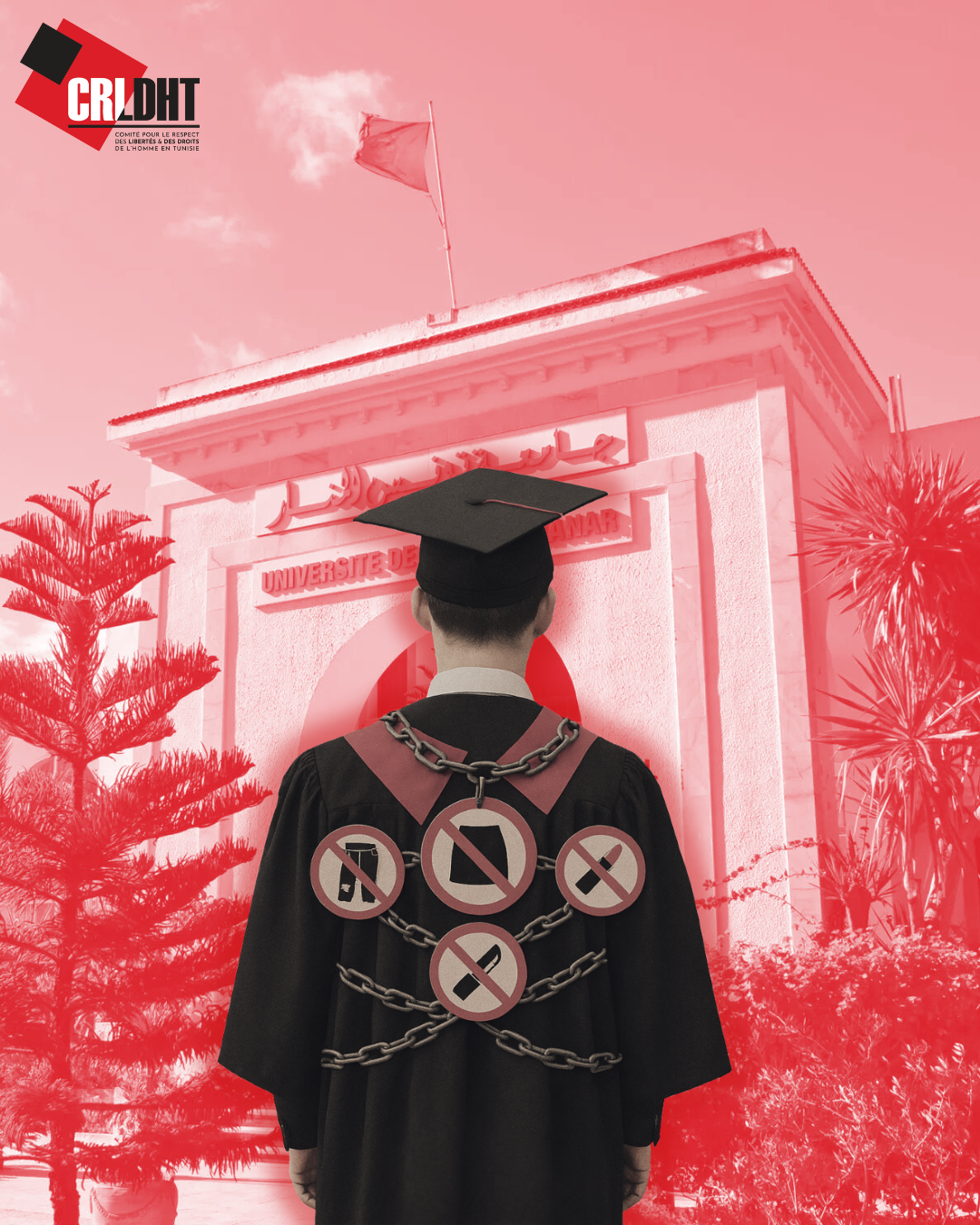
At the start of the 2025-2026 academic year, a joint communiqué from the Tunis Faculty of Law and Political Science and the Faculty of Economics and Management sparked an outcry. Under the guise of a "reminder of internal regulations", the administration published a list of absurd restrictions: a ban on ripped pants, short skirts, shorts (or "chortes", to use the now viral term), "excessive" make-up and even outfits deemed too "flashy".
A text that speaks volumes: instead of fighting for the quality of courses, research or career opportunities, the Tunisian public university chooses to control... the length of skirts and the thickness of mascara.
This is not a detail. When a university arrogates to itself the right to decide what students wear, it's taking on a disciplinary logic worthy of another age. It's no longer a question of pedagogy, but of policing the body.
And behind the body, it's freedom that's targeted. Freedom of expression, freedom to be oneself, academic freedom. These are the freedoms that are curtailed when the university imposes a dress code.
The ridiculousness of these circulars lies not only in the spelling mistakes ("chorte") or vague terms like "indecency" and "excessive make-up". The problem is fundamental: the university's mission is not to moralize or judge appearance. Its job is to teach, to stimulate critical thinking, to prepare citizens and professionals.
Harvard, Oxford, the Sorbonne or Cambridge don't waste a minute measuring the size of a skirt or counting the holes in a pair of jeans. They invest in research, innovation and creativity. In Tunisia, dusty bureaucratic language is recycled to mask the institution's failure to fulfill its true mission.
Through these communiqués, the very spirit of the university is being misused. Academia should be a place of emancipation, plurality and debate. Instead, it is becoming a place of surveillance and standardization.
This drift is not insignificant: it prepares generations for obedience rather than freedom. It produces docile subjects, not critical citizens.
The contrast is striking: in Tunisia's private and foreign universities, students dress freely, experiment, assert their style and learn in a climate of trust. In the public sector, they are infantilized, supervised and punished. Two youths coexist: one open to the world, the other locked in state conservatism.
Banning jeans with holes or make-up is much more than an administrative measure. It's the manifestation of a will to social control that's infiltrating everywhere: right down to the universities, which are supposed to be a space for free expression and freedom.
A regime without academic freedom is just a hollow décor. And a university that monitors bodies instead of training minds abdicates its primary mission.
In Tunisia, dress codes protect neither decency nor the university. They reveal a power obsessed with control and incapable of assuming freedom. It's not the skirt that's too short, but the academic conception.