There's no doubt that in Tunisia, the authorities in power are pursuing a planned and premeditated policy aimed at muzzling all objective voices - and not just dissident ones. It thus becomes almost "normal", in the logic of the regime, for the apparatus in place to attack free and neutral journalists, indeed the entire profession, in order to bring its members into line and control, even tame, the communication front in the media space. From now on, allegiance to Kaïs Saïed's enigmatic project, to his person, as well as propaganda and false praise for his fictitious achievements, seem to be the only way to become a journalist.
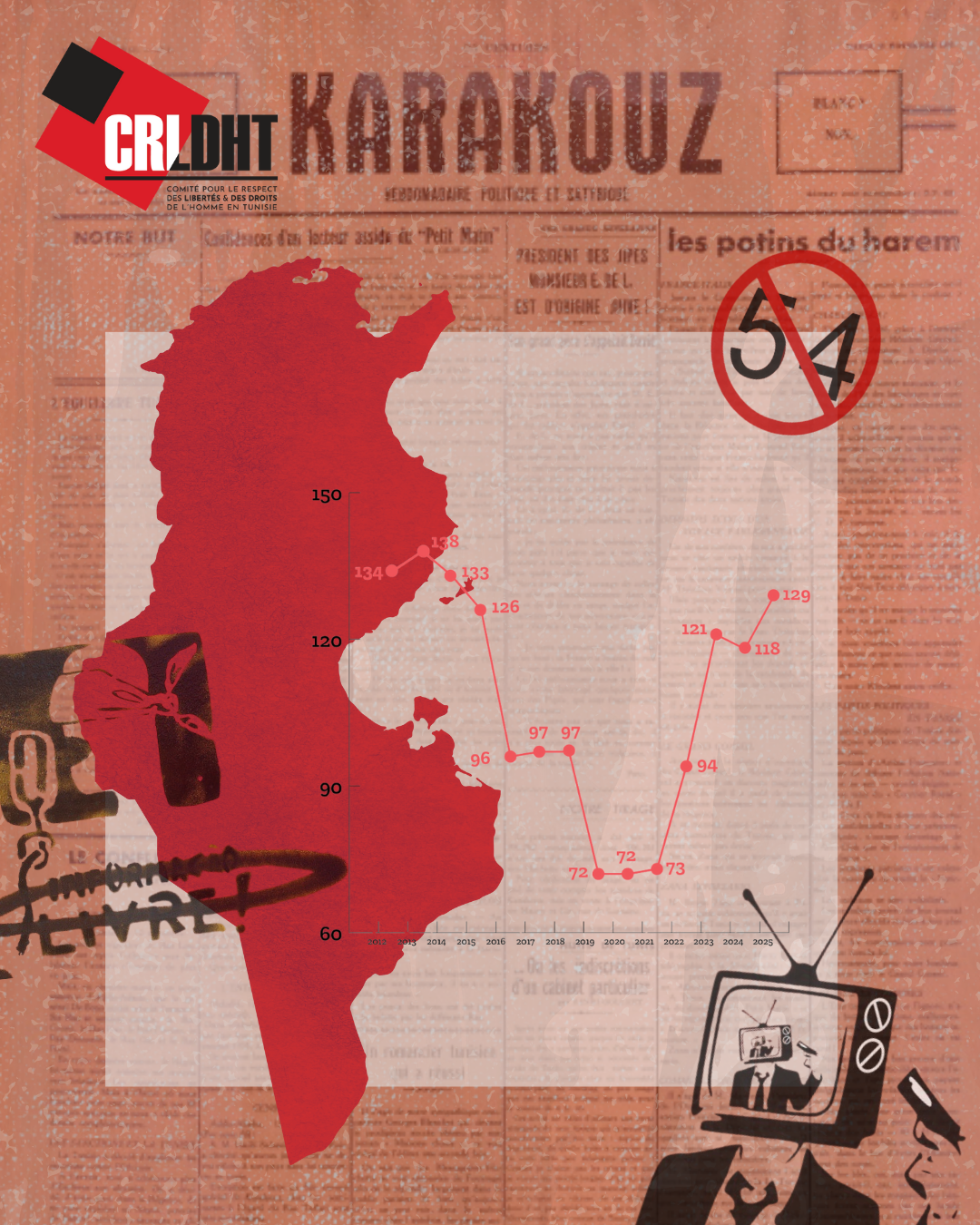
Gradually, since July 25, 2021, independent journalists have been in the crosshairs of an increasingly repressive regime. It began with Amer Ayed, then Khlifa Kassemi, Chadha Ben hadj mbarek, Mohamed Boughaleb, Sonia Dahmani, Morad Zghidi, Borhen Bessaies, to name but the most high-profile cases. Dozens more are being prosecuted for practicing their profession. The legal grounds invoked vary: from terrorist crimes to the ominous Article 24 of Decree-Law 54/2022, via incriminations in the Penal Code such as contempt of the President of the Republic. But Decree-Law 54 remains the most widely used tool of repression - even though it is not applicable to journalists, who are criminally governed by Decree-Law 115/2011, a more specific text that is totally ignored by the Public Prosecutor's Office and, more importantly, by the courts.
In addition to this criminal repression, which denies all due process rights, there are administrative restrictions, such as the refusal to issue 2025 professional cards to over 2,000 journalists, on the pretext of a lack of quorum on the commission responsible for issuing them, without however extending the validity of 2024 cards.
Foreign journalists have also been struggling to renew or obtain accreditation since September 2025, and the work of hundreds of them remains vulnerable, despite some announced but unfulfilled social and fiscal measures.
Censorship is also expressed through the suspension of the activities of journalists working in associations, such as those of Nawaat and Inkyfada, two structures that have particularly shone in the investigative press.
Among the most blatant symbols of this drift is lawyer and columnist Sonia Dahmani, detained since May 2024 for exercising her right to expression. She was arrested after a spectacular and violent raid on the headquarters of the Bar Association. Since then, she has endured summary trials based on Decree-Law 54, humiliations, restrictions on visits, deliberate denial of medical care, as well as the persecution of her sister Ramla, sentenced in absentia to two years' imprisonment simply for denouncing such treatment.
In a tragic irony, while languishing in a Tunisian jail cell, Sonia Dahmani has just been honored in New York with a prestigious international distinction, in recognition of her courage and commitment to freedom of expression.
This contrast provoked a wave of international outrage. Several influential members of the US Congress - Richard Durbin, Bill Cassidy, Adam Schiff and James McGovern - sent an official letter to President Kaïs Saïed, demanding Sonia Dahmani's immediate release and denouncing the seriousness of the violations to which she has been subjected. They recall that Tunisia, the cradle of the Arab Spring, now has a moral and legal obligation to respect its international human rights commitments.
Faced with increasing attacks on press freedom, the National Union of Tunisian Journalists (SNJT) launched a national protest movement on November 20, 2025, at the government esplanade at the Kasbah.
The journalists, who turned out in large numbers despite the pressure, brandished the 2024 professional card, which had become a symbol of their administrative exclusion, and raised the red headband, a sign of collective resistance.
The slogans chanted were explicit:
"Freedom for the Tunisian press",
"No to Decree 54",
"Journalism is not a crime".
SNJT General Secretary Zied Dabbar said:
"Despite the restrictions, journalists turned out in force. This is just the first step in a movement that will continue to defend our existence and the freedom of the press."
Relay actions were organized in several media, including Ulysse FM radio, where journalists and technicians wore the red band to show their solidarity.
The CRLDHT
- Strongly condemns the restrictions and systematic attacks on press freedom perpetrated by Kaïs Saïed's authoritarian regime, as well as the illegitimate and illegal legal proceedings brought against journalists.
- Expresses its full solidarity with Tunisian journalists and their union, and calls for the immediate release of all journalists imprisoned for exercising their profession - starting with Sonia Dahmani, a national and international symbol of resistance - as well as the lifting of all administrative restrictions.
- Urges all citizens, as well as national and international civil society, to defend press freedom and the right to expression, in order to save the Tunisian state from a profound dictatorial drift, and to refuse self-censorship, fear and resignation in the face of a counter-revolution that is taking root.