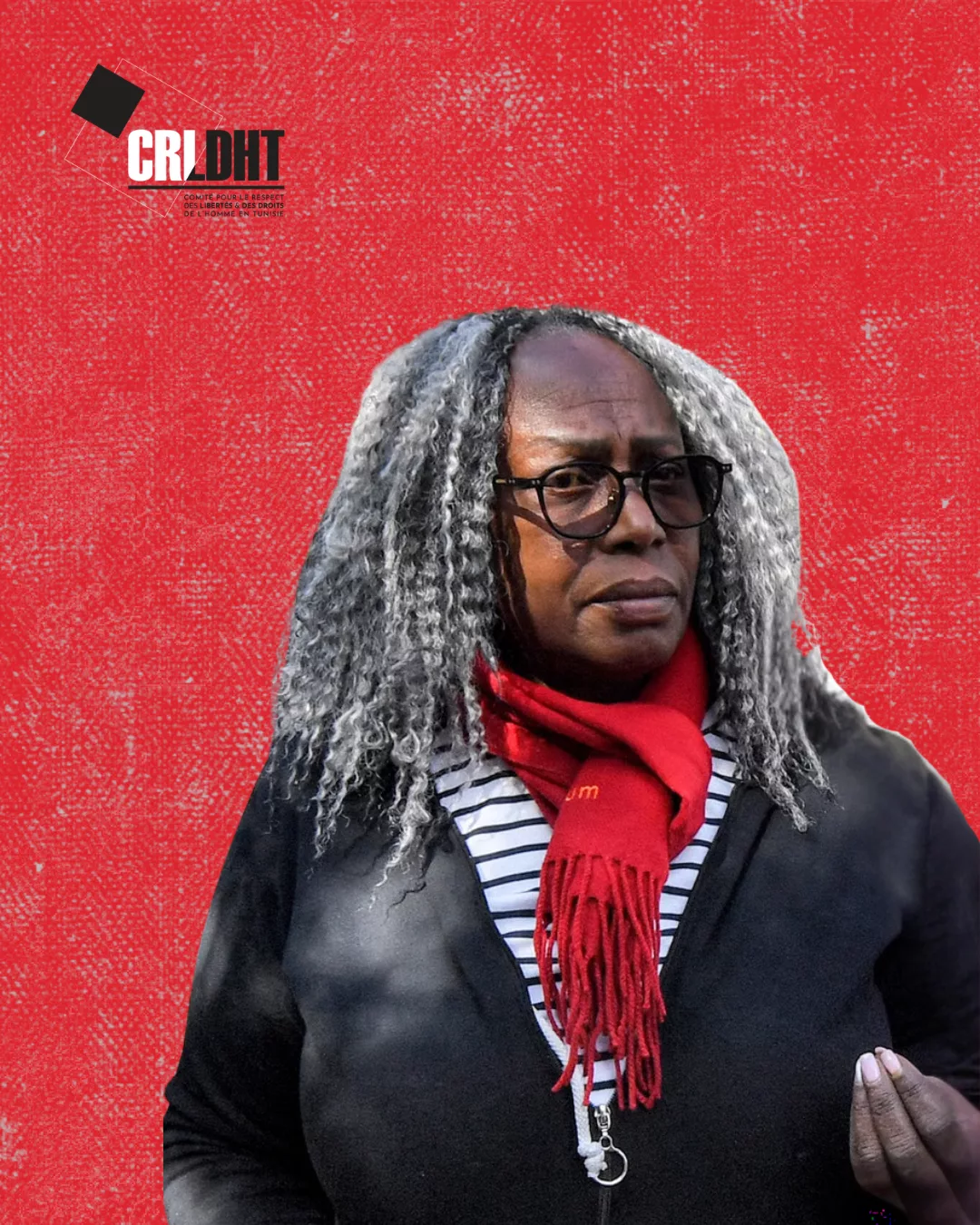
On June 23, 2026, the Fifth Criminal Chamber specializing in terrorism cases at the Tunis Court of Appeals upheld the sentence against Saadia Mosbah to eight years in prison and a fine of more than 120,000 dinars on charges of money laundering related to the management of her organization, Mnemty. This decision is not merely a sentence of exceptional severity. It marks a profound turning point in Tunisia’s recent history. By convicting one of the leading figures in the fight against racism, the government is sending a clear message: it is no longer discrimination that is being combated, but those who denounce it. This verdict makes Saadia Mosbah one of the most striking symbols of the criminalization of civil society and human rights defenders in Kaïs Saïed’s Tunisia.
This conviction therefore goes far beyond the personal fate of the president of the Mnemty association. She has become a symbol of the criminalization of anti-racism, solidarity, and, more broadly, all human rights defenders.
From a historic breakthrough to an unprecedented setback
The irony of the story is particularly cruel.
During the democratic transition that followed the 2011 revolution, Tunisia made significant progress in the area of fundamental rights. On October 23, 2018, the Assembly of the Representatives of the People adopted Organic Law No. 2018-50 on the elimination of all forms of racial discrimination, the first legislation of its kind in the Arab world.
This law marked a historic turning point. For the first time, Tunisian law explicitly recognized the existence of racism, provided a legal definition of racial discrimination, imposed criminal penalties for racist acts and speech, and required public authorities to implement policies aimed at prevention, victim protection, and public awareness. Its adoption was hailed by the United Nations, the African Commission on Human and Peoples’ Rights, and numerous international partners as one of the most significant democratic achievements of Tunisia’s transition.
This victory also bore the mark of Saadia Mosbah.
A Black woman who was herself a victim of the very discrimination she denounced, she had devoted years to raising awareness of a reality that many preferred to deny: racism exists in Tunisia. Through the Mnemty association, she had supported victims, documented instances of discrimination, raised public awareness, and played a decisive role in the drafting of this historic law.
Eight years later, the contrast is striking.
One of the key architects of this democratic victory has now been sentenced to eight years in prison.
The woman who helped enshrine the fight against racism in Tunisian law is now being treated like a criminal.
February 23, 2023: The Switch
This reversal can be traced back to the speech delivered by Kaïs Saïed on February 21, 2023, before the National Security Council.
By denouncing an alleged plot to alter Tunisia’s demographic makeup by settling migrants from sub-Saharan Africa, the head of state is echoing the core tenets of the “Great Replacement” conspiracy theory, popularized by far-right movements in Europe.
He speaks of “hordes of illegal migrants,” accuses foreign parties of seeking to alter the country’s identity, and suggests that certain Tunisian organizations are involved in this effort.
This speech marks a real turning point.
In just a few days, attacks against sub-Saharan migrants have been on the rise. Thousands of people are being evicted from their homes, losing their jobs, falling victim to violence, or abandoned in desert areas along the country’s borders. Racist insults have become commonplace. Hatred, which had previously been a marginal phenomenon, is now receiving political endorsement at the highest levels of government.
Racism is no longer merely a social phenomenon; it has become an instrument of government.
Saadia Mosbah, a designated target
In this new political context, Saadia Mosbah has become an obvious target.
Because she is Black. Because she advocates for migrants. Because she embodies the 2018 law against racial discrimination.
Because, by its very nature, it serves as a reminder that hate speech coming from the highest levels of government is incompatible with the principles of equality and dignity enshrined in this law.
But Saadia Mosbah is not an isolated case. Her arrest is part of a much broader crackdown on organizations and activists who, for years, have been assisting migrants from sub-Saharan Africa and defending their rights.
Following the presidential address on February 21, 2023, civil society organizations have gradually been labeled as accomplices in an alleged plot to “alter the demographic composition” of Tunisia. Those that provided humanitarian, legal, or medical assistance to migrants have, in official discourse, become tools of foreign powers. International funding, long regarded as a driver of the development of Tunisian civil society, is suddenly being presented as evidence of a destabilization campaign.
This campaign is not aimed solely at Mnemty. The Tunisian Council for Refugees (CTR), Terre d’Asile Tunisie—a partner of France Terre d’Asile—as well as several other organizations working to protect refugees and migrants are facing raids, financial investigations, suspensions of activities, or legal proceedings. Several NGO leaders have been summoned, questioned, or placed under investigation for money laundering, foreign funding, or aiding irregular immigration. The objective is clear: to cast humanitarian work in a suspicious light and deter any form of solidarity with migrants.
On May 6, 2024, this strategy reached a new stage. Following a meeting of the National Security Council, Kaïs Saïed publicly accused the associations of serving foreign agendas and criticized the relevant authorities for failing to adequately investigate their funding. Just a few hours later, the public prosecutor’s office opened a criminal investigation against Mnemty. The organization’s headquarters were raided, and Saadia Mosbah was arrested shortly thereafter. Such swift action—unprecedented in Tunisian judicial practice—makes it difficult to believe this was a mere coincidence. It appears as though the political decision preceded the judicial one.
The case does not end with Saadia Mosbah, however. Her son, Farès Kablaoui, and several members of Mnemty — Ghofrane Benous, Zied Rouine, Amina Boukamcha, and Hiba Abassi —are also being prosecuted in this case, even though some of them will later receive suspended sentences or have their charges partially dismissed. This difference in treatment reinforces the impression that Saadia Mosbah was, from the outset, the true target of these proceedings.
Prosecutions for money laundering thus appear to be a tool of political repression rather than a response to actual financial crime. They make it possible to portray human rights defenders as common criminals, to discredit their activism, and to prevent their imprisonment from being seen for what it is: a punishment inflicted on a woman whose main “crime” is having defended the most vulnerable and refused to conform to the official narrative.
Criminalizing Solidarity
The Saadia Mosbah case has thus become a symbol of a broader policy: after labeling sub-Saharan migrants as enemies within, the government is now targeting those who defend them. By criminalizing solidarity, it seeks to silence an entire independent civil society and impose a climate of fear in which humanitarian engagement itself becomes suspect.
The real issue here is not one of an association's accounting.
What is on trial in the courts is not financial management. It is solidarity itself.
Through Saadia Mosbah, the government is not merely seeking to convict an activist. It is sending a warning to Tunisian civil society as a whole. The message is crystal clear: defending migrants, denouncing racism, documenting human rights violations, receiving international funding, or simply taking a critical look at public policies can now lead to criminal charges, pretrial detention, and a harsh criminal sentence.
The goal goes far beyond the case of Mnemty. The aim is to deter any independent citizen-led initiative and to turn civic engagement into a high-risk activity. Suspicion has become the norm; solidarity, a reason for investigation; and foreign funding—which is strictly regulated by law and has long been encouraged as part of international cooperation—is now presented as evidence of treason.
This strategy is part of a broader trend that has been observed since July 25, 2021. Following political parties, judges, journalists, lawyers, and labor unions, civil society is now being directly targeted. Civil society organizations are no longer viewed as essential actors in democracy, but rather as countervailing forces that must be neutralized.
The choice to charge her with money laundering is obviously not insignificant. This particularly stigmatizing criminal charge allows the image of a human rights defender to be replaced with that of a financial offender. It avoids openly acknowledging political repression while publicly discrediting those being prosecuted. The charge thus becomes a weapon of delegitimization: instead of responding to ideas or causes, the aim is to smear those who champion them.
The eight-year prison sentence, upheld on appeal, thus takes on its full meaning. Given its exceptional severity, it goes far beyond the mere framework of judicial repression. It aims to serve as a warning, to instill fear, and to convince other civil society actors that the price of activism can be imprisonment. In a context where dozens of human rights defenders, lawyers, journalists, and activists are already being prosecuted or imprisoned, Saadia Mosbah’s conviction marks a new milestone in the construction of a state where criminal law is becoming an instrument of governance.
A European Responsibility
This development would likely not have reached such a scale without the goodwill—or at least the extreme leniency—of European partners.
Since the signing of the memorandum of understanding between the European Union and Tunisia in July 2023, Tunisian authorities have played a central role in the European policy of externalizing border control. In exchange for financial support amounting to several hundred million euros, Tunis has been entrusted with a strategic role: to prevent departures to Europe and to keep migrants en route to the European continent within its territory.
This emphasis on immigration control has profoundly altered the way several European capitals view the human rights situation in Tunisia. While arbitrary arrests, political trials, hate campaigns against migrants, and the crackdown on civil society were on the rise, official reactions remained timid, often limited to statements of principle with no real political consequences.
This silence is not neutral. It is interpreted by the Tunisian authorities as an implicit green light. As long as Tunisia fulfills its role as Europe’s border guardian, the erosion of the rule of law seems to take a back seat. The defense of fundamental freedoms becomes a variable used to adjust migration policies.
The Saadia Mosbah case tragically illustrates this contradiction. The woman being sentenced today is precisely someone who defended those most directly affected by the migration agreements between Tunis and Brussels. By criminalizing her actions, the Tunisian authorities are making it more difficult to provide any independent assistance to migrants. And by continuing to prioritize security cooperation despite this abuse, European partners run the risk of appearing not only as silent bystanders, but also as the indirect beneficiaries of a crackdown that facilitates the implementation of their migration policy.
By consistently treating Tunisia as Europe’s front line in the fight against migration, the European Union has helped create a situation in which human rights defenders have become obstacles rather than partners. This political and moral responsibility can no longer be avoided.
A Symbol of an Era
The Saadia Mosbah case alone encapsulates Tunisia’s political trajectory since 2021.
In 2018, as part of the transition to democracy, a historic law against racial discrimination was passed.
In 2023, the country’s highest-ranking official resorted to rhetoric inspired by the xenophobic theories of the “Great Replacement.”
In 2026, one of the main architects of this law was sentenced to eight years in prison.
This series of events tells a story that goes far beyond the fate of a single activist. It illustrates the shift from a Tunisia that sought to protect victims of discrimination to a Tunisia where advocates for equality have themselves become victims of repression.
When the fight against racism is criminalized, when solidarity is equated with a threat to national security, and when human rights defenders are prosecuted as criminals, it is no longer just one woman who is on trial.
It is the democratic legacy of the Tunisian revolution that now finds itself in the dock.