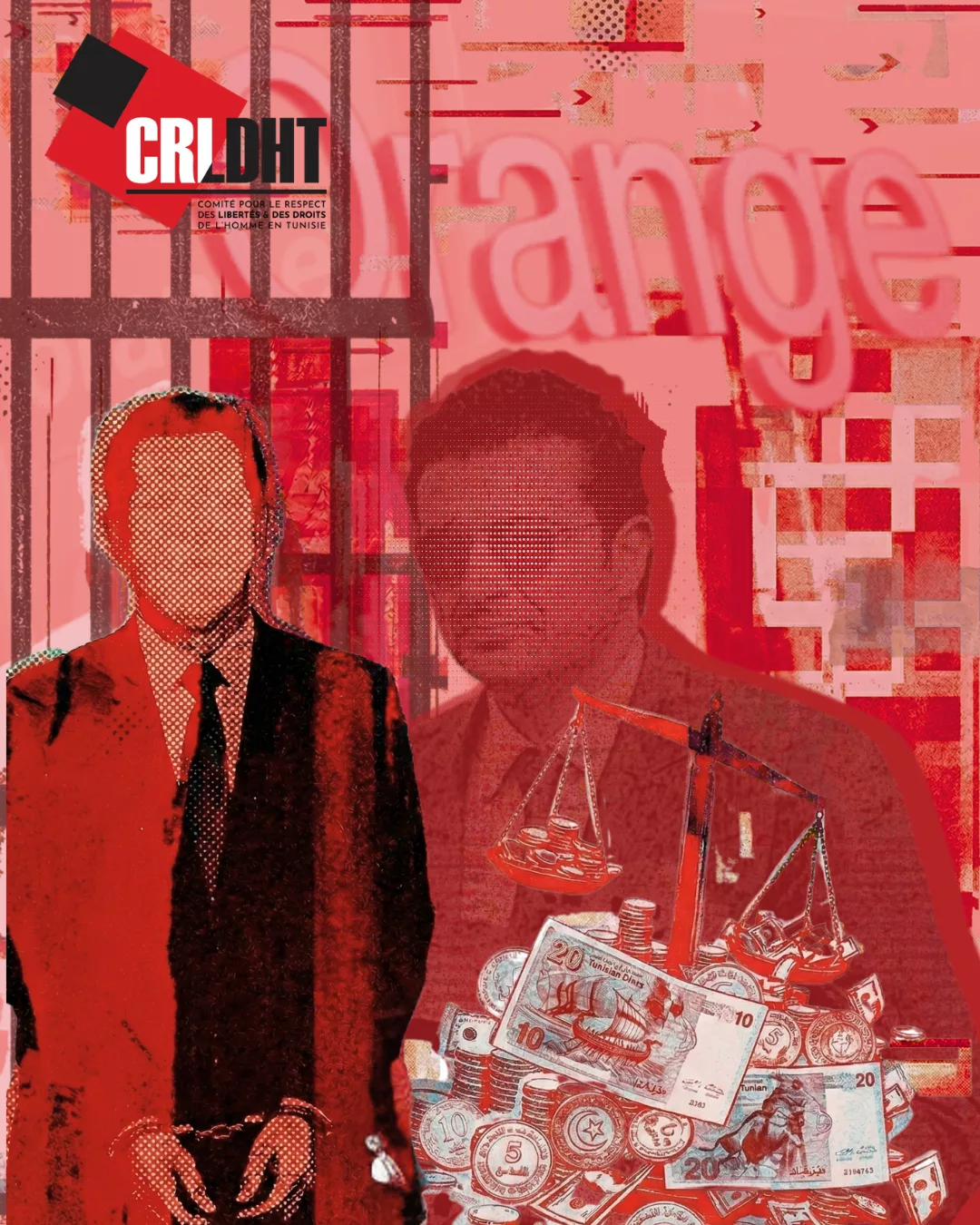
The Committee for the Respect of Freedoms and Human Rights in Tunisia (CRLDHT) expresses its deep concern following the judgment handed down on March 2, 2026, by the Criminal Chamber of the Tunis Court of First Instance, under the jurisdiction of the Economic and Financial Judicial Division, in the so-called "Orange" case, relating to the decision adopted at the restricted ministerial council meeting of January 18, 2018, concerning the case of businessman Marouane Mabrouk and the issue of the European freeze on his assets.
According to publicly available information, the following individuals were convicted:
- Youssef Chahed, former head of government,
- Mabrouk Korchid, former Minister of State Property and Land Affairs
- Mohamed Anouar Maarouf, former Minister of Communication and Digital Economy
- Lotfi Ben Sassi, former advisor to the head of government in charge of investments
- Mehdi Ben Gharbia, former Minister of Relations with Constitutional Institutions, Civil Society, and Human Rights
- Mohamed Ridha Chalghoum, former Minister of Finance
- Khemaïes Jhinaoui, former Minister of Foreign Affairs
- Adel Grare, former CEO of El Karama
The court ruled:
- Six (6) years' imprisonment,
- An individual fine of 800 billion millimes (235 million euros)
- An additional joint and several penalty of 800 billion millimes payable to the State,
- Prohibition from holding any public office.
These amounts lead, de facto, to a theoretical financial exposure of 1,600 billion millimes per convicted person.
It should be noted that businessman Marouane Mabrouk was convicted by the same court on March 2, 2026, in a separate case involving a company he owned.
In this case, he was sentenced to 14 years in prison, accompanied by heavy fines and the confiscation of assets. Added to this sentence were an additional six years in prison handed down in the case relating to the lifting of the freeze on his assets, bringing the total sentence to 20 years' imprisonment.
Reminder of the contested decision
The decision that is the subject of the proceedings was made in a formal setting at a ministerial council meeting in January 2018.
It aimed to support the request to remove businessman Marouane Mabrouk's name from the European freezing list in order to allow a share sale transaction, provided that a Tunisian bank guarantee on first demand in the amount of 32 million dinars was provided to the State.
This amount was set based on an estimate by the Department of Justice, which valued the alleged assets abroad at approximately €7 million.
The mechanism adopted provided that the guarantee could be enforced immediately in the event of a final judgment establishing the illegality of the funds.
A collective decision, selective convictions
So it was a decision:
- taken within a collegial governmental framework,
- backed by a financial guarantee mechanism,
- which took place in the context of official diplomatic negotiations between Tunisia and France
- and presented as an economic and sovereign decision.
The available evidence shows that certain ministers who participated in the same Ministerial Council are not among those convicted. However, the debates within the Council reportedly revealed two positions:
- A trend in favor of lifting the freeze unconditionally;
- A trend in favor of lifting restrictions accompanied by financial guarantees.
The final decision adopted was a compromise: lifting in exchange for a guarantee.
The central question, therefore, is this: on what specific legal grounds was criminal liability assigned to individuals in the context of a collective government decision?
However, the principles of equality before the law and personal criminal responsibility require that any conviction be based on clear, precise, and strictly individualized grounds.
Furthermore, another fundamental question remains: on what legal basis was Marouane Mabrouk convicted, in the absence of evidence establishing illegal acts on his part or, at the very least, an active role on his part that could have prompted the Council of Ministers—or some of its members—to adopt the decision in question? The mere fact that he benefited from the deliberation is not, in itself, sufficient to charge him with a criminal offense.
On the proportionality and nature of financial penalties
The amounts awarded—800 billion millimes individually, doubled by an equivalent joint and several liability—appear to bear no direct relation to:
- the estimated amount of the assets concerned (approximately €7 million),
- the amount of the bank guarantee provided (32 million dinars).
The principle of proportionality of penalties, enshrined in international standards, requires that the severity of the established facts be commensurate with the penalty.
The unprecedented scale of the penalties imposed—combining staggering individual fines and a joint sentence of an identical amount—is no longer a matter for ordinary justice.
The amounts imposed are disproportionate to the alleged facts and have effects akin to total and permanent expropriation or extortion. This is no longer a punishment: it is financial ruin. Such excess tramples on the principle of proportionality and transforms the sanction into a tool of elimination.
This verdict cannot be presented as a simple application of the law. Its spectacular nature, the selectivity of the convictions, and the exclusion of other members who were nevertheless parties to the same collegial decision are troubling signs. A collective decision becomes a variable responsibility: some are punished, others are spared, without any clear and plausible objective criteria.
The disproportionate amounts, the disparity in treatment between ministers who sat on the same Council, and the general political context raise a straightforward question: are we dealing with an independent judiciary or with the execution of instructions from the top?
When a judgment resembles a political message more than a judicial decision, justice ceases to be a power—or even a simple function, in the words of Kaïs Saïed. It becomes an instrument. And when it becomes an instrument, it no longer protects the law: it protects power and renders services, instead of rendering justice.
The CRLDHT reiterates that all criminal proceedings must respect the presumption of innocence and the right to a fair trial as guaranteed by the Tunisian Constitution and by international conventions ratified by Tunisia, in particular Article 14 of the International Covenant on Civil and Political Rights, as well as the principles of personal criminal responsibility, legality, equality before the law, and proportionality of penalties.
The fight against corruption is an essential requirement of any society, and under no circumstances should it be carried out to the detriment of the fundamental guarantees that form the very basis of the rule of law.
The CRLDHT :
- Insists on respect for procedural guarantees in appeals;
- Reaffirms that equality before the law and proportionality of penalties are non-negotiable pillars.
- Considers that this political exploitation of the justice system is counterproductive, that it encourages the very abuses it claims to combat, and that it cannot constitute a credible legal basis for any request made to foreign judicial authorities for the restitution of ill-gotten gains.
Defending the rule of law does not mean impunity. It means that justice must be done in strict compliance with the universal principles that protect every citizen.
March 4, 2026